War on Iran: Is it the Anarchic Pregnancy of a New World Order?
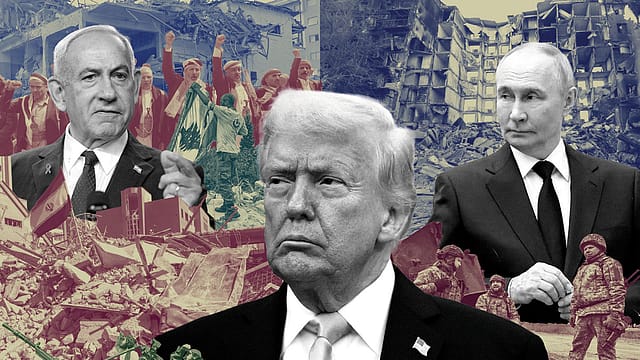
THE 20TH CENTURY WAS DEFINED BY WORLD WARS. They were called world wars not because the whole world was in conflict but because Western empires were fighting viciously for control of the world in an age when conquest was recognised as a legitimate objective. The British Empire was immoral, but it was never illegal.
The 21st century is witnessing worldwide wars: separate fires seeking each other to create a common conflagration, as the principles which have maintained a comparative stability for the last eight decades are in meltdown. Separate wars from Eurasia to the centre of Asia are feeding one another, building up to a raging inferno.
In February 2022 Russia lit a bonfire in Ukraine. In October 2023 Hamas reignited a tinderbox with a terrorist attack on Israel; since then Israel has punished Palestinians by turning Gaza into a strip of rubble leaving over 75,000 dead. In February this year, America was persuaded by Israel to invade Iran and then reeled away to expand its boundaries in Lebanon. In a sideshow with dangerous consequences, US President Donald Trump’s favourite ally Pakistan invaded Afghanistan, four years after the Americans flew away suddenly from its Bagram base on August 30, 2021. Last reports suggest that Pakistan has moved some 14 kilometres into Afghan territory, which will ensure the longevity of this conflict. As the Afghans used to say, Americans had a watch, they had time.
Ukraine’s President Volodymyr Zelensky has just toured Qatar, Saudi Arabia, the UAE, and Jordan offering drones for hard cash. Reports indicate that Russian satellites are being used by Iranian missiles. An arc is becoming a circle.
What began in Ukraine is merging into a contiguous War of the Five Seas: Mediterranean, Black, Caspian, Red, and Arabian. Each trigger is different, but the impetus to fire comes from the collapse of the global order established in 1946 through the charter of the United Nations, which sought a global architecture of stability based on the sanctity of sovereignty. Aggression across borders was made illegal for the first time in human history. That promise proved to be short-lived.
The peril was best articulated by the wisest conservative leader of the last five decades, Britain’s former Prime Minister Margaret Thatcher. In 1981 she described the Israeli attack on Iraq’s nuclear facility at Osirak as “a grave breach of international law”. She explained to the Jewish Chronicle in words that should be etched onto every chancery (unless it is already too late): “If we are not going to live by a system of international law, we are going to live by international anarchy. Then no people anywhere in the world are safe.”
Ironically, the 1946 UN charter was conceived by America and supported Russia. Pax Americana is dead, not least because America is being driven by a narrow definition of national interest which supersedes the sovereign rights of nation states. In retrospect, such idealism might have been a bridge too far, but it held most of the world together through the extreme dangers of a nuclear age. The compact of 1946 has been shattered. When guardians of international security treat their own principles as irrelevant, anarchy is next in queue.
Thatcher was not speaking in a vacuum in 1981, or amidst calm seas and glowing harvests. She was offering sage advice during the first modern invasion of Iran, by Iraq’s Saddam Hussein, the despot who subjugated his own people with as much enthusiasm as he advocated the freedom of Palestinians.
The region had stepped into a new age two years before with the dramatic success of Iran’s Islamic Revolution. It redrew and rescaled the strategic map of West Asia. Till 1979, Iran’s monarch Mohammad Reza Pahlavi had served as America’s most loyal ally, not least because the CIA saved his life and throne in 1953. Captive to his mentors, the Shah stayed out of seminal wars between Israel and its neighbours in 1967 and 1973.

Egypt, more confident after its victory in 1973, came to terms with America and Israel by 1987, leaving Syria as Moscow’s last protectorate in the region while Iraq flaunted fake non-alignment. Washington might have let diplomacy and negotiations find a route towards reconciliation with Islamic Iran, but any such possibility was sabotaged by a rash band of student revolutionaries who on November 4, 1979 took 52 Americans serving in the Tehran embassy hostage. Death to Israel and America became the favoured chant of radicals without a prior cause. Their challenge to a superpower’s prestige was compounded by the embarrassing failure of America’s rescue mission in April 1980. Only five of the eight helicopters mobilised for Operation Eagle Claw reached in operational condition. President Jimmy Carter, displaying timidity uncharacteristic of the White House, aborted the effort. The eagle was wounded. Carter’s successor Ronald Reagan was determined to ensure that the eagle soared again.
Reagan’s response towards Iran was nuanced and commissioned at arm’s length. In September 1980 Iraq invaded Iran, without provocation or explicable reason. Iran was not remotely a nuclear power. Its armed forces, created with American help under the Shah, were skewered and uncertain.
Saddam Hussein expected to capture Tehran within a week, and order the regime change which is still on the agenda five-and-a-half decades later. America gave silent support worth billions of dollars in aid, technology, and intelligence. He got massive financial support from Saudi Arabia. It took eight years, with over half-a-million casualties, for this devastating conflict to end where it began, in the restoration of status quo ante. The long war had tested Iran’s will, and Iran had prevailed. One of its commanders, Ali Khamenei, was nearly killed on the frontlines; he rose to become Ayatollah and Supreme Leader, and was assassinated in the first airstrike of the 2026 war.
Superpowers tend to cloak their interests with the veil of virtue, but sometimes the best minds let slip the truth. The brilliant Republican academic powerbroker Henry Kissinger summed up America’s agenda in a pithy sentence when asked about the Iran-Iraq war: “It’s a pity both sides can’t lose.”
Republican President George W Bush ensured the defeat and destruction of Iraq with another inexplicable war begun without provocation. He justified America’s invasion of Iraq in March 2003, in collusion with Britain’s Tony Blair, with a falsehood, claiming that Iraq had “weapons of mass destruction”, code phrase for nuclear weapons. Any such possibility had been eliminated by Israel’s air attack on Osirak in 1981. The true objective was the elimination of Iraq’s military capability and control of Iraq’s oil resources. America won a pyrrhic victory, as will be evident when the dynamics of the present war play out, for George W Bush created space for pro-Iran militias. The Iraq war has been burnt into generational memory.
DONALD TRUMP MAY USE maverick, coarse or contradictory phrases to justify his attack on Iran, but the agenda is much older than his political career. More candid than his predecessors, Trump has no time for the charades of Bush and Blair. Democratic presidents in the past half-century have also been hostile to Iran, but wary of military adventure. Trump believed that America had become invincible under Trump.
After four weeks of war the adventure has gone sour. We do not know the outcome, but the best interpretation that the Pentagon could put on the situation in the last week of March was “fluid”. Trump said, at the beginning, that he was surprised by Iran’s military capability and political resilience; by now he must be shocked. The destruction of America’s array of weapons has been extraordinary: a $700 million AWACS aircraft; radar equipment worth over a billion dollars; aircraft carrier USS Gerald Ford rushed out of battle seas under the thin cover story of an on-board fire that had injured 200 and clogged bathrooms; missile hits on aircraft carrier USS Abraham Lincoln; every American military base in the region struck; Israel’s famed Iron Dome pierced by Iran’s drones and missiles, hitting major cities and infrastructure for the first time in any conflict; Dimona, home of Israel’s nuclear facility, being bombed, proving that Israel’s most sensitive asset is in the crosshairs.
The repeated devastation of Iran by the formidably armed and trained US and Israeli air forces is not a story. Their strength was known. Iran’s response is breaking news. These statistics might help us understand Iran; it spends 4 per cent of its GDP on research and development; it has some five million students in 2,000 universities; Tehran has the largest number of doctorates compared to any other city.
We do not know, just now, whether Trump will opt for escalation or cut his losses. Both sides need a victory narrative to wind down. Iran has an advantage. It can declare victory if it can avoid defeat. Trump needs something substantial as a war trophy. Regime change is gone as a possibility. The people’s uprising has turned into a nationalist mood across Iran. America is now demanding that the Strait of Hormuz remain open, which it was before war began.
With better planning by the Pentagon, America could have seized Kharg island through a ground offensive in the opening hours of its offensive on Saturday, February 28 while the air force hit Tehran. Trump could have declared victory by Monday and lived happily ever after. Four weeks later, Iran, with a million-strong force at its disposal, is prepared for a ground invasion. For America, this war is part of a strategic calculus designed to define security and favourable energy flows. For Iran, this is the last war for generations; Iranians believe that its result will determine Iran’s place in world affairs for the rest of this century.
Iran’s claims can no longer be dismissed as bombast. It has vowed to set invading American troops “on fire” and hinted at a counter-invasion of the UAE and Bahrain. The implications are startling. If there is street fighting in Dubai, the ebbing confidence in the Gulf as a second, and tax-free, home of the world will further evaporate.
From the sidelines the Houthis are reminding anyone who will listen that the Arabic name of the passage to the Red Sea between Yemen and Djibouti-Eritrea is Bab el Mandeb, or gate of tears, so-called after the tears shed after the mighty earthquake that separated the Arabian peninsula from Africa. The implication: there will be tears again. It may not be as potent a threat as they would wish, but these allies of Iran have been kept in reserve for the endgame.
The law of unintended consequences thrives in war. The regime in Tehran has not changed yet, but opinion polls suggest regime change in Tel Aviv and regime adjustment in Washington after the autumn elections in Israel and America. Benjamin Netanyahu could be defeated; Republicans may lose control of the Senate.
The setback to America’s arms industry is under scrutiny. It is overpriced and underperforms. Iran’s drones could fetch a better income than oil. Russia’s S-500 Prometheus suddenly looks a better deal than America’s THAAD, which was unable to protect Dimona or indeed itself at American bases. Israel has, according to estimates in Western media, used half of its THAAD capacity; lost 50 per cent of David’s Sling missiles, 80 per cent of its Arrow 2 and 3 interceptors. An Israeli newspaper reported that the chief of the Israel Defense Forces (IDF) Lt General Eyal Zamir told the cabinet security committee that the army, deployed in Gaza, Lebanon, West Bank, and Syria was overstretched and needed another 100,000 reservists. Chinese weapons technology will be in demand. India could become a third beneficiary with the rising reputation of BrahMos missiles.
In 2023 America controlled 43 per cent of global arms exports, worth an estimated $400 billion in goods and services. Any change will affect the security structure for nations which supply weapons and hold the source code. Think-tank commanders in every capital must already be busy with fresh thoughts about tanks.
Rebirth is more difficult than birth. The anarchy of 2026 could become the violent pregnancy of a new world order. The management of the new world will not be in the sole hands of the victors of World War II.