Vietnam: Guide Me, Anthony Bourdain
SHE YAWNS NOISILY, her feet resting on a short plastic stool and a folding fan swatting away the fat coils of heat emanating from the cauldron of broth bubbling beside her. But the effort bears no relief from the midday Saigon sun, the scorch of this uneasy temperature wrapping around her, and us—her patrons—with the thickness of real denim, clinging with stubbornness beneath the second fabric of streetside eatery smells found anywhere in Vietnam: a heady concoction of diesel plumes, cigarette smoke, incense, warm beer and fresh seafood.
Streams of sweat wash down from her nón lá, the conical straw hat, and percolate under her layered and resting chin. We are all watching her and she is aware of our gaze, as celebrities in public spaces are, yet she periodically wipes the perspiration away with the back of her free palm, casually streaking the bare ground below.
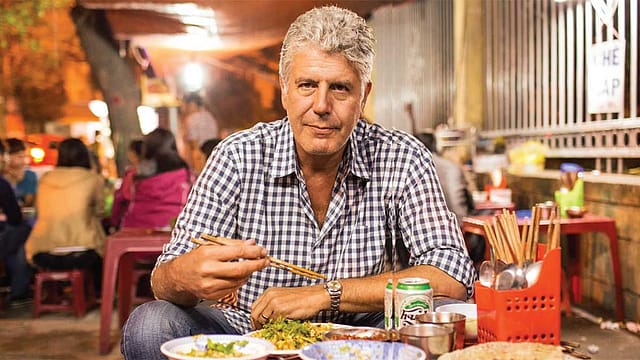
This middle-aged woman is Nguyen Thi Thanh, better known simply as the Lunch Lady, her global fame entirely born from a visit by the greatest food-travel documentarian who ever lived, the late Anthony Bourdain, who ate at this tented roadside soup-house in
District 4 of Ho Chi Minh City back in 2009, which was then televised in his incredibly popular travel show, No Reservations. Before Bourdain, the Lunch Lady’s popularity was very much within this business district, exclusively among the locals, apocryphal tales of the working class lining up in the hundreds at lunch hour for her take on noodle soup—a different combination of goodness for each day of the working week, made from scratch. The late arrivals wouldn’t be fed, for the cauldron would invariably lie empty by then.
Post Bourdain, three things happened simultaneously. The tourists came. The soup got pricier. And the locals thinned out. Almost entirely. Today, at midweek lunch hour, only three of the many large communal plastic tables are occupied, a Scandinavian couple on one, a Frenchman on the other, and I, all of us having made the seemingly unnecessary journey from the tourist hotspot of District 1, thanks to Bourdain’s influence. So much so that the solo Frenchman smokes from a packet of Marlboro Red (Bourdain’s choice of cigarettes) while reading a copy of The Quiet American by Graham Greene, the novel that forced Bourdain to visit Vietnam in the first place and promptly fall in love with this country, a land that he often called his spiritual home.

The soup of the day, as announced by the blackboard, is bánh canh cua, a thick broth of tapioca noodles, crabmeat, shrimp and quail eggs. But the Scandinavians seem most upset at all the side dishes, the easily recognisable plates containing spring rolls and fried chicken, that have been dumped on their table by The Lunch Lady’s assistant. “We didn’t order these, do they come with the soup?” one of them asks, only to be ignored by both the lady and the assistant. “We really only want the soup,” he says, this time walking up to the supine owner, who doesn’t meet his gaze but irritably nods at the assistant. He clears the table and returns with the soup, with a side of nuoc cham, the divine Vietnamese fish sauce.
“They tried to do the same thing with me too,” says the Frenchman, who is nearly done with his soup bowl, to the Scandinavian couple. “It seems to be a thing, according to Tripadvisor. I just found out.” I hastily open the mentioned travel guidance app on my phone. The reviews are far from flattering, the first 10 I view have these exact titles: ‘Literally a scam’, ‘big disappointment’, ‘Don’t go’, ‘Overrated’, ‘cheats’, ‘overhyped’, ‘SCAM ALERT’, ‘tourist trap’, ‘not worth it’, ‘Bourdain trap’. The Frenchman rises to pay his bill and asks the assistant if he can take a selfie with The Lunch Lady. “Only if you buy her recipe book, otherwise no picture,” he says, pointing to a pile of books on the proprietor’s table. So, he simply pays his dongs and leaves.
I, too, politely return the first set of plates placed in front of me. When the bánh canh cua arrives, I think of Bourdain’s voice-over for his equivalent bowl on No Reservations. “This is a broth that the gods were suckled on. Like all truly great soups, it soon becomes the centre of the universe. You pass through an event horizon of pleasure, moments ticked off in mouthfuls. Everything else ceases to exist.”
Those words would ring true for almost every other bowl of noodle soup (and pho for that matter) that I would experience across the very length of Vietnam, but not this one. Fame, in this case, had curdled into fatigue, the romance of discovery replaced by routine indifference. Yet that, too, seemed inseparable from travelling the trail carved by Bourdain across a country he helped mythologise for millions like me. Not every stop would justify the journey. But the journey itself already had.
VIETNAM,” BOURDAIN once said, “grabs you and doesn’t let you go. Once you love it, you love it forever.”
He first arrived in Vietnam because of The Quiet American. Years later, I arrived because of him. This journey across the country—from roadside soup kitchens in Ho Chi Minh City to the beer-drenched alleys in Hanoi—was an attempt to experience Vietnam through the palate and sensibility of the man who arguably introduced its cuisine to much of the world. Sometimes the trail led to transcendence, sometimes to tourist traps, but almost always to a deeper understanding of why Vietnam occupied such a powerful place in Bourdain’s imagination.
Like Bourdain and perhaps because of him, I too decided to hire a two-wheeler (a Honda Wave in my case) to putter through the varied streets of Saigon, now Ho Chi Minh City, from its labyrinthian alleyways in the old French Quarter of Greene’s novel to the broad roads of its central administrative districts. “To do otherwise,” warned Bourdain, “would be to miss [Vietnam] entirely.”
A typical day in Ho Chi Minh City would begin by pulling over at a streetside café for a hit of Vietnamese coffee, cà phê den dá—a rich, black brew dripping slowly into a glass containing cold condensed milk—and end, late at night, by parking beside a streetside pub for many slugs of bia hoi, the fabled, keg-dispensed, freshly-brewed draft beer that was pumped out with a foot-pedal and hosed with a pipe directly into a glass kept cold with floating ice.
Between day and night were visits to even more streetside eateries, the brick-and-mortar restaurants few and far between. The only indoor spots of note were at the Ben Thành Market, where one could savour every sea-protein of choice, from eel to squid all under one roof, and a restaurant called Bánh Xèo 46A, serving only the eponymous bánh xèo. The etymology of its name was most interesting: Bánh was the crepe, while xèo was an onomatopoeia for the sizzling fry of the batter. The dosa-like pancake was folded over chunks of pork, shrimp and bean sprouts. Dipped in fish sauce, the very first bite was enough to understand why the kitchen thrived despite serving just one dish.
But the real magic was always out in the open, where anonymous and improvised canteens were set up by vendors placing a few colourful plastic stools around scattered plastic tables. No menus, no explanations, all of them packed with locals, for whom eating out was simply part of daily life. You ate what was served on colourful plastic plates, the nameless flavours speaking for themselves. One such joint was on Vinh Kanh Street, colloquially known as Oc Street. Oc means snail and the dish presented to me by a cook in dark green army fatigues was oc xào me: snails sauteed in butter and tamarind sauce. What did it taste like? Like snails. But tangy.
Even if pho remains Vietnam’s most popular dish worldwide, bún cha—the smoky combination of grilled pork, cold rice noodles and hot broth—may well be its most immortalised, thanks to the now-iconic 2016 plastic-table dinner shared by Barack Obama and Bourdain. When Obama asked Bourdain for eating instructions, Bourdain replied: “Fork it [the sticky rice noodles] and drop it into the bowl. Dip, stir and you are ready for the awesomeness.” To indulge in that awesomeness, then, I travelled to the capital in the north of the country, for bún cha is native to Hanoi.
Even though I didn’t want to, I found my scooter leaving behind several bún cha joints inside Hanoi’s Old Quarter in its wake, almost instinctively powering towards Bún ChaảHurong Liên, the hole-in-the-wall where Obama and Bourdain slurped and clinked pints of bottled Bia Hanoi. Hurong Liên was expectedly crowded, inside and outside—the waiting line of mainly Caucasian tourists snaking once around the block. Disappointed, I rode a few blocks away, where at yet another anonymous alley-side joint, a plastic board bore the promise of draft beer and bún cha.
There was no memorabilia here, no framed photographs, no curated mythology. Just pork patties charring over coal, cold noodles soaking in bowls of broth and old men hunched silently over sweating glasses of beer, plumes of cigarette smoke rising from nostrils. When my order finally arrived—cold beverage and piping hot meal— Bourdain’s checklist for happiness in Vietnam suddenly felt complete. Seated in a nameless eatery on a nameless street in an episode of Parts Unknown, he had once declared: “All of the things I need for happiness? Little plastic stool. Check. Tiny little plastic table. Check. Something delicious in a bowl? Check.”