US Uses Hellfire Missile to Disable Commercial Ship Heading to Iran
The United States military says it disabled a commercial vessel that was attempting to reach an Iranian maritime facility after the ship allegedly ignored repeated warnings from American forces.
According to the United States Central Command (CENTCOM), the Gambia-flagged merchant vessel M/V Lian Star was observed travelling through international waters toward an Iranian port in the Gulf of Oman.
In a statement posted on X, CENTCOM said US forces had "observed M/V Lian Star transiting international waters toward an Iranian port on the Gulf of Oman and issued more than 20 warnings while informing the vessel it was in violation of the US blockade".
American officials said the vessel's crew failed to comply with instructions to stop, prompting military action.

Zeroing In on ECI
09 Oct 2026 - Vol 05 | Issue 41
Constitutional legitimacy versus political opportunism
"A US aircraft disabled the vessel by firing a Hellfire missile into the ship's engine room after Lian Star's crew failed to comply. The ship is no longer transiting to Iran," they said.
What Is the US Maritime Enforcement Campaign?
The incident forms part of a broader maritime enforcement operation launched by Washington in the region.
According to CENTCOM, US forces have so far disabled five commercial vessels and redirected 116 others as part of efforts to enforce a blockade targeting Iranian maritime activity.
The campaign began on April 17 after Iran effectively closed a key regional waterway amid a wider conflict that followed coordinated US and Israeli military strikes on February 28.
While military tensions remain high, diplomatic efforts have produced a fragile ceasefire that has held since April 7.
Why Is the Strait of Hormuz So Important?
The confrontation centres on one of the world's most strategically important shipping corridors between Iran and Oman.
The waterway serves as a major route for global exports of petroleum and liquefied natural gas, while also facilitating the movement of agricultural commodities, including fertilisers.
Disruptions in the corridor have stranded significant volumes of cargo, contributing to instability in global energy and commodity markets.
Reduced shipping activity has increased economic pressure on businesses, consumers and agricultural producers worldwide.
What Are Washington's Objectives?
The maritime restrictions are designed to limit Iran's ability to export goods and generate revenue.
By restricting commercial access to Iranian ports and shipping routes, Washington aims to reduce Tehran's access to foreign currency reserves and increase economic pressure on the country.
US policymakers view the campaign as a means of weakening Iran's financial position while negotiations over broader regional issues continue.
Is Diplomacy Still Underway?
Despite the military confrontation, diplomatic discussions continue.
Attention is focused on proposals to extend the current ceasefire by 60 days, creating space for renewed negotiations over Iran's nuclear programme and regional security concerns.
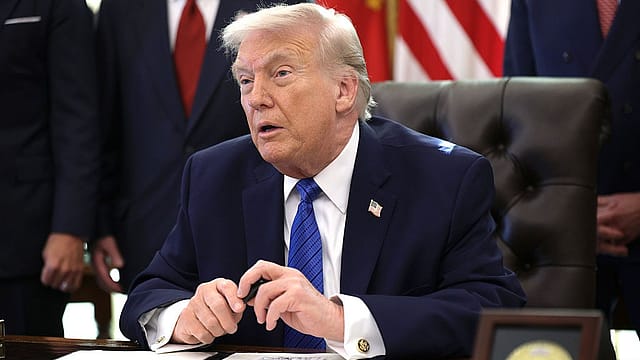
US President Donald Trump held a high-level meeting with senior advisers on Friday to assess the situation. However, the administration has not yet decided whether it will support a deal aimed at extending the ceasefire and reopening the affected shipping route.
Iran has also signalled caution, indicating that no final agreement has yet been reached.
Has Shipping Completely Stopped?
No. While maritime traffic has been significantly reduced, commercial vessels continue to move through the corridor.
This has occurred despite Iranian assertions that all transits require its approval.
The continued movement of some ships suggests that trade through the waterway has not completely ceased, although volumes remain well below pre-conflict levels.
How Has Iran Responded?
Iran has reiterated its claim to oversight of maritime movements in the area and has warned against external interference.
On Saturday, Iran's joint military command issued a warning through state television, stating: "Any violation of these regulations will place the security of their passage at serious risk."
The warning was directed at military forces that might attempt to challenge Iranian oversight of the shipping corridor.
What Position Has Qatar Taken?
The dispute has also drawn in regional governments seeking to prevent further disruption.
Qatar's Deputy Prime Minister, Sheikh Saoud bin Abdulrahman bin Hassan bin Ali Al Thani, said Doha opposes permanent shipping levies but remains open to temporary arrangements that could help restore normal transit.
He stated that, "but for certain times when they say they are going to use it for mine clearing or some usage of the fees for a temporary time, this is something that is negotiable, and it could be something that will help the transit of the Strait of Hormuz to be back to normal stage."
His comments suggest that regional actors are exploring practical measures to ease tensions and restore commercial shipping flows.
What Happens Next?
The disabling of the M/V Lian Star underscores the increasingly aggressive nature of the maritime standoff between the United States and Iran.
With military enforcement continuing, global trade routes under strain, and diplomatic negotiations still unresolved, the coming weeks could determine whether the fragile ceasefire evolves into a broader agreement or whether tensions in one of the world's most critical shipping corridors escalate further.
(With inputs from ANI)