Updating Panchsheel: Five principles that should guide India through the new world disorder
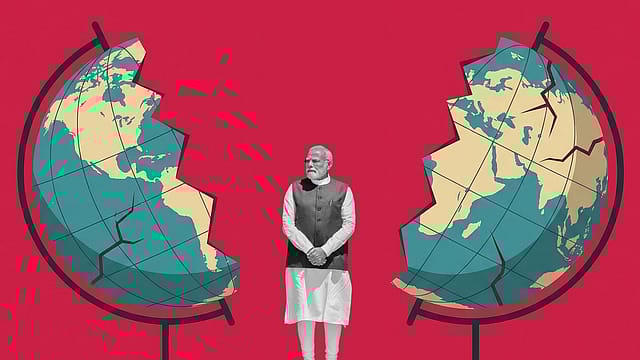
AS SOMEBODY WHO spent nearly three decades at the United Nations (UN) extolling the virtues of globalisation and multilateralism and their unifying power, I confess to finding myself considerably less sanguine about their prospects today. The world we inhabit— fluid, fragmented, and fraught with strategic competition—bears little resemblance to the optimistic post-Cold War order that once promised a global consciousness, where the tragedies of our time would be recognised as universal in origin and reach, and tackling them would be a collective responsibility assumed by us all. Today, that promise strains under unprecedented pressures, and we stand at an inflexion point in human history where the old certainties have crumbled whilst the contours of a new order remain stubbornly indistinct.
The post-war international system, established in the aftermath of two World Wars, the Holocaust, and Hiroshima, was neither unchallengeable nor immutable. It was a construct of its time, shaped by the exigencies of Cold War rivalry and the promise of liberal democracy. For decades, this system—anchored by American leadership, multilateral institutions, and a commitment to free trade—delivered unprecedented prosperity and relative stability. Yet it was the presidency of Donald Trump that truly accelerated its unravelling. His embrace of ultranationalism, disdain for multilateral institutions, and aggressive trade policies marked a sharp departure from the bipartisan tradition of American globalism. Trump’s administration viewed the post-war system not as a legacy to uphold but as a liability to be discarded whenever it impeded narrowly defined national interests.
The consequences have been profound and far-reaching. By undermining the very institutions that once projected American influence—the UN, the World Trade Organization (WTO), NATO—Washington opened the door for alternative visions of global governance. Beijing, long wary of American dominance, seized the opportunity to recast itself as a defender of multilateralism and stability. Chinese President Xi Jinping has repeatedly emphasised the need to “safeguard the authority of the United Nations” and promote “inclusive economic globalisation”—a rhetorical pivot that positions China as a responsible stakeholder in contrast to Washington’s perceived belligerence. Xi’s message resonates more strongly today than it might have a decade ago, particularly amongst developing nations weary of being buffeted by decisions made in Washington and Beijing rather than being empowered to shape their own destinies.
The New Geopolitical Reality
We are not returning to the bipolar standoff of the 20th century. Instead, we are entering a more fluid and contested phase—one where power is diffuse, partnerships are transactional, and legitimacy is up for grabs. In the global geopolitical landscape, certain developments have emerged that are reshaping international politics with extraordinary velocity.
First, there is a palpable backlash against globalisation in developed countries. The economic and cultural consequences of globalisation—job displacement, wage stagnation, and the erosion of traditional community structures—have sparked widespread discontent. This has manifested in populist movements, protectionist policies, and a retreat from international cooperation. The Trump administration’s imposition of 50 per cent tariffs on Indian imports exemplifies this new reality, a stark reminder that even the most robust partnerships are vulnerable to a populist leader’s whims. The recent easing of US-China trade tensions, with Washington reducing tariffs on Chinese goods from 145 per cent to 30 per cent whilst China reciprocated by cutting tariffs from 125 per cent to 10 per cent, further demonstrates the transactional nature of contemporary great-power relations—and incidentally threatens to undermine India’s carefully cultivated ‘China Plus One’ strategy.

The recent meeting between US President Donald Trump and Chinese President Xi Jinping on the sidelines of the APEC Summit in Busan, South Korea, and Trump’s use of the term ‘G2’ to frame the gathering, has raised profound questions for India. Strategic calm between the US and China may reduce global volatility, but it also demands sharper policymaking and diplomacy from us.
For years, New Delhi has operated on the foundational assumption that the US would always view it as a ‘useful instrument’ to constrain or counterbalance a rising China. The unspoken pact of the Indo-Pacific strategy—where India’s geopolitical weight was seen as crucial to Washington’s China strategy—has taken a major hit. The transactional nature of the Trump-Xi deal highlights a clear hierarchy of US interests: for the Trump administration, the relationship with Beijing, driven by the colossal trade deficit and the desire for high-profile deals, remains far more important than the one with New Delhi. This is evident in the differential treatment: while a partial trade truce was quickly struck with China, the US has continued to pressure India with tariffs, even as a bilateral deal with New Delhi is being negotiated. Indians have lost jobs as a result of US tariffs, while China is being hailed in Trump’s social media posts.
The assumption that the US would always have India’s back is now obsolete. New Delhi must recognise that its strategic value to Washington is conditional and subject to the vagaries of US domestic politics and the immediate priority of managing the relationship with the peer competitor, China. This necessitates a profound and urgent recalibration of India’s foreign policy assumptions. Our strategic options must revolve around maximising strategic autonomy and building comprehensive national power.
Second, China’s rise continues to reshape the global order. Its growing assertiveness in political, economic, and military domains challenges American primacy, whilst its Belt and Road Initiative (BRI) has created new patterns of economic dependency across Asia, Africa, and Latin America. China has emerged as the largest arms supplier to Pakistan, accounting for 81 per cent of its arms imports between 2020 and 2024, with more than 85 per cent of Pakistan’s defence equipment now being Chinese. This relationship has evolved from mere procurement to co-production to joint research and development, as well as operational collaboration (and real-time intelligence sharing) during Operation Sindoor, creating a formidable challenge for India’s security calculus. We find ourselves confronting a two-front threat from China and Pakistan, with our military remaining resource-constrained, overstretched, and vulnerable despite recent modernisation efforts.
Third, and perhaps most consequentially, we are witnessing the emergence of new platforms for international cooperation, particularly amongst nations of the Global South. These countries are seeking greater representation in global governance structures without necessarily aligning with traditional Western powers. This assertiveness reflects a justified frustration with the inequities embedded in the post-war international architecture—from the exclusive UN Security Council that includes only five permanent members who fail to represent global geography adequately, to economic governance structures where the developed Global North remains openly non-adherent to environmental regulations whilst expecting the developing Global South to bear the burden of mitigation at the cost of their own development.
Trade Wars and Protectionism
The resurrection of mercantilist thinking represents one of the most troubling aspects of our current predicament. For decades, economists and policymakers operated on the assumption that rational economic self-interest would inevitably lead nations towards free trade and open markets. That assumption has been comprehensively disproved. Trade wars have proliferated, supply chains have been weaponised, and economic interdependence—once celebrated as a force for peace—is now viewed with suspicion as a source of vulnerability.
The technology sector exemplifies this new reality. Semiconductors, artificial intelligence (AI), and quantum computing—these are not merely commercial concerns but instruments of geopolitical competition. Export controls, investment restrictions, and technology transfer barriers have fragmented what was once a genuinely global industry. The US has sought to constrain China’s access to advanced semiconductor manufacturing equipment, whilst China has retaliated with restrictions on rare earth exports. India, meanwhile, finds itself caught between competing imperatives: the desire to attract foreign investment and technology whilst maintaining strategic autonomy and nurturing indigenous capabilities.
This fragmentation extends beyond technology. Agricultural products, pharmaceuticals, and critical minerals—all have become subjects of strategic calculation rather than purely economic exchange. Countries are prioritising supply chain resilience over efficiency, national champions over global optimisation. The pandemic accelerated these trends, exposing the brittleness of just-in-time supply chains and inspiring a wave of vaccine nationalism that augured poorly for future global cooperation on public health challenges.
The Global South’s Assertion
Into this vacuum has stepped a newly assertive Global South. During India’s G20 presidency in 2023, we succeeded in elevating the African Union to permanent membership—a symbolic but significant acknowledgement of Africa’s growing importance and a rebuke to those who would perpetuate the continent’s marginalisation. The Voice of the Global South Summit, also convened under India’s leadership, proposed a comprehensive ‘Global Development Compact’ focusing on trade facilitation, capacity-building, and concessional finance—precisely the issues that multilateral institutions have failed to address adequately.
This is not an anti-Western movement, despite the tendency of some Western commentators to characterise it as such. It is a movement for inclusion, for representation, for a voice in decisions that affect developing countries profoundly. When developed nations exempt themselves from environmental regulations whilst demanding that developing countries curtail their carbon emissions and sacrifice economic growth on the altar of climate mitigation, is it any wonder that the Global South demands a more equitable arrangement? When the architecture of global finance perpetuates debt traps and extracts wealth from poor countries whilst enriching creditors in wealthy ones, is it unreasonable to call for reform?
The BRICS grouping (Brazil, Russia, India, China, and South Africa)—recently expanded to include several other nations—represents one manifestation of this assertiveness. Whatever one thinks of some of its members’ domestic governance, BRICS reflects a desire to create alternative platforms for cooperation that are not dominated by Western powers. The New Development Bank, the Contingent Reserve Arrangement— these are not merely symbolic gestures but practical mechanisms for South- South cooperation.
India’s Unique Position and Responsibility
In this turbulent landscape, India occupies a unique and increasingly consequential position. Globally, we are neither a status-quo power wholly content with the existing order nor a revisionist power seeking to overturn it entirely. We are a civilisational state with a pluralistic democracy, a rapidly growing economy, strategic autonomy, and relationships spanning the geopolitical spectrum. If America is a melting pot, then India is a thali—a selection of sumptuous dishes in different bowls, each distinct yet contributing to a satisfying whole.
This diversity is both our strength and our challenge. We maintain robust partnerships with the US through frameworks like the Quadrilateral Security Dialogue (Quad), collaborate with Russia on defence and energy, engage with China despite border tensions, and lead initiatives within the Global South. Some characterise this as strategic ambiguity; I prefer to call it multi-alignment. We are not seeking to exist passively between competing powers, as non-alignment once allowed us to do, but to actively shape the space between them. We navigate an increasingly networked world with agility and clarity, forging coalitions that advance both national interests and universal principles.
This approach has served us well. India finds itself courted by major powers and smaller nations alike, precisely because we refuse to be subsumed into rigid blocs. Southeast Asian countries anxious to balance Beijing’s growing influence look to New Delhi as a partner that can provide options without demanding exclusive allegiance. African nations value India’s development assistance, which comes without the political conditionalities often attached to Western aid or the debt traps associated with some Chinese lending. Latin American countries appreciate India’s advocacy for South-South cooperation and reform of global governance structures.
Yet we must acknowledge our vulnerabilities. Despite our growing clout, we remain—to borrow a colleague’s apt phrase—“not the swing power that we desire to be, but a swung power buffeted by decisions made in Washington and Beijing.” American tariff decisions profoundly affect our exporters. Chinese infrastructure investments in our neighbourhood shape regional dynamics. European climate policies influence our industrial development. The global financial system remains structured in ways that constrain our policy autonomy.
To transcend these constraints, India must build its own instruments of leverage. This requires continued economic growth, certainly, but also strategic investments in capabilities that enhance our autonomy: indigenous defence manufacturing, technological innovation, energy security, and financial market depth. We must cultivate Europe as we have not done before, recognising the European Union’s (EU) emergence as a distinct pole in a multipolar world. We must diversify our partnerships, expand our trade agreements, and increase the diplomatic space we need to navigate global contradictions.
The Path Forward: Pragmatism Tempered with Principle
What, then, should guide India’s approach in this age of disorder? I would suggest five key principles.
First, we must address the crisis of multilateralism. The institutions of global governance that emerged from the ashes of World War II were designed for a different world. The UN, the Bretton Woods institutions, and the General Agreement on Tariffs and Trade (GATT)—all reflected the power configurations and ideological assumptions of 1945. The UN has been under scrutiny, yet I do believe that we need to recommit ourselves to the UN. As someone who served the UN for nearly three decades, from 1978 to 2007, I witnessed firsthand its evolution from a Cold War battleground to a post-Cold War laboratory of global cooperation. I saw the UN falter in Rwanda and Srebrenica, and rise to the occasion in East Timor and Namibia. I saw it struggle with bureaucracy and politics, yet persist in its mission to feed the hungry, shelter the displaced, and give voice to the voiceless. Today, when people decry its failures over Gaza and Ukraine, I acknowledge again that the UN is not perfect—nor was it ever meant to be—but it remains indispensable.
As someone who spent much of his adult life in its service, I remain convinced that the UN matters. It matters to the refugee seeking shelter, to the peacekeeper standing guard, to the diplomat negotiating a fragile truce. It matters to all of us who believe that cooperation is not weakness, and that justice is not a luxury. The UN remains an indispensable symbol—not of perfection, but of possibility. As Dag Hammarskjöld said, it was meant “not to take mankind to heaven, but to save humanity from hell”. In the aftermath of its 80th anniversary, its challenge is to become more representative, responsive, and resilient in a world that needs principled global cooperation more than ever. In this sense, the future of multilateralism rests not only on institutional reform but on rebuilding its legitimacy. It must resonate with the concerns of ordinary people, not only with diplomats. It must prove that global cooperation can generate real dividends—jobs, security, dignity—rather than merely uphold abstract principles. It must shift from technocracy to empathy. To turn away from this would be to turn away from the very idea of our shared humanity. Our own survival, and that of the only universal organisation we possess—the United Nations—relies not on sentimentality but on reinvention. And that reinvention begins with acknowledging that in an interconnected world, no nation can be fully sovereign unless all are.
This means that we must remain committed to reforming rather than abandoning multilateral institutions. For all their flaws, these institutions provide irreplaceable platforms for dialogue, norm-setting, and collective action. The alternative to reformed multilateralism is not splendid isolation but anarchic competition—a Hobbesian world where might makes right and smaller nations are reduced to pawns in great-power games. India has a compelling interest in a rules-based international order, even if we must work tirelessly to ensure those rules are equitable rather than instruments of hegemony.
Second, we must build coalitions around specific issues rather than permanent alignments. On climate change, we might work with developing nations to demand climate justice and equitable financing, whilst collaborating with Western countries on green technology. On technology governance, we might partner with the EU on data privacy standards whilst engaging with the US on innovation ecosystems and AI development. On maritime security, we might cooperate with Japan, Australia, and the US in the Indo-Pacific whilst maintaining dialogue with China to prevent escalation. This issue-based approach allows us to maximise leverage whilst maintaining flexibility.
India must accelerate its move towards a genuine ‘multi-aligned’ foreign policy, deepening strategic ties with other key global powers and regional groupings, in particular Europe, the UK, the Gulf states, Africa, and ASEAN. The future of the Quad (with Japan, Australia, and the US) remains uncertain, with Trump yet to confirm attendance at the next summit scheduled to be hosted by India. Its utility must be viewed constructively but alongside the value of enhanced engagement with Russia, Central Asian states, and even China. New Delhi should leverage its growing geopolitical weight to extract maximum benefit from competing powers.
Third, we must invest heavily in South- South cooperation, recognising that the Global South’s collective voice grows more powerful when we speak in concert. During its G20 presidency in 2023, Prime Minister Narendra Modi declared that India was now the voice of the Global South—unbowed, plural, and potent. Its democracy, he said, was not just a system but a “bouquet of hope”, nourished by the strength of its multilingual, multicultural fabric. India’s development assistance, technical expertise, and diplomatic convening power position us naturally as a leader in this space. Our diplomacy must be assertive, pragmatic, and unapologetically Indian, seeking to be ‘non-West’ without being ‘anti-West’. This stance resonates across the Global South, where many rising and middle powers—concerned with peace and stability in their own regions—are choosing to safeguard their geopolitical and economic interests rather than be swept into the vortex of great-power rivalries. They seek agency, not alignment; voice, not vassalage.
But leadership requires more than speeches at summits; it demands concrete action—capacity-building in healthcare and education, technology transfer in renewable energy and digital infrastructure, knowledge sharing on democratic governance and pluralistic societies.
Fourth, we must never lose sight of our values. India’s sustained commitment to constitutional democracy, its celebration of diversity, its civilisational religious pluralism, its rejection of hegemonic ambitions—these are not merely internal characteristics but foundations of our international standing. As authoritarian alternatives to liberal democracy proliferate, India’s example becomes increasingly valuable. We demonstrate daily that a diverse, populous developing nation can govern itself democratically, accommodate multiple faiths and languages, empower citizens through free expression and rule of law, and pursue development without sacrificing liberty. This soft power—the power of example, of culture, of ideas—may prove as consequential as any military capability.
Fifth, we must cultivate both strategic autonomy and strategic restraint. The current global landscape presents both opportunities and challenges for India’s strategic autonomy. The unipolar moment of American dominance has given way to a fragmented world order, where China’s assertiveness, Russia’s revisionism, and the West’s internal divisions, accentuated by Washington’s unpredictability, create a fluid and unpredictable environment. For India, this means recalibrating its relationships with major powers while safeguarding its core interests—territorial integrity, economic growth, technological advancement, and regional stability. India must be a sovereign pole in a rebalancing world— a nation that neither aligns blindly nor isolates itself. Strategic autonomy requires not just diplomatic skill, but economic strength, technological capability, and political coherence. We cannot be truly autonomous from a position of weakness.
In a world of cyber threats, AI warfare, and space competition, autonomy must extend beyond traditional domains. It must encompass data sovereignty, digital infrastructure, and supply chain security. India’s recent efforts to build indigenous platforms, secure critical minerals, and assert its voice in global tech governance are steps in this direction.
Strategic autonomy is not just a slogan—it is a strategy. It is the art of navigating a turbulent world without losing one’s bearings. For India, it is both a legacy and a necessity, rooted in its civilisational ethos and geopolitical imperatives. As the global order shifts, India must continue steadily to walk the tightrope—engaging with the US without becoming a vassal, deterring China without provoking war, and partnering with Russia without inheriting its isolation. It must invest in capabilities, cultivate partnerships, and assert its interests with clarity and confidence.
The temptation to match rivals symmetrically—to build aircraft carriers because China builds them, to establish bases abroad because others do—must be resisted. India’s strength lies not in mimicking others but in playing to our distinctive advantages: our demographic dividend, our democratic credentials, our diaspora, our cultural appeal. Hard power has its place, certainly, but it must be balanced with soft power and deployed judiciously rather than reflexively.
In pursuing strategic autonomy with restraint, India does not reject the world— it reclaims its agency within it. Strategic autonomy is not about standing alone; it is about standing straight, and standing tall.
An Imperative for Imagination
We stand at a juncture that demands not merely tactical dexterity but genuine strategic imagination.
The old order is dying, and the new one struggles to be born. In this interregnum, as the Italian Marxist Antonio Gramsci observed, all sorts of morbid symptoms appear—xenophobia, authoritarianism, zero-sum thinking, the resort to force rather than diplomacy. Yet the same uncertainty that produces these pathologies also creates opportunities for transformation.
India has a major role to play in shaping the regimes of the future, given our size, growing clout, and stake in practically every major multilateral organisation. Our unique identity as a non-hegemonic global power positions us to script an equitable ethic for a new international order—one that accommodates different voices, gives the Global South a meaningful seat at the table, provides China a place that is respectable without allowing domination, and extends to countries like India and African nations their rightful place of honour.
This will require moving beyond the risk of greater bipolarity towards genuine multipolarity. It will demand reforms to global structures even in the absence of crises as catastrophic as those that birthed the UN. It will necessitate respect and humility in our approaches to others, liberal and free-thinking engagement that opens minds rather than closes them, and a recognition that we all live downstream from one another’s choices.
The challenges we confront—climate change, pandemic disease, nuclear proliferation, terrorism, mass migration, technological disruption—respect no borders and yield to no single nation’s efforts. They cry out for solutions that, like the problems themselves, cross frontiers. Whether one hails from Delhi or Denver, Toronto or Tokyo, it is simply unrealistic to think only in terms of one’s own country. Global forces press in from every conceivable direction; people, goods, and ideas traverse vast distances with ever greater frequency, speed, and ease.
In this interdependent world, India’s greatest contribution may be demonstrating that plurality need not mean paralysis, that democracy need not mean dysfunction, that development need not demand authoritarianism. If we can harmonise our diverse interests like the different elements on a thali, if we can balance pragmatism with principle, if we can lead by example rather than by diktat—then we will have shown that another world is possible, one more just and equitable than the one we inherited.
The question is not whether the global order will be transformed—that transformation is already underway. The question is whether we possess sufficient wisdom, courage, and imagination to ensure that what emerges from the chrysalis of the old order is a butterfly rather than a moth, a creature of beauty rather than destruction. India’s answer to that question will profoundly shape not merely our own future but that of the world we inhabit together.