Two Suitors, One Empty Chair
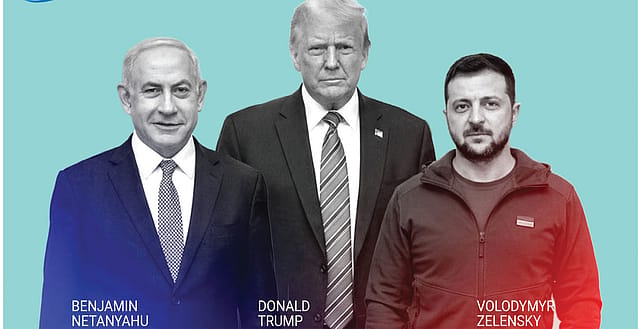
Lindsey Graham's funeral was meant to be an occasion for mourning, but it became something closer to a proxy summit. Volodymyr Zelensky and Benjamin
Netanyahu, leaders in two wars that refuse to end, arrived in Washington ostensibly to memorialise a shared patron and found themselves instead competing for what he used to provide: Donald Trump’s undivided attention. Both secured separate audiences in the Oval Office within hours of one another, each departing with talking points rather than commitments—missile-production licences for Kyiv, vague nuclear reassurances for Jerusalem. Of the two, it is Netanyahu whose asking price has quietly changed.
Elections loom in Israel by autumn, and the numbers are unflattering: his coalition is trailing in poll after poll, weighed down by unresolved grievances over October 7, a fractious ultra-Orthodox alliance, and a war whose ending nobody can predict. A leader who once arrived in Washington issuing demands now needs a photograph suggesting strength he cannot currently manufacture. Trump remains indispensable to both, but for Netanyahu the meeting was more diplomacy than insurance, purchased at a moment when his domestic hand has rarely looked weaker and tensions with Trump never higher.
Is Germany Soft on Islamic Terror?

Grief over the July 25 attack on Berlin’s Christopher Street Day parade curdled quickly into recrimination. A rented van driven into the crowd, followed by a machete assault, leaving a 65-year-old Polish woman dead and 29 wounded. The attacker, 21-year-old Abdul Ballout, had a documented history of a juvenile conviction and a failed attempt to join the IslamicState. Although he was shot dead by police the day after, that such a profile could walk free and approach a major public event unhindered is a key question for German and European counterterrorism. Chancellor Friedrich Merz has struggled to contain the fallout. But he has been unambiguous about the operational failure, remarking pointedly that he can locate his own phone anywhere on the planet, and even his iPad through it, while German authorities apparently cannot do the same for individuals flagged as security risks. Merz has floated tighter movement restrictions for suspects and revisiting who holds surveillance responsibility. The far-right AfD is predictably exploiting the same fallout, accusing Merz of tolerating “migrant violence” ahead of Berlin’s state election. But the deeper question of how the EU’s patchwork of detention thresholds and monitoring powers keeps producing these gaps will outlast the current outrage cycle.
Colombian Turncoat
President-elect Abelardo de la Espriella, the self-styled El Tigre, now prepares to govern the country whose laws he once helped members of its most notorious industry evade. His legal career in Bogotá and Miami, for years, saw De la Espriella represent paramilitary figures, corruption-accused politicians and clients tied to narcotics and money-laundering, including businessman Alex Saab. He now promises to eliminate the very trade he once helped clients navigate, promising mega-prisons and military crackdowns modelled on El Salvador’s President Nayib Bukele. Colombians voted for a hardliner; they got a man whose career was built defending the people he now vows to destroy.