Two Chokepoints and No Exit
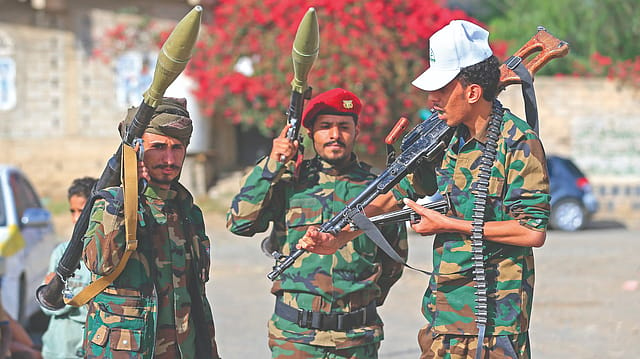
The Middle East’s oil map has narrowed to a dangerous point. With the Strait of Hormuz choked by the Iran war, Bab al-Mandab was meant to be the fallback. Saudi seaborne crude through the Red Sea rose eightfold to compensate. But that fallback collapsed with Houthi forces sweeping Yemen’s Red Sea coastline, seizing Mocha and the chokepoint island of Perim. The Shiite rebels now sit just across the water from Africa. A mysterious drone strike from Iraq on Saudi Arabia’s east-west pipeline—Riyadh’s overland hedge—knocked out yet another route even as the kingdom declined to retaliate. Brent crude has climbed past $107. The stranger twist is Washington’s posture. Iran, battered by recent US strikes and evidently losing its grip on Hormuz leverage, might have expected a harder American response on the Red Sea. Instead, Donald Trump has rebuffed Saudi pleas for strikes on the Houthis, saying the group “doesn’t want to fight” America. The Saudis are now exposed on two fronts in the unfolding consequences of a war that has generated a crisis nobody controls. Iran is weakened but unbowed; its proxy is emboldened rather than restrained; and two of the world’s oil arteries are simultaneously squeezed, with no obvious off-ramp for anyone involved.
Caught in the Crossfire

Ed Sheeran didn’t really fire Macklemore. That decision came from above him; from stadium ownership uneasy about the rapper’s onstage “Free Palestine” chant. Sheeran’s real offence, apparently, was staying quiet before clarifying the choice wasn’t his to make. For that measured honesty, four supporting acts walked away on the US tour, and Sheeran found himself painted as the villain of someone else’s decision—and politics. Yet his instinct was to protect the people around him: his crew, musicians, and fans. That wasn’t complicity. It was a performer trying to hold a tour together while everyone else was choosing sides.

Zeroing In on ECI
09 Oct 2026 - Vol 05 | Issue 41
Constitutional legitimacy versus political opportunism
A Thread through a Thousand Years
Almost a thousand years since English needles first drew wool through linen, the Bayeux tapestry has crossed the Channel to hang, for the first time, in the land of its making. Stitched in the 1070s, likely by Englishwomen working near Canterbury, it travelled to Normandy and stayed there until conservation science, and President Emmanuel Macron’s 2018 pledge, finally made the crossing possible. Its unveiling at the British Museum this month is being seen as more than an exhibition. It’s a gesture of post-Brexit goodwill, sealed by the presence of both King Charles and Macron at the opening. The tapestry’s power lies in its contradictions. It is saturated with martial bravado—swaggering horses, bared swords, a battlefield thick with unclothed corpses, and large penises—yet the women who embroidered it appear only at the margins, cloaked in ambiguity, their motives for mockery or grief left for historians to speculate. That a monument to masculine conquest survives chiefly through female hands and needlework is its quiet irony. Ticket queues are stretching for hours, evidence of what commentators are calling “Bayeux mania”. William the Conqueror might be surprised that medieval cloth can still summon a nation to form a line.