Trump’s War On Peace
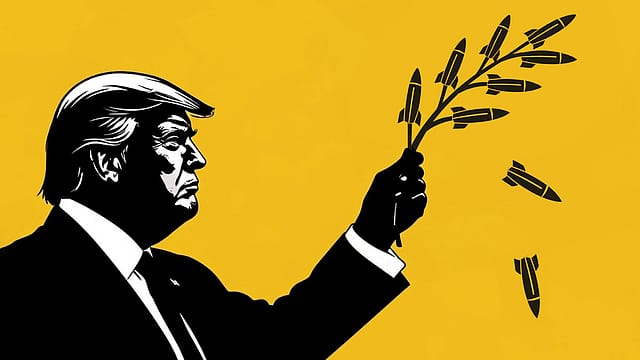
Donald Trump’s second presidency marks a decisive shift in US statecraft: foreign policy as personal theatre, multilateralism displaced by a doctrine of calculated disruption, and the institutional order recast through a narrowly transactional ‘America First’ realism.
Moving beyond the improvisation of his first term, Trump’s second term is deliberately revisionist. His administration has upended foundational norms, including withdrawing the US from scores of international organisations and the Paris Climate Agreement. Nowhere is this “disruption as doctrine” approach clearer than in his treatment of sovereignty and territoriality—evident in recurring annexation threats towards Greenland and Canada, and in the articulation of a personalised “Donroe Doctrine”, an idiosyncratic evolution of the Monroe Doctrine.
On the economic front, Trump has weaponised trade as a tool of primary national power, with his tariffs spurring significant international volatility. Even after the US Supreme Court struck down many of those tariffs as illegal, Trump immediately responded by imposing a 15 per cent global import duty under a different national law.
His policies and actions in the security realm have triggered increasing international volatility and instability, including widening divisions within the Western bloc.
By mistaking disruption for strategy and bullying for leadership, Trump has made America appear more erratic and less dependable than at any time since 1945. The US can still project overwhelming force, but its ability to shape stable outcomes, build coalitions and lead by example is steadily eroding.
The Myth
Trump’s self-proclamation as a global peacemaker sits uneasily—indeed irreconcilably—with his record in office. Such is his reliance on militarised statecraft that he ordered more military strikes on countries in just the first year of his second presidency than the entire four-year term of his predecessor, Joe Biden.
In speeches, social-media posts and ceremonial initiatives, Trump has cast himself as the man who ended eight “unendable wars”, deserved the Nobel Peace Prize and restored American strength while avoiding costly “forever wars”. Yet the empirical record of his second presidency reveals something quite different: a sustained dependence on high-intensity military force across multiple theatres, a dramatic expansion of nuclear-weapons capabilities, and a foreign policy increasingly personalised, transactional and erratic.
This disjunction reflects a deeper doctrinal shift: Trump’s redefinition of peace itself. In his formulation, peace is not the product of diplomacy, compromise or durable political settlements; it is the abrupt cessation of violence through overwhelming, unilateral force—what his advisers describe as “peace through shock”.
The result is a foreign policy that claims the mantle of non-interventionism while normalising frequent, destructive military action. The long-term effect is to weaken American strategic credibility, erode international norms, and leave America less secure in a world already defined by sharpening great-power rivalry.
There is a growing gap between Trump’s words and actions. Take his National Security Strategy (NSS) that he released a little over three months ago.
At first glance, the NSS promises a restrained and pragmatic approach to US foreign policy. It criticises previous administrations for defining American interests so broadly that “almost no issue or endeavour is considered outside its scope,” and instead pledges a more focused conception of national interest. The document outlines four core principles: a narrowed definition of national interest, “Peace through Strength,” a “Predisposition to Non-Interventionism”, and “Flexible Realism”.
The language of non-interventionism is especially striking. Rooted rhetorically in the Declaration of Independence, the NSS asserts that all nations possess a “separate and equal station”, implying respect for sovereignty of other states and a high threshold for military action. It disavows ideological crusades and promises “peaceful commercial relations” without imposing social or political systems on others.
This is how that section reads in full: “Predisposition to Non-Interventionism—In the Declaration of Independence, America’s founders laid down a clear preference for non-interventionism in the affairs of other nations and made clear the basis: just as all human beings possess God-given equal natural rights, all nations are entitled by ‘the laws of nature and nature’s God’ to a ‘separate and equal station’ with respect to one another. For a country whose interests are as numerous and diverse as ours, rigid adherence to non-interventionism is not possible. Yet this predisposition should set a high bar for what constitutes a justified intervention.”
On paper, this suggests a break with the interventionist US habits of the post-Cold War era. In practice, however, the NSS embeds a paradox.
While professing a predisposition against intervention, it simultaneously calls for maintaining the world’s most powerful military, accelerating technological dominance and undertaking a sweeping nuclear modernisation programme. The document thus creates conceptual space for a foreign policy that claims restraint while preserving—and expanding—the capacity for aggressive action.
The operational reality of Trump’s second presidency exposes how hollow the claimed predisposition to non-interventionism has become. Rather than reducing the use of force, the administration has shifted towards a “shock and awe” model—favouring short, high-intensity operations instead of long-term operations that usually result in a military quagmire.
In Yemen, Trump’s Operation Rough Rider (March-May 2025) involved hundreds of strikes over a 53-day period, the most intense US bombing campaign in that country’s history.
In Iran, Operation Midnight Hammer deployed more than 100 aircraft and massive bunker-buster bombs against nuclear facilities, with the White House declaring the Iranian nuclear programme “obliterated”. On June 25, 2025, the White House posted on its website: “Iran’s nuclear facilities have been obliterated—and suggestions otherwise are fake news.” Yet, just months later, Trump is threatening to launch war on Iran if it does not abandon its nuclear programme.
In Venezuela, the US conducted a regime-change military operation early this year, abducting President Nicolás Maduro and gaining control of the world’s largest proven oil reserves. This operation, however, was framed not as war, but as a law-enforcement operation.
These headline operations were accompanied by intensified drone and air campaigns in Somalia, Nigeria, Syria, and the Caribbean, alongside the militarisation of the US southern border under a memorandum treating migration as an “invasion”. Data from conflict-monitoring organisations indicate that the US under Trump carried out more than 600 airstrikes in 2025 alone.
In ordering the Christmas Day strikes in Nigeria, Trump portrayed the bombings as necessary to protect Christians from ISIS attacks. Yet Sokoto state, where the US conducted the airstrikes, is largely Muslim, and the local Catholic bishop explicitly denied that Christians there were being systematically targeted. Nor is there any clear evidence that the insurgents operating in Sokoto are linked to ISIS.
The key innovation under Trump is not restraint but reconfiguration. Trump has replaced prolonged US occupations with repeated, high-tempo kinetic actions justified as counter-terrorism, counter-narcotics or protection of religious freedom.
Just the form of intervention has changed. The frequency, geographic reach and normalisation of intervention have only increased.
Manufacturing a Persona
Against the backdrop of expanded military activity, Trump has constructed an elaborate narrative of peace-making. At the United Nations (UN) in September 2025, he claimed to have ended seven “unendable wars”, later revising the number to eight. He practically crowned himself a global peacemaker at the UN, claiming “everyone” says he should win the Nobel Peace Prize. The boast was vintage Trump: detached from reality and delivered with a straight face.
He has created a personalised ‘Board of Peace’, launched at Davos earlier this year, over which he exercises unilateral control. The board is effectively a one-man show—Trump alone can veto decisions, set the agenda, invite or expel members and even anoint his own successor. Trump has even renamed the US Institute of Peace building after himself.

The cases he cites as evidence of his peace-making often collapse under scrutiny. Some of the alleged wars—such as tensions between Egypt and Ethiopia or Kosovo and Serbia—were not wars at all. Others, such as the Cambodia-Thailand dispute or the Armenia-Azerbaijan conflict, were addressed primarily through regional diplomacy or remain unresolved despite ceremonial agreements.
In still others—most notably Israel and Iran—Trump did not end a conflict but actively escalated it, joining hostilities through direct US military strikes on Iranian nuclear facilities.
The pattern is consistent: inflate the scale of a conflict, insert the US—and Trump personally—as the indispensable mediator, deploy coercive force and then declare victory regardless of the underlying political reality. Peace, in this narrative, becomes a branding exercise rather than a substantive outcome.
The human consequences of this doctrine are visible in Yemen and Gaza.
In Yemen, <Operation Rough Rider> achieved its immediate objective of halting Houthi attacks on shipping lanes but at significant humanitarian cost. Independent monitors estimate hundreds of civilian deaths in just 53 days, including strikes on critical infrastructure such as the Ras Isa port, a lifeline for humanitarian aid, and a migrant detention centre in Sa’ada that killed dozens of African migrants.
The Trump administration’s response has been to dismiss or deflect such reports, blaming “human shielding” by adversaries and measuring success solely by restored maritime security. The NSS’ supposed “high bar” for intervention thus becomes, in practice, a high tolerance for civilian harm.
In Gaza, Trump’s approach has been equally stark. His early proposal to “take over” and redevelop the enclave into a “Riviera of the Middle East”, initially tied to the displacement of millions of Palestinians, has evolved into a heavily securitised but still vague reconstruction plan overseen by his Board of Peace. Plans for a permanent US military presence in Gaza underscore the extent to which “peace” is conceived as managed pacification backed by force, rather than a political settlement grounded in rights and sovereignty.
The Nuclear Paradox
Perhaps the clearest illustration of the gap between rhetoric and reality lies in Trump’s nuclear policy. While presenting Iran’s nuclear ambitions as an existential threat justifying military strikes and coercive diplomacy, the US under Trump has allowed the last remaining US-Russia nuclear arms control treaty, New START, to lapse. At the same time, the US is expanding and modernising its own nuclear arsenal.
The Trump administration boldly frames this not as contradiction but as doctrine: “Peace through strength” in its purest form.
American nuclear weapons are portrayed as stabilising instruments wielded by a responsible democracy, while the same weapons in the hands of adversaries are deemed inherently illegitimate. The result is a shift away from the Cold War logic of mutual restraint towards a model of unilateral primacy.
This is reflected in America’s 2026 “nuclear modernization” budget, a cornerstone of the Trump administration's “peace through strength” doctrine. The budget, which represents a historic financial commitment to the already-formidable US nuclear triad, totals approximately up to $90 billion in authorised spending—a 26 per cent increase over the Biden administration’s final request.
The consequences are predictable. By abandoning treaty constraints and investing tens of billions of dollars in new delivery systems, warhead and missile defences, the US encourages rival powers to expand their own arsenals.
Iran, meanwhile, has responded to last summer’s US strikes on its nuclear facilities by seeking to rebuild its programme in more hardened and secretive configurations, illustrating how tactical victories can generate long-term strategic instability.
Strategic Consequences
Beyond military actions and nuclear policy, Trump’s approach has reshaped the very process of American foreign policy. Diplomacy has become an extension of his personal brand, marked by spectacle, unpredictability and a preference for dramatic gestures over sustained engagement.
Major decisions—from bombing Iranian nuclear sites to proposing regime change—are often announced impulsively, with allies and even cabinet officials learning of them through social media.
Professional diplomats and intelligence officials are sidelined, eroding institutional expertise and continuity. Where foreign governments once relied on their intelligence services to understand American policy, they now simply monitor presidential social-media posts.
Trump’s excessive personalisation of policy breeds confusion and mistrust. Allies cannot be certain whether statements reflect official policy or personal impulse, while adversaries struggle to interpret whether threats are credible or performative.
The blurring of public policy and private gain, including the influence of Trump’s booming business ventures, further undermines the credibility of US decision-making. Trump’s personal wealth has risen on the back of cryptocurrency ventures and other deals, with mounting evidence that his family’s business empire is influencing decision‑making on sanctions, financial regulations, travel restrictions, and even choices of partner states.
The cumulative effect of these patterns is deeply corrosive for US foreign policy and long-term American strategic interests.
First, Trump’s redefinition of peace as “shock and awe without occupation” normalises frequent, highly destructive uses of force while devaluing diplomacy. This weakens international norms governing the use of force and exposes as hollow US claims to uphold international law and civilian protection.
Second, his militarised statecraft accelerates arms races, great-power rivalries and regional instability. The lapse of the last remaining nuclear arms control treaty, combined with expansive US nuclear modernisation and missile defence initiatives, incentivises rivals to expand their own weapons of mass destruction (WMD) capabilities. The cycle of action and reaction increases the risk of miscalculation and escalation.
Third, Trump’s transactional and personalised diplomacy weakens alliances and partnerships as well as the US-led international order, which has traditionally helped amplify American power. Allies and strategic partners confronted with America’s unilateral actions and unpredictable policy shifts are more likely to hedge, pursue strategic autonomy or seek alternative partnerships. This is exactly what India is doing.
Fourth, the fusion of foreign policy with domestic political theatrics erodes the credibility of US commitments. When actions appear driven by personal branding or electoral considerations, both friends and adversaries are likely to discount American assurances and threats.
Finally, by mistaking disruption for strategy and coercion for leadership, Trump has made the US appear less reliable and less trustworthy.
Trump’s peacemaker narrative is not merely a matter of personal exaggeration. It reflects a deeper transformation in how American power is conceived and exercised. By redefining peace as the product of overwhelming force, he has blurred the line between war and diplomacy and normalised the routine use of violence.
The costs are already visible: destabilised regions, renewed arms races, strained alliances, and a global perception of the US as erratic and self-interested. In the long run, these trends threaten to leave America weaker, lonelier and less capable of shaping the new global order in ways that serve its interests.
Trump has already etched his name into the history books—not as a strategic innovator, but as a leader who turned American foreign policy into a vehicle for spectacle and coercion, mistaking shock for strategy. Rather than ‘Make America Great Again’, he is steadily diminishing his country’s power, leaving the US less trusted and less credible than at any point since the end of World War II.