Trump’s China Reset: From strategic competition to transactional coexistence
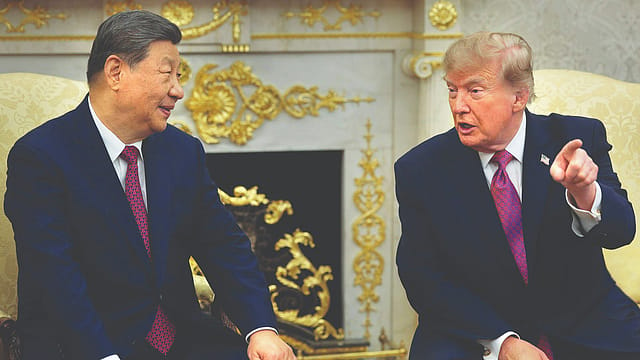
US President Donald Trump’s China policy has undergone a significant recalibration between his first and second terms. The first Trump administration marked a decisive break with the assumptions of engagement, moving Washington towards a broad conception of “strategic competition” that encompassed trade, technology, ideology, human rights, Taiwan and the wider military balance. The second term, by contrast, has retained the coercive instruments of the earlier approach but narrowed their purpose, increasingly subordinating them to transactional economic bargaining. Chinese President Xi Jinping’s recent visit to Washington captured this evolution: considerable ceremony and leader-level theatre, but limited substantive movement on the structural disputes defining the relationship.
Trump’s first term represented a fundamental shift in the US approach to China. Washington increasingly treated Beijing not as a prospective stakeholder in an American-led order, but as an economic and strategic challenger whose rise had to be constrained.
Trade was the initial battleground. The administration invoked Section 301 to investigate Chinese intellectual-property practices and forced technology transfer, followed by tariffs covering hundreds of billions of dollars of Chinese imports. The January 2020 Phase One agreement subsequently sought to convert this confrontation into a negotiated bargain, securing Chinese commitments on purchases of American agricultural and energy products as well as intellectual-property protections.
But trade was only one component of a much broader strategy. The administration tightened technology restrictions, expanded measures against Chinese firms linked to the military, and increasingly scrutinised Chinese activity in Hong Kong and Xinjiang. Washington also adopted a more explicit position on Taiwan and South China Sea. Officials such as Matt Pottinger and Mike Pompeo helped articulate a more comprehensive critique of the Chinese political and economic model.
The apparent contradiction between Trump’s personal outreach to Xi and his escalating pressure on Beijing was therefore central rather than incidental. Personal diplomacy was used to manage a relationship that was simultaneously being redefined as competitive. The objective was no longer simply to induce China to become a more responsible participant in the existing order; it was to alter the terms on which the US and China interacted.
The second Trump administration initially appeared set to intensify this trajectory. During the campaign, Trump had threatened tariffs substantially higher than those imposed during his first term. In early 2025, the administration moved rapidly, combining new tariffs, fentanyl-related duties, restrictions affecting small-package imports and the broader reciprocal-tariff campaign. At their peak, tariffs on Chinese goods approached 145 per cent.
Beijing responded in kind, including through tariffs and restrictions involving critical rare-earth supplies.
The result was a rapid movement from escalation towards bargaining. Tariffs were reduced through successive truces, while some technology restrictions were eased. The administration also became less willing to allow disputes over Taiwan, South China Sea, human rights or China’s political system to obstruct commercial negotiations. The centre of gravity of China policy consequently shifted from comprehensive strategic confrontation towards managed economic competition.
The October 2025 Busan understanding was particularly significant in this respect. The emerging arrangement combined tariff reductions with Chinese commitments on agricultural purchases and a pause in some rare-earth restrictions. Subsequent negotiations, including Trump’s May visit to Beijing, further reinforced the emphasis on purchases, investment and institutionalised economic dialogue.
This did not amount to the abandonment of competition. Rather, competition was being placed within a more transactional framework. Technology controls, supply-chain diversification and concerns about China’s industrial power remained. But the administration increasingly appeared willing to moderate these instruments when doing so could produce a tangible commercial gain.
The September 2026 Xi-Trump summit in Washington provided the clearest illustration of this recalibration. Xi’s first state visit to Washington since 2015 was accompanied by considerable ceremony, with Trump personally greeting the Chinese leader and hosting a state dinner. Yet, the substantive outcomes were incremental.
The existing trade truce was extended to January 10, 2027, while the two sides agreed on preferential tariff treatment covering roughly $30 billion of non-sensitive goods in each direction. Institutional mechanisms such as Boards of Trade and Investment were formalised, alongside an AI dialogue and an incident-communication channel. There was also agreement on continued summit-level engagement, including participation in forthcoming APEC and G20 meetings, while discussions continued on military crisis communications and missing-in-action remains cooperation.
These arrangements are useful for managing the relationship, but they do not resolve its central contradictions. There was no major breakthrough on technology self-reliance, the underlying trade imbalance, critical-mineral competition beyond the earlier pause, or the principal security disputes. Taiwan was raised by the Chinese side, particularly in relation to opposition to independence, but it featured far less prominently in the public American readout.
The summit therefore demonstrated the strengths and weaknesses of Trump’s personalised diplomacy. It can create political space for temporary bargains and reduce the immediate risk of escalation.
There is both continuity and change in Trump’s China policy.
The continuity is evident in the centrality of tariffs, the emphasis on reciprocity and trade deficits, and the preference for direct leader-to-leader bargaining. The instruments of economic coercion developed during the first term have not disappeared.
What has changed is the breadth of the strategic agenda. The first-term approach increasingly linked economic competition to technology, ideology, human rights, alliances and military strategy. The second-term approach has narrowed the immediate objective to economic advantage and managed coexistence. The language of an emerging “new Cold War” has consequently become less central to official policy, while the willingness to compromise on selected technology restrictions and avoid geopolitical flashpoints has increased.
This should not be mistaken for the disappearance of strategic competition. The underlying contest over technology, supply chains, industrial capacity and the military balance remains intact. What has changed is the hierarchy of priorities.
Trump’s second-term China policy is therefore best understood not as a return to engagement but as a more transactional form of competition. Washington continues to regard China as a major challenger, yet it is increasingly seeking to compartmentalise that rivalry and extract short-term economic gains without allowing every strategic disagreement to become a confrontation.
The September summit illustrated precisely this tension. The optics of personal diplomacy were strong, while the substantive gains remained limited. Washington obtained additional commercial commitments and political theatre; Beijing secured additional time and space for its economic and technological objectives. The larger structural contest, however, remains unresolved.
The evolution of Trump’s China policy thus reflects a change in the operating logic of the strategic competition: from a broad campaign to reshape the US-China relationship towards a more personalised, transactional effort to manage an increasingly unavoidable rivalry.