Trump Plays the Modi Card
A SURPRISINGLY SMALL NUMBER of nations condemned or criticised the assassination of Iran’s Supreme Leader Ayatollah Ali Khamenei by US and Israeli air strikes. The nations who did so make for interesting reading. Apart from Russia and China, which see Iran as a strategic partner and strongly oppose American power, there was North Korea which said the attack was an “illegal act of aggression”, Pakistan expressed “grief and sorrow” at Khamenei’s death, Malaysian leader Anwar Ibrahim “unreservedly” condemned the killing but Türkiye’s Recep Tayyip Erdogan was less forthcoming, saying he was “saddened” by the “passing” of the Iranian leader. The Houthis and Hamas condemned the “heinous” act and vowed vengeance but it would have been surprising if they had not done so.
On the other hand, European Union (EU) foreign policy chief Kaja Kallas said Khamenei’s death was a “defining moment in Iran’s history” and hoped the Iranian people may have a path to a different Iran, one they have greater freedom to shape. Then UK Secretary of State for Defence John Healey said protecting British military personnel and civilians was a priority and told the BBC that “no one will mourn” Khamenei. As they bore the brunt of Iran’s retaliation, the Gulf Cooperation Council (GCC) nations accused Tehran of endangering vital energy hubs, residential areas and economic facilities, and asserted their right to do what was needed—including military retaliation—to secure territories and citizens. India did not immediately react to Khamenei’s death and Foreign Secretary Vikram Misri signed the condolence register at the Iranian embassy in New Delhi only on March 5 while External Affairs Minister S Jaishankar posted on X that he had spoken to his Iranian counterpart Abbas Araghchi. Sometimes, when the course of events is unclear, holding back is a better option.
Watching and waiting is not necessarily doing nothing and can be a better option than preachy comments issued without a careful consideration of India’s interests. While Congress condemned Khamenei’s death as “unequivocally reprehensible”, the government chose to rely on discrete diplomacy. India’s relations with Iran are not insignificant but its security and economic relations with the Gulf Arab states have grown exponentially. Condemning US and Israel was not only unlikely to alter their decisions but would certainly impact India’s vital interests. In a morally ambiguous world, practical considerations matter. Despite the apparent delay in expressing condolences, Iran proved receptive to Indian requests to let oil bound for India to pass through the Strait of Hormuz on request. Jaishankar and Araghchi spoke more than a few times and the Iranian foreign minister was in India for three days on May 13- 15 for the BRICS foreign ministers’ conference. Iran understood India needed to protect its interests and recognised that it had not participated in or supported a hostile act against Tehran.
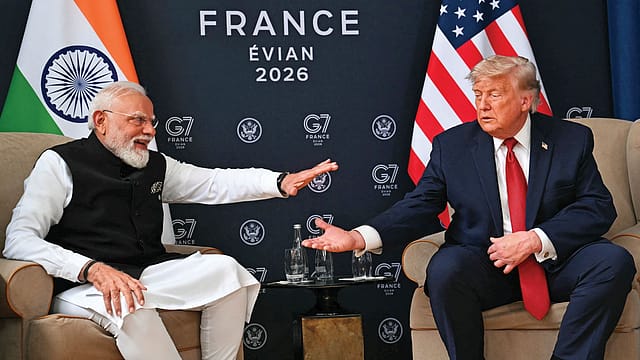
In the circumstances, the meeting between Prime Minister Narendra Modi and US President Donald Trump at Évian on June 17 after a gap of more than 15 months had an element of unpredictability, particularly due to the ‘open’ format of the G7 media interactions, with the two leaders sitting side by side. After a longish period of unsettled relations and a slow return to normalcy, the meeting saw Trump acknowledging Modi the negotiator and showered praise on the prime minister.
“We cannot be closer than we are... I don’t think we could be any closer. Both him, and I, and our nations, but it really starts with the two of us, we cannot be closer,” Trump said, and added that though Modi is a “beautiful looking man”, he drives a hard bargain. “He’s a very tough negotiator. I’ll give you a lesson. He’s a beautiful looking man, he looks so nice, he’s like an angel. But he’s tough. He’s a killer. He is as tough as they come. But he looks so good. That’s how he gets you by surprise,” Trump said as Modi looked on.
TRUMP’S COMMENTS WERE typically hyperbolic— speaking about a “great” trade deal though the final stages are proving difficult to conclude—but he was clearly bent on creating good vibes, even promising to come to India’s defence in case of an attack. “We had, in particular, some very good conversations with Prime Minister Modi of India. We’re doing trade deals... A lot of things are happening between the United States and India. The United States is doing the best we’ve ever done. We have over $19.2 trillion coming in, and we’re building factories, we’re building everything. The Prime Minister is building a lot in the United States... But I just want to say he’s been my friend for a long time now, and we’ve always had a great relationship, and it’s great to be with you,” he said and added another flourish, saying if “anybody attacks that man” the US is going to be there to help. Modi’s remarks were, not surprisingly, more matter-of-fact, as he noted a new energy in bilateral ties. “I am happy that our teams are working to achieve targets we have set for them. I congratulate you for the efforts to establish peace in West Asia. We agree that the opening of the Strait of Hormuz is crucial for the global economy. The safety of seafarers is equally crucial,” Modi said. The prime minister’s emphasis on the importance of ensuring the safety and security of civilians, including seafarers was unmistakable. Though the diplomatese was bland, India-US ties received an unambiguous boost with Trump doing all the talking during the media interaction.

The Ministry of External Affairs (MEA) statement was also matter-of-fact, noting the leaders reviewed significant progress achieved in the India-US COMPACT (Catalyzing Opportunities for Military Partnership, Accelerated Commerce and Technology) as also defence, trade, energy and people-to-people ties. “Both sides reiterated their commitment to continue working together to advance the India-US Comprehensive Global Strategic Partnership for the benefit of peoples of both countries and to promote peace, stability and prosperity in the Indo-Pacific and beyond. Trump was clearly intent on avoiding references to rough spots in India-US ties and used every question from Indian journalists to dwell on his warm relations with Modi. His response on the deaths of Indian seamen was careful and he skirted a question on whether sanctions will be reimposed on Russia. The Indian side would have been happy the meeting went well though Modi’s engagements clearly underlined efforts at diversification and expanded trade ties wherever possible.
The international situation was undoubtedly an important consideration since India’s energy supplies and expenses are severely impacted by the closure of Hormuz. The deaths of Indian seamen on board vessels targeted by US forces for allegedly trying to evade the American blockade are a further source of tension. The US blockade was imposed without any international sanction but it is backed with serious military muscle. With details of the Iran deal still unclear and Trump engaged in a major exercise to claim victory while simultaneously warning Iran to deliver on commitments, the discussions were an exercise in keeping India-US relations moving and finding a path to concluding the Bilateral Trade Deal (BTA) that has bedevilled ties since last year.
Ahead of the meeting, the atmospherics at Évian were propitious. Modi was seated next to Trump at the G7 outreach session on June 16 and spoke to the US president briefly before sitting down. There was no hug but Trump clasped the prime minister warmly by the arm. The next day Trump accepted Modi’s steadying arm as he clambered onto the stage for a group photograph. Modi’s remarks at the outreach session stressed the need to restore trust in international relations. The statement was intended to underline the value of stability in relations but also the need to consider an ally or a partner’s sensitivities. As he closed his remarks, Modi referred to the consequences of the war in the Middle East, saying, “Many Indian civilians lost their lives. It is our responsibility to ensure the safety of the seafarers who connect nations through global maritime trade. We must ensure that maritime routes remain secure and seafarers can perform their duties without fear.” The US position on its blockade has been that no ship carrying Iranian oil will sail out of Hormuz. The three ships that came under attack were suspected to be part of a shadow fleet with labels that change frequently. Their attempts to evade detection by switching off locational devices were hardly likely to fool the US fleet but the victims of missile strikes are crew members and not the shadowy owners of the ships. US Secretary of State Marco Rubio’s brusque response to Jaishankar’s phone call that the blockade will be enforced was remarkably bereft of any regard for the loss of lives.
THE IRAN DEAL and the centrality of ties with the US did not prevent India and other attendees at the G7 meet from pursuing and shoring up arrangements with one another. Canadian High Commissioner to India Christopher Cooter, in comments to Indian media, put the matter plainly, saying that no nation wants to be about dictated its choice of trade partners and alliances, in an obvious reference to downswings in Ottawa-Washington relations. Canada’s significant reserves in oil, gas and uranium can make it an important partner for India. The meeting between Canadian Prime Minister Mark Carney and Modi at Évian was one of the Indian leader’s more important conversations. They discussed complementarities between the Indian and Canadian economies and highlighted the importance of resilient and reliable supply chains in energy and food security and reviewed cooperation in commercial contracts for LNG, LPG and metallurgical coal and committed to concluding a comprehensive trade pact by December.
Similarly, the meeting with UK Prime Minister Keir Starmer concentrated on clearing last-minute hurdles to implementing the India-UK comprehensive economic and trade agreement. Modi had only recently met UAE President Sheikh Mohammed bin Zayed Al Nahyan, but the likely steps if the US-Iran truce does hold and Hormuz reopens could be expected to have figured high in their priorities. The meeting with EU leaders dwelled on the FTA reinforcing the India-EU strategic partnership and delivering transformative outcomes. Likewise, discussions with German Chancellor Friedrich Merz reviewed trade and investment, defence and security, green and sustainable development, technology, innovation, education and mobility. The quest to secure supply chains and diversify trade has brought about a convergence between developing and developed economies to an extent not always considered likely.
Modi’s agenda in France included the Bharat Innovates event in Nice on June 14 where he set out an agenda for collaboration between Indian talent and European capital and expertise. “Some young innovators are shaping the future through smart cities, advanced manufacturing, and new materials. Others are ensuring a sustainable future through green hydrogen, electric mobility, and battery technologies. At the same time, several startups are developing new technologies in the fields of defence and security,” he said. The event, he said, recognises that AI, quantum computing, biotechnology, space technologies and advanced materials will shape the future. “We seek partnership. We seek co-development. We seek joint research. We seek shared manufacturing. And we seek long-term collaboration,” the prime minister said. The effort to equip the Indian economy to upskill and modernise is a constant theme in Modi’s engagements. The innovation ecosystem, says an event backgrounder, rests on specific interventions like a $10 billion fund to de-risk private research and development, the one nation, one subscription scheme to improve student access to knowledge resources, startup initiatives and specialised platforms like iDEX (Innovations for Defence Excellence), BIRAC (Biotechnology Industry Research Assistance Council), and IN-SPACe (Indian National Space Promotion and Authorisation Centre).
At the start of his visit to Europe, Modi might have had his task cut out. A single-minded and consistent focus on India’s interests and determined efforts to expand India’s trade and commercial prospects strengthened his hand. What might have been a bruising encounter ended in an amicable handshake.