Trump Backs Israeli Help for Saudi Arabia as Yemen Alleges Missile Attack on Aden Airport
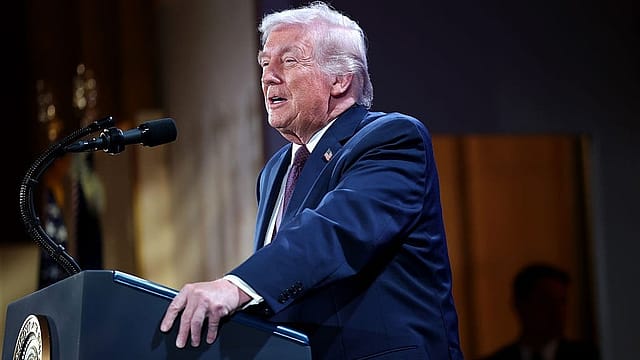
US President Donald Trump has urged Saudi Arabia to accept Israel’s offer of help against the Houthis, as Yemen’s internationally recognised government accused the group of firing two missiles at Aden International Airport while a passenger aircraft was preparing to take off.
Speaking to reporters at the White House before leaving for a rally in Georgia, Trump endorsed Israeli assistance to Saudi Arabia amid escalating missile and drone attacks.
“Yeah, I do, sure. Israel has been very helpful to Saudi Arabia,” he said when asked whether Riyadh should accept the offer.
Trump also suggested the hostilities could create fresh momentum for Saudi Arabia to join the Abraham Accords, the framework established in 2020 to normalise relations between Israel and several Arab countries.

Zeroing In on ECI
09 Oct 2026 - Vol 05 | Issue 41
Constitutional legitimacy versus political opportunism
Asked whether an agreement with Riyadh was back on the table, he said: “Yeah, I think so. Yeah, I think so. Maybe more than ever.”
Saudi Arabia has consistently maintained that normalisation with Israel requires a clear pathway to Palestinian statehood.
MISSILES LANDED NEAR PASSENGER AIRCRAFT
Yemen’s Information Minister Moammar Al-Eryani said two missiles landed near Yemenia Airlines flight IY 612 as it prepared to depart Aden for Cairo on Friday.
According to the minister, the missiles struck approximately 500 metres from the aircraft and about 100 metres from the centre of the runway. He said the passengers and crew were safe.
“Divine providence has prevented a horrific humanitarian catastrophe that could have claimed the lives of dozens of innocent travelers,” Al-Eryani said.
He described the incident as a direct threat to passengers, flight crews and civilian aviation, stressing that Aden airport remained a vital gateway for Yemenis travelling for medical treatment, education, employment and family visits.
Al-Eryani said Yemen’s government, backed by the Saudi-led coalition, would continue to protect civilian institutions and essential facilities.
SAUDI COALITION REPORTS INTERCEPTIONS
The Saudi-led coalition said it had intercepted and destroyed a ballistic missile launched towards Yanbu, two cruise missiles over the Red Sea and three drones over Saudi Arabia.
Coalition spokesperson Turki al-Maliki said the drones were intercepted in the southern region and the Riyadh region.
Saudi Civil Defence issued alerts for Khamis Mushait, which hosts a major air base, and the Red Sea port city of Yanbu. It later lifted an early warning alert for Jazan province, saying the danger had passed.
The US Embassy in Saudi Arabia warned American citizens of potential attacks on airports, airspace closures, flight cancellations and other travel disruptions.
Its advisory said the suspension of operations at Riyadh’s King Khalid International Airport had been extended through October 17. Airports in Jeddah and Dammam remained operational, with some delays and cancellations, according to the advisory.
The embassy urged travellers to confirm flight status directly with airlines and airports and follow Saudi Civil Defence instructions.
HOUTHIS ALLEGE SAUDI STRIKES; IRAN OFFERS MEDIATION
Houthi military spokesperson Yahya Saree claimed Saudi forces had carried out 101 airstrikes and missile attacks across Yemen in the preceding 24 hours.
He alleged that civilian sites in Sana’a and several governorates had been targeted, causing deaths and injuries, including among women and children.
Iran, meanwhile, denied involvement in Houthi attacks on Saudi Arabia and said it was prepared to help resolve the conflict if requested.
Iranian Foreign Ministry spokesperson Esmaeil Baghaei said Tehran did not regard further escalation as beneficial and called for respect for Yemeni sovereignty, an end to foreign intervention and the lifting of the air and naval blockade.
Iranian Deputy Foreign Minister Saeed Khatibzadeh separately said Saudi Arabia had yet to respond to Tehran’s mediation offer.
The exchanges have brought civilian aviation, Saudi infrastructure and Red Sea maritime routes into sharper focus as the conflict intensifies.
With inputs from ANI