Tom Stoppard (1937-2025): In the Arcadia of Ideas
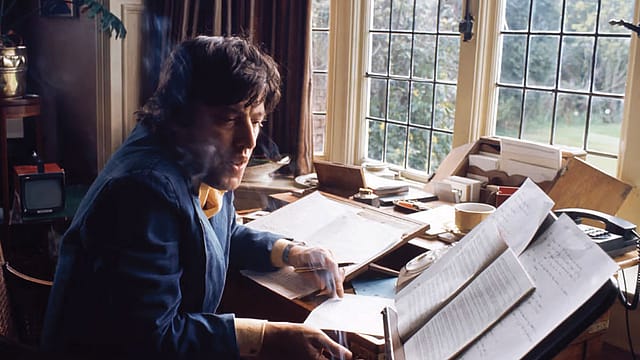
IT WAS IN DARJEELING that Tomáš Sträussler became Tom Stoppard. The legendary British playwright and Hollywood scriptwriter, who died in Dorset on November 29 at 88, was born in Czechoslovakia. His family fled the country on March 15, 1939, the day the Nazis invaded, as the patron of the shoe-town of Zlín in Moravia, Jan Antonín Bata, evacuated his Jewish employees and their families to his factories outside Europe. The Sträusslers went to Singapore, which had its own Bata factory. When the Japanese came knocking on the door, Tomáš, his mother Marta and brother Petr fled to India, via Australia, and ended up in the Himalayan town where the boys would attend Mount Hermon school. Stoppard would later say they were the “Bata people”, referring to his roots in Zlín but perhaps not unaware that Bata’s original factory town in India lay just south of Calcutta. More pertinently, it was in Darjeeling that his mother married a British major, Kenneth Stoppard, who gave the boys his family name and the brothers became Tom and Peter. Tom’s mother, incidentally, found employment managing the local Bata store. Eugen, a doctor, had stayed behind in Singapore and died in the war in 1942. For long, Stoppard believed his father perished as a PoW but discovered much late in life that his ship had sunk. The family moved to England in 1946 with Major Stoppard and Tom began his staggered evolution into an honorary Englishman, first putting on Englishness “like a coat”.
Sir Tom Stoppard did not come from the margins. He was a rank outsider. He was Jewish and Central European in a society where the slightest misstep, such as a mispronunciation, was noted if not always commented on. The experience of mainstreaming himself worked its way into his worldview, characters, and plots. His best-known work Rosencrantz and Guildenstern Are Dead, first staged at the 1966 Edinburgh Festival, took two of Shakespeare’s minor characters in Hamlet, the prince’s old but now distrusted friends, and put them centrestage. The major
characters of Shakespeare’s play, like Hamlet himself, do come on stage in cameos and utter lines from their old script, but Rosencrantz and Guildenstern have little understanding of what is going on out there on the main stage, or in the world.
The MissOil Strike
03 Apr 2026 - Vol 04 | Issue 65
The War on Energy Security
This foregrounding of the marginal and imagining their words and circumstances into existence, clearly echoing Samuel Beckett’s Waiting for Godot (1953), should not lead us into underestimating Stoppard’s own centrality. He bent British theatre to his will. His intellect and success—he earned not only fame but also several fortunes—bequeathed his artistic progeny a scene set aglow by the kind of light and stimulation that come only once in a creative generation.
Although Stoppard first made his name with the 1963 TV broadcast of his 1960 play A Walk on the Water (retitled Enter a Free Man in 1968), his fame really began with Rosencrantz and Guildenstern. The play was initially criticised in some quarters as unempathetic, emotionally cold, and even flippant. Yet it began building Stoppard’s reputation for tortuous intellectual conceits and linguistic pyrotechnics marked by brilliant wit, puns, double entendres, situational ironies and paradoxes. Critics were reminded not only of Beckett but of Shakespeare himself. And his good looks didn’t hurt either.
This effortless ability to entertain despite the intellectual rigour of his work— his slow and careful writing itself was anything but effortless—helped Stoppard easily bridge with Hollywood and cross the Atlantic where he was always in high demand as a scriptwriter and, more often, as script doctor. He shared an Oscar for the screenplay of Shakespeare in Love, adapted Jerome K Jerome’s Three Men on a Boat for TV and Tolstoy’s Anna Karenina starring Keira Knightley and Jude Law (the 2012 film). Before that, in 1990, he had directed the Rosencrantz and Guildenstern film with Gary Oldman as Rosencrantz and Tim Roth as Guildenstern. Stoppard was always sought for his skills with screenplays and many a Hollywood script would have been a disaster without his intervention. He even wrote most of the dialogue for Indiana Jones and the Last Crusade without featuring in the credits. A ready reckoner of his popular and critical success is a list of some of the big awards he won: one Oscar; one Golden Globe; five Tonys; three Laurence Oliviers. That is to say nothing of the numerous special awards and honours from media, literary societies, critics’ circles, universities, etc.
The breadth of Stoppard’s imagination, already evidenced in Rosencrantz and Guildenstern, would be demonstrated again and again, not least in a play like Travesties (1974). Lenin, James Joyce and Tristan Tzara had all been in Zurich during World War I but it took a Stoppard to invent the possibilities of that forgotten little fact of history. Travesties was called a Wildean fantasy, and not merely because The Importance of Being Earnest plays its own role in it.
Part of the early (and persistent) critical refrain was that Stoppard’s plays lacked substance and were feats of clever wordplay and showmanship. Dennis Kennedy, editor of the Oxford Companion to Theatre and Performance, citing the allegation of a lack of social commitment, noted that his “theatrical surfaces serve to conceal rather than reveal their author’s views, and his fondness for towers of paradox spirals away from social comment”. At the time of writing Travesties, Stoppard, a political conservative who had taken care to keep politics out of his work, had spelt it out himself: “I must stop compromising my plays with this whiff of social application. They must be entirely untouched by any suspicion of usefulness. I should have the courage of my lack of convictions.” Of course, 1974 was the year of Labour’s and Harold Wilson’s return, even as history was preparing the ground for Margaret Thatcher and the death of Old Labour or socialism as the British had known it. Stoppard’s courage in going against the intellectual grain of postwar Britain must have been a conviction in itself. Without overtly cheering “art for art’s sake”, Stoppard’s belief that politics would only cheapen his work was sound judgement. His plays aged better than those of most of his contemporaries.
Near the end of his life, in 2020, Stoppard returned to his roots and wrote Leopoldstadt, set in the Jewish quarter of early 20th-century Vienna. The play won the Laurence Olivier Award for Best New Play and later, four Tonys. Stoppard has explored most things a single creative mind could, from quantum physics to mathematics and thermodynamics and espionage, in his oeuvre. He also famously said that he wrote to understand his thoughts and explore his ideas.
A key to the mystery of creation he discovered was equilibrium. He told his biographer Hermione Lee, “Equilibrium is pragmatic. You have to get everything into proportion. You compensate, rebalance yourself so that you maintain your angle to your world. When the world shifts, you shift.” Coming from a man whose life was determined at its very initiation by the ghastliest chapter of 20th-century history, it was nothing if not an assertion of the triumph of life. Strength of mind matters most of all. The process of thought can never stop once it starts. As far as literary influence staring down the chain of anxiety goes, Stoppard would rank right at the top among the giants of postwar literature.
Knighted in 1997 for his services to literature, Sir Tom Stoppard was Central European in his intellectual bearing, possessing that peculiar ability to laugh at oneself, to be self-critical, of Mitteleuropa’s heimatlose Emigranten. But he was also an Englishman who loved his cricket.