Thunder from the East: The steady rise of India and China’s great-power ambition run parallel to the West’s decline
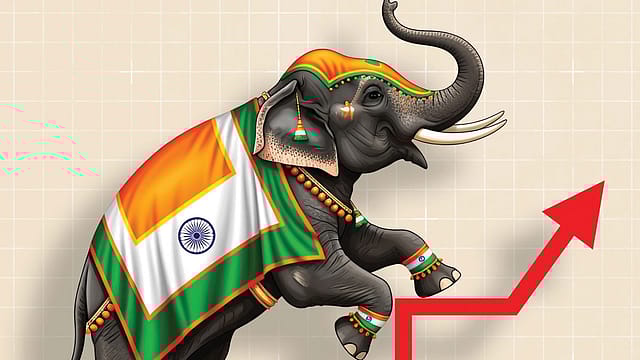
HISTORY HAS COME FULL CIRCLE. ASIA LED the world for millennia—economically, scientifically and culturally. Now, after centuries of contact, both pleasant and unpleasant, with the West, Asia is again set to be the world’s leading economic engine. The next twenty five years leading up to 2050 promise to dwarf the technological advances of the nineteenth and twentieth centuries, themselves the most technologically fertile in human history. During those 200 years—1800-2000—mankind transformed the planet. Seminal inventions were made: electricity, telephones, automobiles, aeroplanes, antibiotics, computers, and the internet.
By the middle of this century, life will have changed even more fundamentally. Pathbreaking discoveries in life sciences and GenAI will transform society. Hyperspace travel will bring the mysteries of deep space and time closer to human understanding. Telecommunications will achieve speed and multidimensional interactivity unimaginable today. Just as the concept of self-driving cars and neural implants that allow thoughts to govern physical actions would have been incomprehensible to the citizens of 1900, the still undiscovered technologies of this unfolding century are impossible for us to predict or even conceive.
Three countries will exert a centripetal force on world affairs in 2050: the US, China and India. Europe will be rich, but the unwinding of the Atlantic alliance will neuter its global influence. That leads us to a fundamental question: the balance sheet of Western civilisation. On the positive side of the ledger are the philosophical insights of Plato, Socrates and Aristotle, the genius of Pythagoras, the wisdom of Greece, the muscularity of Rome, the literature of Shakespeare, the art of Leonardo da Vinci, the science of Louis Pasteur and the universities of Yale and Harvard in the New World that lent lustre to an embryonic, evolving West.
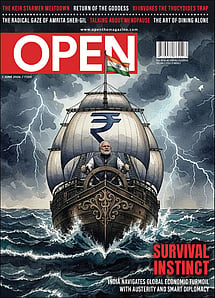
Survival Instinct
22 May 2026 - Vol 04 | Issue 72
India navigates global economic turmoil with austerity and smart diplomacy
WHILE CHINA’S SUPPLY-CHAIN logistics are unmatched, European, American and Japanese companies have drawn up plans to reduce dependence on them by de-risking without decoupling. The shift isn’t easy. Though labour costs have risen in China, they are still lower than those in the West and Japan and competitive with wages in East Asia.
Foreign investors have factored in three considerations as they move businesses out of China: one, China’s growing ties with Russia; two, Beijing’s crackdown on foreign companies; and three, further trade disruptions with the US under President Donald Trump.
Taiwan remains unfinished business for China. With dissent in Hong Kong silenced, an ageing Dalai Lama’s influence over Tibetans waning and Uyghur Muslims in Xinjiang out of sight in detention camps to subdued international outrage, reunifying Taiwan with the mainland is firmly on Xi Jinping’s agenda. An amphibious invasion of Taiwan can, however, prove difficult. Besides, Taiwan controls 55 per cent of the global supply of advanced semiconductors that are the backbone of the tech and AI ecosystem.
A Chinese military attack on Taiwan may come as early as 2027, theorised Philip Davidson, America’s top military officer in the Asia-Pacific command. Davidson told a Senate Committee in March 2021: “I worry that they (China) are accelerating their ambitions to supplant the United States and our leadership role in the rules-based international order by 2050. Taiwan is clearly one of their ambitions before that. And I think the threat is manifest during this decade.”
CHINA’S MULTIPLE CHALLENGES—slowing economic growth, an ageing workforce and a high-tech US embargo— may however stay Xi’s hand. China is a master of disguising the truth. Mao Zedong was an expert practitioner. Sujan R Chinoy, director general of the Manohar Parrikar Institute for Defence Studies and Analyses, reveals how Mao used historical sleight of hand to burnish Beijing’s hard and soft power: “It is extraordinary that in his seminal book, On China published in 2011, former US National Security Adviser and later Secretary of State Henry Kissinger thought it fit to add a prologue devoted to India–China relations. It is laced with factual inaccuracies and appears to be aimed solely at eulogizing Mao Zedong’s great abilities as a military strategist. Mao, in fact, drew heavily from Chinese classics and history.

“Based on his understanding of Chinese sources, Kissinger wrote that in deciding to ‘knock’ India back ‘to the negotiating table’ through military action in 1962, Mao claimed to his commanders that he banked on strategic principles drawn from China’s so-called historical experience of defeating India in ‘one and a half’ wars. Both the examples that Kissinger narrated are clearly ersatz, revealing Kissinger’s insufficient scholarship on ancient India.
“The fact is, there was no war between India and China during the Tang period (618–907 AD). There is a reference to a small event in A History of Sino-Indian Relations by Yukteshwar Kumar of Cheena Bhavana, Visva-Bharati University, Santiniketan. It involves a mention of Emperor Harshvardhan sending an emissary to China in 641 AD. After his death and the decline of his empire, Wang Xuance, the Tang envoy to the court at Thaneswar, and his entourage were reportedly attacked by local feudal powers. Apparently, Wang fled to Tibet and sought to regroup before launching a military campaign against some north Indian villages. If this is the story that Mao was referring to, it is apocryphal in terms of its scale and significance.”
Xi is the most hardline Chinese leader since warmonger Mao Zedong. At the end of the Mao era, China following the violent 1966-76 Cultural Revolution was riven by civil strife and mired in poverty. It took Deng Xiaoping’s focus on economic reforms in 1979 to lay the ground for today’s China, the world’s second-largest economy. Xi’s Mao-esque policies could, however, undermine China at a key inflection point in its global rise.
In contrast to Mao, the diminutive Deng transformed China economically with sweeping reforms beginning in 1979. Deng Xiaoping’s real name was Deng Xixian. He adopted the former name as a young revolutionary. Deng’s biographer Richard Evans, who was Britain’s ambassador to China in 1984-88 and had a bird’s eye view of China’s early economic reforms, wrote that after the initial liberalisation in 1979, “A second wave of reforms took place from 1983 to 1985. The impact of these reforms on agricultural output, and on the income and morale of the peasants, was enormous. From 1978 to 1984, the output of grain per head of the (total) population grew by an average of 3.8 per cent per year (compared with 0.2 per cent between 1957 and 1977), the output of cotton by 17.5 per cent compared with a fall of 0.6 per cent) and the output of meat by 9.0 per cent (compared with 1.7 per cent). Rural consumption per head, having grown by only a third between 1965 and 1978, almost trebled between 1978 and 1986.”
In 1984, on the thirty-fifth anniversary of the founding of the PRC [People’s Republic of China], Deng delivered an important speech, harking back to the past but also plotting the future. It is worth recalling Deng’s words: “Thirty-five years ago Chairman Mao Zedong, the great leader of the people of all our nationalities, solemnly proclaimed here the founding of the People’s Republic of China. He declared that the Chinese people had finally stood up. In the past thirty-five years not only have we ended a dark period of our history for all time and created a socialist society in China, but we have changed the course of human history.”
When Deng delivered this important speech in 1984, China’s GDP was just $0.26 trillion. By 2000, it had risen to $1.21 trillion. It was only after 2009 that the Great Economic Leap Forward—as it might well have been dubbed—took place. In just four years between 2009 and 2013, China’s GDP nearly doubled from $5.1 trillion to $9.6 trillion at a compounded annual growth rate (CAGR) of a barely believable 17 per cent. The pathway to Great Power status had been laid. But, as history has repeatedly shown, the journey to global power is strewn with unexpected forks in the road.
In 2050, the world will be integrated economically in a way we could have scarcely imagined a generation ago. Two of the world’s three largest economies will be Asian: China and India. In 1950, two of the world’s three largest economies were European: Britain and the Soviet Union. The third, and the biggest, the US, comprised an overwhelming majority of people of European descent. In 2030, for the first time in over 300 years, there won’t be a European country among the world’s three largest economies. That is a lesson history teaches nations.
Only one of the three Great Powers of 2050—India—will have the unique distinction of achieving pre-eminence without violating the integrity of other territories as European nation-states did on their way to global power. Europe’s contribution to democracy for itself and dictatorship for its colonies sits uneasily with the violence it inflicted on its Asian and African possessions.
Countries that were colonised by Europeans emerged among the poorest worldwide in the 1950s when a new decolonised era began. British, French and Dutch colonies—India, Algeria and Indonesia, respectively, for instance—were poorer when their European colonisers left than when they arrived. Countries like Malaysia and Singapore (formed from British-occupied Malaya) became modern, prosperous nations only after British colonialism ended in 1957.
Could Europe have achieved its level of technological, cultural, political and economic development without the critical mass of resources from the colonies that fuelled the Industrial Revolution in the 1700s and 1800s? It was only after the era of colonialism and transatlantic slavery began, followed by the Industrial Revolution, that Britain and the rest of Europe wrenched themselves out of relative poverty and frequent plagues, creating within 200 years modern, wealthy societies across Europe and North America.
Did the means justify the ends? Was European colonialism in Asia and Africa and the brutal centuries-long transatlantic slave trade to the Americas justified by the wealth it brought to the West and the order it imposed on the rest? The balance of global power in 2050 will have shifted decisively. History teaches us that, eventually, nations rise and fall to their natural level.
The West hasn’t yet fully come to terms with a country that will shortly be the world’s third-largest economy without colonising other peoples’ land, shipping African slave labour across oceans, massacring Native Americans and Australian Aborigines in colonised territories or imposing a brutal communist dictatorship.
All the others have done at least one of these on their way up: Britain, France, America and China among global powers, and Australia, Canada and Spain among middle powers. India’s rise presents a different, non-acquisitive model, without colonialism, transcontinental slavery, overseas genocide, displacement of indigenous peoples in conquered territories thousands of miles away and communist dictatorship.
In 1700, most quasi-nation-states were what we might today call Third World. There was poverty, disease and malnutrition. A small group of nation-states in Europe lifted themselves within 200 years, by 1900, through science and slavery, colonialism and industrialisation, to what we today call the First World.
When Emperor Ashoka of the Mauryan dynasty united most of the Indian subcontinent in 300 BCE, there was no Roman Empire. The writ of Greece ran to a limited geography. Reviewing a book by Kate Kitagawa and Timothy Revell titled The Secret Lives of Numbers: A Hidden History of Math’s Unsung Trailblazers in the New York Times, Alec Wilkinson observed: “Mathematics has been described as the longest continuous human thought. This thought is typically said to have been held most effectively by Western mathematicians and mainly by men. The narrative supporting this notion regards mathematics as having its origins in ancient Greece and the mathematics done in other early cultures as peripheral—barbarian ‘science or ethnomathematics’ even though non-Western thinkers often practised math that was more advanced than what Europeans knew.”
PREJUDICE WASHES OVER much of the West’s historical narrative, downplaying advances in science, maths and art by non-Western cultures. The atrocities inflicted by European invaders on Native Americans and indigenous Australians are given short shrift. That Western historians live on land their ancestors occupied across oceans by force of arms, driving indigenous people into impoverished Reservations in North America and shambolic settlements in Australia, does not strike them as deeply unjust.
America’s wealth was built in three phases. In the first, during the 1700s, it was built on slavery and occupation of Native Americans’ land. In the second phase, during the 1800s, it was built by invading Mexico and doubling the territory of the newly independent US, annexing Mexico-owned California, Arizona, Nevada and New Mexico. In the third phase, through the 1900s, it was built on war and regime change across nations in the Middle East, Asia, Eastern Europe, and South America. The US has invaded, bombed and sanctioned more countries than any previous nation or empire, including the British and French.
Colonial taxes from Asia and Africa, especially from resource-rich India, helped Britain balance its books. After the 1960s, with most of its colonies gone, colonial taxes dwindled. But it took another sixty years of living on its own revenues, unbolstered by colonial taxes, before Britain’s economy drifted into its pre-colonial growth rate of 1.5 per cent a year. With inflation at 2 per cent, living standards dipped, a cause for angst in the British underclass. The angst is now percolating upwards to the middle class as Britain and the rest of the West confront both diminishing global power and declining living standards.
President Trump’s ‘America First’ policy has created an illusion of a revival of US hegemony with Europe cast adrift and China resurgent in a new world order under a White supremacist America. But America’s crumbling infrastructure, ballooning national debt, rising inner-city poverty, gun violence, dysfunctional single-parent families, ideological fracture and its transformation by 2050 into a White-minority country for the first time since Europeans arrived over 400 years ago belie the illusion.
A 400-year long tide has turned.
(This is a curated excerpt from Era of India: From Impoverished Colony to the World's Third-Largest Economy by Minhaz Merchant)