The Wounded Heart of Havana: A dispatch from the ruins of a revolution
THE TRUCK WAS parked straight across the highway. No lights. No warning. Just the solid wall of a vehicle someone had abandoned in the middle of the night on the road between Havana and the east, and then my colleague’s car hit it at speed. A piece of his brain stayed on the asphalt while the rest of him was bundled into whatever transport could be found and rushed to a hospital from which he emerged months later, alive but not entirely the same man who had got behind the wheel. This was Cuba’s night in a single image, and it was one of the most difficult periods the island had known: the beautiful road, the invisible obstacle, the darkness so total it erased the difference between driving and dying. No one was surprised.
This was the island at night during the Período Especial, when there was no fuel for the streetlights, no paint for the road markings, no money to move the broken-down trucks that stopped where they ran out of diesel, monuments to a particular tropical entropy, until someone decided to push them aside. Or didn’t.
I had been on that road many times. I kept going back. Cuba does that. It reaches into you and rearranges something, and then you spend years trying to put the furniture back where it was and finding you can’t quite remember the original arrangement. I first went as a young correspondent for a national newspaper, in the early nineties, when the Soviet Union had collapsed, taking with it the annual US$5-billion subsidy that had kept the island’s revolutionary dream on life support. What followed was the Período Especial en Tiempo de Paz—the Special Period in Time of Peace, a name of such magnificent bureaucratic euphemism that it could only have been coined by a regime that had spent decades perfecting the art of calling starvation something else. Cubans lost on average six kilos each during those years. Protein disappeared. Rumours circulated, in the countryside, about certain rodents that turned out to be quite nutritious if you knew how to cook them.
And yet. The Malecón at sunset, that eight-kilometre seawall curving along Havana’s waterfront like a lover’s embrace, was always filled with people who seemed to have chosen beauty as a form of political resistance. They sat on the wall and dangled their legs over the spray and played guitars and drank whatever there was to drink and talked with that specific Cuban volubility, that machine-gun wit that made every conversation feel like a jazz improvisation. Theme stated, subverted, taken somewhere no one expected, resolved with a laugh that contained everything: the hunger, the pride, the absurdity, the tenderness.
The jineteras were there too, in those years, young women who had discovered that the body was the one form of capital the state couldn’t collectivise, at least not entirely. When they started to earn too much, becoming middle class, and the authorities caught them with foreign clients, they were sent to cut sugarcane as punishment. Private restaurants, the paladares, began sprouting in living rooms and back gardens, two or three tables, whatever the family could cook, usually delicious in ways the state cafeterias had forgotten how to be. Castro watched these small entrepreneurships with the anxiety of a man who understood that every private table with a candle and a menu was a philosophical challenge to his revolution. Every few years he would tighten the screws: raids, fines, closures. The middle class that was trying to be born would be strangled back into the correct proletarian posture. And then the screws would loosen again, a little, because people had to eat.
I spent New Year’s Eves in Havana, in the neighbourhood of Miramar, at the home of Yosvany Terry, a saxophonist, percussionist, son of a legendary musician. Yosvany, after moving to the States, in 1999 eventually became director of Jazz Ensembles at Harvard. His family home was music, permanently: someone was always playing something, the father with his chekeré, Yosvany with his saxophone, the conversation itself carrying the syncopated structure of Cuban Spanish.
I lived in rooms in what were becoming paladares. The family lived in the back, as foreigners slept in the good bedroom and ate at the good table and paid in dollars. I travelled up and down the island: deep-sea diving in María la Gorda on the western tip; riding horses through the tobacco plantations of Viñales, those extraordinary mogotes, the limestone monoliths rising from the valley floor like the knuckles of buried giants, casting their shadows over rows of tobacco plants. In Santiago, I swam with domesticated dolphins in a pool, an experience that felt morally complicated in a way I couldn’t quite articulate, something about the word “domesticated” in a context where the humans around me were also, in a sense, trained to perform their revolutionary enthusiasm on cue.

And then at night, driving back. Always the darkness. Always the road where anything might be parked. There was another kind of darkness too, the kind that power inflicts rather than merely neglects. While the Pope visited Havana in January 1998, I flew, as a reporter, with Hermanos al Rescate, or Brothers to the Rescue, the Miami exile organisation that had been searching the Florida Straits for balseros migrants since 1991, over international waters north of the island.
The morning was clear and I could see Havana shining at a distance, that romantic city glittering on the water, dreamily sealed from above as it was from below. Then a Cuban MiG drew alongside us and asked us to turn around. Asked is perhaps too courteous a word for what a military jet says when it flanks a Cessna at close range. We turned around, aware of the fact that two years earlier, in February 1996, Cuban MiGs had shot down two Hermanos al Rescate planes over these same waters, killing four people, in an operation Raúl Castro allegedly authorised personally. The pilots never turned around. I thought about them as we banked north, the MiG peeling away, Havana receding, the sea beneath us flat, blue, indifferent. Today, 30 years later, Raúl Castro, now ninety-four years old, still breathing, still the actual gravitational centre of the Cuban system, is being indicted in Florida for those deaths. He’s in Rubio’s and Trump’s crosshairs. The wheel turns, slowly, in the tropics.
In October 1997, a year before that flight, I stood in the Plaza de la Revolución in Santa Clara for the burial of Ernesto Che Guevara de la Serna. What remained of him, anyway: the fragments recovered from a Bolivian mass grave 30 years after his execution, returned to Cuba with the solemnity of a state occasion and the particular emotional charge of a myth completing its own circle. Six small wooden coffins carried on jeeps, surrounded by schoolchildren in violet and mustard uniforms standing at rigid attention. At the Hotel Santa Clara Libre, the best vantage point in town, the cooks had come out of the kitchen and were leaning from the windows to watch. A helicopter circled three times. A girl fainted and was carried away by stretcher-bearers, still clutching a Cuban flag.
Fidel spoke. Of course, Fidel spoke. He spoke for four hours under a sun that was doing its level best to cause medical emergencies in the crowd, and did cause one in me, whether it was the heat or the meat I had eaten at a restaurant where the provenance of certain ingredients was wisely left unspecified, I spent the following days in a condition of revolutionary gastric solidarity with the Cuban people that I hadn’t planned for.
I remember looking up at the billboard at the entrance to Santa Clara, where a photographed Che smiled his famous smile over the slogan Hasta La Victoria Siempre, and feeling the particular vertiginous quality of that moment. Here was the corpse of a man who had been dead for 30 years, being buried for the first time, while the ideology he died for was undergoing its own quieter interment all around us. The Soviet subsidies were gone. The sugar harvest was collapsing. The paladares were opening and closing like sea anemones. And Fidel stood at the microphone and said: “To resist the embargo, to reach victory, we will always follow his example. Nothing was impossible for him and what seemed impossible he was capable of making feasible.” Except exporting the revolution, I thought.
I wrote in my reportage at the time that perhaps it was the corpse of Marxism itself being deposited under the burning sun at the feet of the statue. Some Italian communist readers might have found that overwrought. But I was 29 years old, I had eaten something mysterious and I was standing in thirty-five-degree heat watching a dead revolution bury its most photogenic hero, so I stand by the excess.
What I loved about Cubans, and still love, in memory, in the friends I’ve kept across oceans and decades, was the irony. Not the bitter irony of people who have given up, but something more specifically Cuban: an irony that coexisted with genuine feeling that could contain both the joke and the thing the joke was about without resolving the tension between them.
There is a line by José Martí, the nineteenth-century poet and independence hero whose face appears on everything in Cuba from currency to murals, who spent years in exile in the US and wrote: Viví en el monstruo y le conozco las entrañas. I lived inside the monster and I know its entrails. He meant America, of course, the great northern monster, the empire that Cuba had been fighting to escape and then fighting to define itself against for the duration of its existence.
Cubans in the Special Period had a variant. They would say, with the specific deadpan of people who have perfected gallows humour as a survival strategy: Fui en el monstruo y como lo extraño. I was in the monster, and boy, how I miss it.
Most people I met, across those years of reporting trips, did not believe. Not in the revolution, not with any conviction that hadn’t been ground out of them by decades of shortage. They waved their flags because not waving was dangerous, and they attended the rallies because attendance was noted, and they repeated the slogans because the slogans were the local lingua franca and using them cost nothing. But in private, around the tables of the paladares, with a foreigner who was clearly not a regime spy if only because no regime spy would be this obvious about his ignorance of local customs, they said what they thought. They wanted to eat better. They wanted their children to have futures that didn’t require either ideological compliance or a ninety-mile swim to Florida. Many tried the swim. Many didn’t make it. The sea between Havana and Miami is warm and very deep and does not care about your political opinions.
I met the Miami diaspora too, across those years, the exile community that had been calcifying in its rage since 1959, passing the hatred down through generations like a family heirloom, polishing it, keeping it sharp. There’s something almost admirable about the intensity of their grievance, the way it had survived intact through decades of disappointment, every American administration that got Cuba wrong in its own particular way, every false dawn, every moment when the regime should have fallen and didn’t. I remember flying with Hermanos al Rescate and understanding viscerally what fuelled these men, the photograph of a lost Havana carried in the memory like an open wound, the city glittering in the morning light across ninety miles of water they could see but not reach, a homeland that existed in the past tense of their parents’ grief and the present tense of their fury. That inherited wound, carried long enough, hardens into politics. Marco Rubio is the purest expression of this transmutation: a man whose entire political identity is constructed around a loss inflicted before he was born, who carries his parents’ exile in his bones and has turned it into foreign policy, who sits now as Secretary of State and engineers the blockade that is strangling a country he has never really known except as an absence, a before, a paradise that existed only in someone else’s memory.
The revolutionary leadership, meanwhile, has proven itself over 66 years to be one of history’s most durable anachronisms. Cuba is not the Soviet Union. It is not even Venezuela. And it’s not North Korea, although it resembles it sans tropics. But it has something the others lacked: the romantic aura of its own founding myth, the lingering charisma of Fidel projected now onto a void, the stubborn pride of a people who’ve been told so long that they’re resisting the Empire, that they have come to believe it even when their refrigerators are empty and their hospitals have no medicines and the streetlights don’t work. It’s the monster’s fault. Is it though?
Now I hear from a foreign friend who lives there still, insulated from the worst by solar panels and an electric vehicle, which is the modern solution for those with the resources to opt out of a grid that no longer functions. My friend, who has to remain anonymous for evident reasons, says it with quiet certainty: this is the final act. The leadership is not governing anymore. It’s negotiating, who goes where, what gets kept, which accounts in which jurisdiction, which grandchildren of which generals get to keep which hotels. Díaz-Canel, the apparatchik who succeeded the myth without inheriting an atom of its charisma, is the administrator of a liquidation he didn’t design and cannot stop.
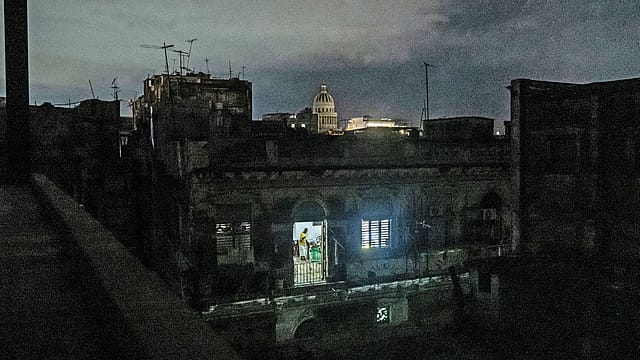
ON MARCH 16, 2026, the national power grid collapsed completely. Ten million people in total darkness. And this, finally, is worse than the Período Especial, worse than anything I witnessed in those years of mysterious meat and parked trucks and darkness as chronic condition. Not the rolling blackouts Cubans had learned to schedule their lives around, four hours here, six hours there, with the specific Cuban art of timing the cooking and the studying to the intervals of power.
The Malecón is in darkness. Havana, the most romantic city in the western hemisphere that has survived everything with its beauty more or less intact, reduced to what it would’ve been before electricity: candles in windows, people sitting in doorways, the sound of voices in the dark because the voices were all that still worked.
The CIA director flew into Havana with something that was described as negotiations and felt like an ultimatum. El Cangrejo—the Crab, as Raúl’s grandson Raúl Guillermo Rodríguez Castro is known—sits at the negotiating table with Rubio’s people, a Castro at the last table, trying to secure the terms of surrender while calling it something else. Trump says he will have the honour of “taking Cuba”, with the real estate man’s confidence in his own ability to acquire anything sufficiently distressed. “Whether I free it, take it—I think I can do anything I want with it.” A nation of 10 million people, reduced to an acquisition target.
In Morón, a provincial city in the interior, a place where nothing has ever happened, people set fire to a Communist Party office. In decades of revolution, this hadn’t happened. That we know of, that is. The party offices had been sacred, or at least feared, which amounted to the same thing. The fire in Morón was something more final than a protest. A statement that the fear had run out.
I think of Yosvany, who left in 1999 and now teaches jazz to Harvard students, returning to Marianao every year to visit his parents and preserve the Afro-Cuban musical traditions that he believes are more endangered than anyone admits.
I think of the tobacco farmers in Viñales, moving between the rows with that slow deliberate rhythm that has nothing to do with ideology, only with the pace that the plant requires. The mogotes throwing their shadows. The red earth. The particular quality of the light at four in the afternoon when it comes through the leaves at a low angle and makes everything look like a painting of itself.
I think of the dolphins in Santiago, circling in their lagoon, performing their politically incorrect domestication.
I think of my colleague, and the truck in the dark, and the piece of him that stayed on the asphalt.
Fui en el monstruo y como lo extraño.
The joke, of course, was never really about America. It was about the impossible position that Cuba has occupied for its entire modern existence: between the revolution it chose and the abundance it couldn’t have, between the pride of resistance and the exhaustion of what resistance costs, between Martí’s monster and the ordinary human desire for a refrigerator that works and a hospital with medicine and a road with lights and a future for your children that doesn’t require them to choose between compliance, prostitution, or exile through the open sea.
The monster is still there, ninety miles north, and Cuba is still inside it in every sense that matters, politically, economically, culturally, psychologically. What has changed is that the monster has decided, finally, to digest rather than coexist. The strangulation is deliberate, precise, calibrated: not a war but an energy bill, not an invasion but an oil blockade, not conquest (for now) but the patient application of leverage until the thing being leveraged snaps. Whether this is the snapping, whether the fire in Morón and the collapsed grid and the CIA director in Havana and El Cangrejo at the negotiating table add up to the final act or to yet another Cuban act of improbable survival, no one genuinely knows. My “man in Havana” says it’s over. Cuba has a long history of making people who thought they understood it look like fools.
What I know is this: the Malecón is dark tonight. The reef off María la Gorda is still there, intact, the silence underwater absolute. And on a highway somewhere between Havana and the east, in the darkness, there is probably still a truck parked across the road with no lights, waiting for whoever comes next.
Cuba does that. It keeps waiting. The question is what it’s waiting for.