The War President’s Silver Hoard in Greenland
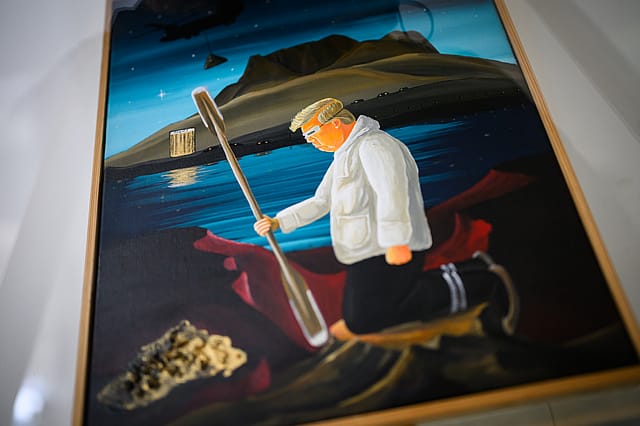
At the Davos Congress Centre on Wednesday 21 January 2026, at exactly 3:15 p.m. Central European time, Donald Trump entered a private room with NATO Secretary General Mark Rutte. A tense 47 minutes later, he emerged and published a statement that every cable news anchor interpreted as a retreat, a backing down, a capitulation to European pressure. But was that really the case? What Trump actually executed was the opening move in the largest strategic resource acquisition play by the US since the purchase of the Territory of Louisiana from the French in 1803.
The silver market understood it immediately. Within 18 hours, silver exploded from $96 to $110 per ounce, a $14 move, 14.6% in one week. But that's not the story. The story is what's happening beneath that price move. The story is that bullion dealers across the United States have stopped answering their phones. The story is that the Chicago based Comex vaults experienced the largest 7-day silver withdrawal in modern history. The story is that silver lease rates, the cost to borrow physical silver just spiked to 8% annualized. That is 16 times higher than normal.
But what did Trump actually reveal? Trump's statement published on Truth Social at 4:23 p.m. Central European time after his momentous meeting with Rutte stated, "Based upon a very productive meeting that I have had with the Secretary General of NATO, Mark Rutte, we have formed the framework of a future deal with respect to Greenland and in fact the entire Arctic region. Based upon this understanding, I will not be imposing the tariffs that were scheduled to go into effect on February 1st."
This was a very loaded statement. Trump didn't say that the deal was done. He said they formed a framework. He didn't say tariffs are permanently off the table. He said he will not be imposing them on 1 February 2026. The sub-text was conditional, temporary, and contingent. And then notice the scope; not just Greenland, but the entire Arctic region. Those are Trump's exact words. The entire Arctic region. That means Alaska; Canada's Northern Territories; Russia's Arctic Coast; the Northwest Passage; every shipping lane, every mineral deposit, every strategic position from Greenland to the Bering Strait. Trump is not negotiating access to an island. He is announcing that the United States through NATO is making a strategic play for control of the Arctic; the entire Arctic continental area.
Now, if you're a casual observer and in Davos having a winter holiday at taxpayer’s expense and with only a passing knowledge of geopolitics, you probably heard no tariffs and moved on with your seminars and parties during the rest of the day. But if you were an institutional buyer, if you were a serious sovereign wealth fund, or if you were a strategic procurement officer at Google or Apple or the US Department of Defense, you heard something completely different. You heard that the United States is about to secure mineral rights to US$1.5 trillion worth of rare earth elements. The United States is about to deploy advanced military infrastructure across the Arctic. The United States is about to control shipping routes that cut Asia to Europe transit times by 40%.
In a CNBC interview 30 minutes after his statement, Trump was asked directly, "What does this framework involve?" He laid out three components. Number one, mineral rights in Greenland for the United States; number two, deployment of what he called the Golden Dome Missile Defense System across the Arctic; number three, total access to Greenland for American military and strategic purposes. The interviewer then asked the obvious question, "Does this mean the US is buying Greenland?" Trump paused. You can watch the video. After 4 full seconds of silence he said, "It's a long-term deal. It's the ultimate long-term deal. I think it puts everybody in a really good position."
Here is what Trump didn't say. Trump didn't say no. Trump didn't say Denmark retains sovereignty. He said it's a long-term deal. And when pressed for specifics, he said, quote, "It's a little bit complex, but we'll explain it down the line." That is not the language of someone who abandoned his objective. That is the language of someone who found a different path to the same destination. Here's the confirmation. Another 30 minutes later, Mark Rutte, NATO Secretary General, was interviewed by Fox News and asked the same question. Will Denmark keep sovereignty over Greenland under this framework? And Rutte said something that should have crashed the dollar immediately. He said that issue did not come up anymore in his conversations that afternoon with Trump. Did not come up anymore? If one parses the term “anymore” it means it came up before. That means sovereignty was on the table. That means Trump and NATO discussed transferring or sharing or redefining Greenland’s status.
Could it be that the issue of Greenland’s sovereignty was off the table because Trump and Rutte reached an understanding. What understanding? Nobody but the proverbial fly on the wall knows. Trump said it's complex and he'll explain later. But here's what we do know. If the US gets mineral rights, if the US gets total military access, if the US gets to deploy strategic infrastructure, then sovereignty on paper becomes irrelevant. The US controls Greenland in practice, even if Denmark owns it in name. And why does Greenland matter? Not because of ICE. Because of what's under the ice?
And that is an estimated US $1.5 trillion in estimated rare earth mineral deposits. These include such exotically named elements like neodymium, praesidium, dysprosium, and terbium that are critical for permanent magnets and electric vehicle motors, critical for wind turbine generators, critical for advanced electronics, critical for military applications. China currently controls 80% of global rare earth refining capacity. If the United States secures Greenland's deposits, that monopoly breaks. But extracting those minerals, processing them, and building the infrastructure requires massive industrial metal consumption. And the single most critical industrial metal for high-tech applications is silver. Silver is the most electrically conductive element on Earth.
And that's when the import of Trump’s announcements sank into the rest of the world. Silver closed that day 21 January 2026 at US$96:40. Things were peaceful and quiet. The next morning in the US On Thursday, 22 January at 7:30 a.m. US Eastern time, silver opened at US$98:35. The waters were still calm. Then at 9:15 a.m., something happened. A massive order hit the Chicago Comex. 12,000 contracts were placed in 4 minutes. Now, let me explain what that means. One silver futures contract equals 5,000 ounces. 12,000 contracts equals 60 million ounces. 60 million ounces of paper silver bought in 240 seconds. Neither was that a retail investor, nor was that even a hedge fund; that was strategic, institutional buying. That means whoever was buying wasn't trying to get a good price. They were trying to get the metal or exposure to the metal at any cost. When institutional players stop caring about price when they just hit market to buy and absorb everything available, it means they have information or they have fear or both. And what could cause that level of urgency? What could make sophisticated players with billions of dollars abandon price discipline and just buy? The answer is simple. They understand what Trump's framework actually means.
Trump signalled that the United States is making a play for control of or at minimum, significant influence over the entire Arctic. And why? Because climate change has melted enough ice that the Arctic is now economically viable. Massive oil and gas reserves that were previously inaccessible are now extractable. And most importantly, rare earth mineral deposits worth trillions of dollars are now economically feasible to mine and process.
The Arctic is the next great resource frontier. It's the 21st century equivalent of the scramble for Africa in the 1800s or the race for oil in the Middle East in the 1900s.Whoever controls the Arctic controls a massive portion of global industrial production for the next century. Trump knows this. China knows this. Russia knows this. That's why all three countries have been militarizing the Arctic for the past 5 years. Russia has built dozens of military bases along its northern coast. China has declared itself a near nation. Even though it's nowhere near the Arctic and has been deploying icebreaker ships and research stations, the United States has been expanding its Alaska installations and conducting joint exercises with NATO partners. And now Trump just announced that NATO is forming a framework to secure the entire Arctic region for the West. That is not a minor diplomatic move. That is a declaration of strategic intent. And strategic intent requires strategic materials.
Silver is a strategic material, not gold. Trump indicated that he is willing to use NATO as a tool for resource acquisition. He's willing to blow up decades of diplomatic norms to achieve strategic objectives. And if he's willing to do that with close allies like Denmark, what does that mean for the stability of the global system? It means the global system is not stable anymore. It's contingent. It depends on whether Trump gets what he wants in any given negotiation. And if he doesn't, he's willing to impose tariffs, sanctions, or worse. That is not a stable environment for international business. That is not a stable environment for global trade. That is not a stable environment for the dollar. And when dollar stability gets questioned, when the reserve currency becomes a political tool rather than a neutral medium of exchange, capital flees to assets that can't be manipulated by politicians like Trump.
Trump has fundamentally changed the US strategic posture in a way that requires massive consumption of industrial metals. Silver is the most critical of those metals. Because silver powers the 21st century economy. Solar panels use silver. Electric vehicles use silver. AI data centres use silver. Missile defense systems use silver. Power grids use silver. 5G networks use silver. Medical equipment uses silver. Consumer electronics use silver. There's no modern technological civilization without silver. And there's not enough of it. The deficit is structural. The demand is accelerating. The supply is fixed. And Trump just added a geopolitical crisis on top of an already tight market.
Trump's framework is intentionally vague because it's not yet a deal . It's the structure of a negotiation that might lead to a deal and negotiations can fail. Denmark's foreign minister has already pushed back. He said Denmark won't negotiate if it means compromising sovereignty. Greenland's prime minister said the same thing. So, there's a very real possibility that Trump's framework collapses, Europe refuses to cooperate, and the entire crisis reignites. If that happens, if negotiations break down, the market will interpret it as the United States couldn't secure the Arctic through diplomacy. So, it might use other means. These other means could include anything from economic coercion to military posturing to unilateral action, all of which would be extremely bullish for gold and silver because all of which represent political instability, dollar weakness, and potential conflict. On the other hand, if negotiations succeed, if Trump actually, gets mineral rights and total access to Greenland through NATO, then the industrial demand story outlined above becomes a reality. Decades of pent-up demand for silver will become a reality. Prices will be volatile. And that's also bullish for silver because it confirms the supply deficit is about to get exponentially worse. In both cases, success or failure, silver prices will go up.
For us in India, what does this mean? Did any of the Indians present at Davos ponder over these developments? Instead of fantasising about putting Trump in his place, New Delhi should be working on understanding how this scenario will play out. The India-EU FTA is indeed a big achievement; but it is not an end in itself. There is a bigger game on with very high stakes. Do we want to join in?