The Siege Within
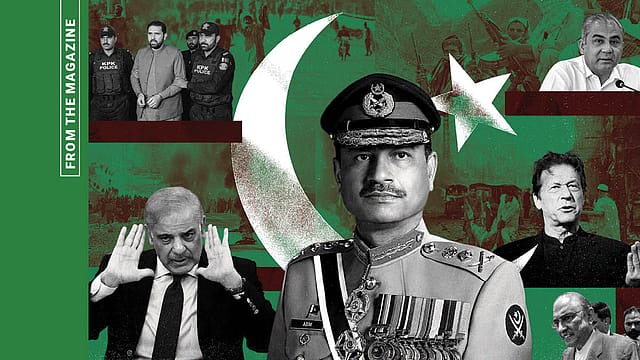
Early on October 11, Sohail Afridi was taken into custody in Peshawar, Pakistan, after security officials broke down his door. Afridi belongs to the Pakistan Tehreek-e-Insaaf (PTI) party and lasted less than a year as chief minister of Khyber-Pakhtunkhwa (KP) province. Soon after he was detained, President of Pakistan Asif Ali Zardari dismissed the provincial government citing, among other reasons, “a surge in terrorist attacks on infrastructure, government installations and law enforcement agencies.”
KP is the fourth territory in Pakistan to experience political turmoil in the last one year. Balochistan, a province that has been restive since Partition, is controlled only by military means; Pakistan-occupied Kashmir (PoK) has witnessed mass protests as economic conditions deteriorated there, leading to demands for political accountability and even secession from Pakistan. The same story was repeated in Gilgit-Baltistan, a predominantly Shia-Muslim area that has been buffeted by economic problems. KP has for long seen violence due to the conflict in Afghanistan. But ‘terrorism’ was just an excuse to dismiss the PTI government.
These ‘reasons’ are unlikely to find purchase with anyone, least of all the people of Pakistan. A week before the PTI government was dismissed, workers and supporters of the party began a march from Lakki Marwat in KP. By the time the march reached Swabi, 100 km from Islamabad, the government was dismissed. The marchers were demanding better medical treatment for Imran Khan, the founder of the party and former prime minister, who has been in jail for more than three years after he was dismissed from his position. The way Khan has been treated—or maltreated—has led to consternation not just within his party but among the people of Pakistan as well. Khan was the first politician who did not belong to the Bhutto and Sharif dynasties to become prime minister in many decades.
The fact is that KP has always seen elevated levels of violence. Since 2004, there has not been a single year when fatalities due to terrorism have been in less than three digits. Even with these levels of violence, two distinct cycles of extraordinary levels of violence can be discerned. From 2007—when 1,922 persons were killed—to 2011, when 1,188 perished. In these five years, 2009 marked the peak of violence when 5,883 persons died. It is interesting to note that the most decried incident of violence—in 2014 when 149 persons, including 132 children were gunned down at a school in Peshawar, lay outside this five-year cycle of high violence.
The current cycle of high violence began in 2023—with 2025 witnessing 2,359 killings—but is nowhere near the violence that started in the early years of American occupation of Afghanistan and lasted until Barack Obama’s “drone war” ended with his first presidency. In 2009, when Obama became US president, 4,122 terrorists, along with 1,120 civilians were killed in KP.
It is no one’s case that governments step in to arrest violence only after the past peak of killings is crossed. But in KP, it is not the killings that have ever spurred any government, be it the one in Peshawar or the one in Islamabad. The reasons are political. Under the hybrid regime run from Rawalpindi, the generals are—once again—restive and want to bring ‘order’ in Pakistan, once and for all.
One plan, aired earlier in the year by Mohsin Naqvi, the interior minister of Pakistan, is to reorganise the existing provinces into smaller units so that current economic and political challenges could be handled better. While the idea was broached by a civilian, behind it lies a “barracks thinking.” Back in 1955, when similar problems existed, Pakistan was reorganised into “One Unit”. The four provinces in West Pakistan were grouped into one unit to provide ballast against Bengali-majority East Pakistan, present-day Bangladesh. The idea now, as then, is to solve political problems by administrative means.
The problems of KP and Balochistan are least likely to be solved by any reorganisation of Pakistan, its large provinces (Punjab and Sindh), or the smaller ones. Decades of misgovernance, destruction of civil liberties and the ‘disappearance’ of people from Balochistan and KP at the slightest pretext, have left economic grievances far behind the political ones and the latter have mutated into outright demands for secession. This has spread, in different degrees, to all provinces and territories barring Punjab. Dismissing a government that was elected barely two years ago will not solve anything, nor will imprisoning a dismissed prime minister.
This will not be the first time that Pakistan finds itself on an edge. Balochistan has seen multiple rounds of insurgency since 1947. But since the killing of Nawab Akbar Bugti in August 2006, the province has remained uncontrollable. Now, even the military finds it hard to keep order there. KP has been in similar flux for a while, and the dismissal of a popularly elected government will not help end ‘terrorism’ there.
Popular Pashtun leaders, such as Ali Wazir of the Pashtun Tahafuz Movement, remain imprisoned under one pretext or another. Instead, the hybrid regime searches for ‘effective’ leaders who will bring ‘order’. This is a contradiction in terms: the leaders who can restore order are least likely to be pliable, and those who are pliable are highly unlikely to have any influence among the people of KP.
Scholars, especially those in Western universities, often marvel at Pakistan’s survival in a state of self-organised chaos. There is nothing to marvel at, really. Pakistan has always found benefactors who help it survive, a helping hand that is not available to almost any other developing country.
Western powers are scared at the prospect of Pakistan’s destruction, their fear being the fate of the country’s nuclear weapons. China, even if it waives off the sunk costs involved in keeping Pakistan alive—even if in a zombie state—will keep on pouring money there as long as it can ‘balance’ India. What is needed to end Pakistan running like a centrifuge is an honest reckoning of its basis as a nation-state. So long that is missing, it will continue to remain on the edge.