The No-Peace, No-War Normal
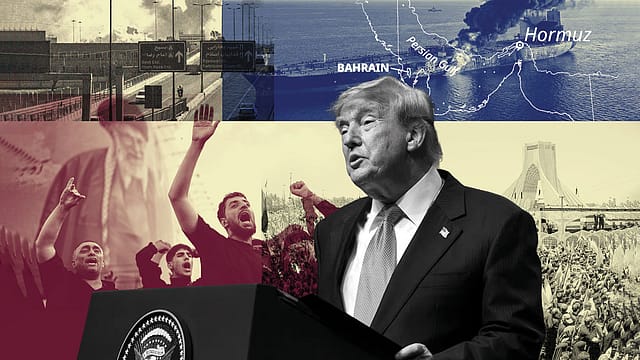
IRAN MAY HAVE miscalculated badly. The Islamic RevolutionaryGuardCorps (IRGC) overplayed its hand, thinking it was invincible, having survived 24,000 combined strikes by the US and Israel earlier. Iran felt the time was right to signal its intent to resume extracting its illegal toll from commercial shipping in the Strait of Hormuz. It couldn’t have been more wrong. Now, there is a particular quality to Donald Trump’s insults that separates them from ordinary diplomatic censure.
These are not measured, nor calibrated for an audience outside his head, and these tend, more oftenthan his criticsadmit, to double as a fairly accurate weatherreportonUSintentions. Whenthepresidentstoodbefore reporters at the NATO summit in Ankara and declared that he no longer wished to deal with Iran’s leadership because “They’re scum... they’re led by sick people and they’re vicious, violent people,” and that more talk was “just a waste of time,” it was tempting to see this as standard Trump repertoire.
Except this time his words preceded actual ordnance and a revocation of the oil sanctions waiver. Within hours, the US was striking Iranian military infrastructure and small vessels in and around the Strait of Hormuz. Tehran was firing missiles and drones at US outposts in Bahrain, Kuwait, and subsequently, Qatar. The 60-day memorandum that had ended the war was, in Trump’s words, “over”.
But the significance of this moment is not that the fighting resumed. The ceasefire had already been honoured mostly in the breach, punctuated since April by naval seizures, drone incursions, and tit-fortat strikes that never added up O P E N I N G S to peace and never added up to war either. The curious thing is that Tehran appears to have handed Trump the pretext he needed, at exactly the moment least advantageous to itself. And it seems to have misjudged what Trump’s response would be.
First the timing. Iran struck three commercial vessels transiting the Strait of Hormuz on July 7, in the middle of a six-day state funeral for Ayatollah Ali Khamenei, and while Trump himself was on a stage in Turkey, flanked by NATO heads of government, having just extracted a fresh $80 billion pledge on Ukraine from the alliance.
Trump loves such coverage, not least for the spectacle. According to a US official cited by news reports, it was precisely this sense of being upstaged and provoked on the world stage that tipped the presidential mood from irritation to fury and hastened the order for a fresh round of strikes. It doesn’t need a close psychological study of Trump to see Iran’s miscalculation: attacking commercial shipping is embarrassing to any US administration, but doing so while cameras from 40-odd allied capitals are trained on the man in the Oval Office is provocation, not negotiation. Whoever inside Iran’s fractured leadership approved the strikes on the tankers likely assumed Washington’s appetite for renewed confrontation was exhausted. It wasn’t. It had, if anything, been sharpened by six months of Tehran testing the limits of an agreement it never fully intended to honour.
The memorandum itself was a peculiar document. It was less a settlement than an agreement to keep arguing later, with just enough linguistic ambiguity to let both sides claim victory in the short term and blame each other for failure later. Article 5 of the 14-point text obliged Iran to make “arrangements using itsbesteffortsforthesafepassage of commercial vessels with no charge, for 60 days only,” after which Tehran is to “conduct dialog with the Sultanate of Oman to define the future administration and maritime services in the Strait of Hormuz... inlinewith... the sovereign rights of coastal states.” Washington’s negotiators were led by a vice president with no foreign policy background, a presidential sonin-law, and a real estate financier. They believed they had secured a permanently toll-free waterway, with Trump publicly promising exactly that in the days before the signing. Tehran read the same clause and concluded the opposite: that the 60-day window was a grace periodafterwhichitretainedthe righttocharge“maritimeservice fees”—its euphemism for toll in an arrangement in which Oman would be a co-beneficiary rather than a neutral broker. The text allows both readings.
Neither side bothered to resolve the contradiction before signing, perhaps because neither expected the truce to hold.
All of this only reinforces the fact that it is the Strait of Hormuz that has become the real fault line of this conflict. Not Iran’s nuclear programme, nor its missile stockpile, not even the smouldering war in Lebanon that the memorandum also left conveniently vague. Whoever controls the practical terms of passage through Hormuz controls a fifth of the world’s seaborne oil trade, and both partiestotheconflictunderstand this better than they understand each other. The Trump administration insists it will not permit Iran to “illegally control an international waterway”; Iran’s Foreign Minister Abbas Araghchi has said Tehran bears sole responsibility for the strait. TheMoU’slanguage, ifanything, tiltstowardIran’sinterpretation. Now, that’s an outcome that says less about diplomatic malice than about the inexperience of the people who drafted it.
Theeconomicconsequences, byany measure, have beensevere and oil prices jumped again. The International Energy Agency called the disruption the largest supply shock in the history of the global oil market. Brent crude, which sat below $70 a barrel before February 28, spiked towards $120 and jumped a further 5-6 per cent within hours of Trump’s declaration that the ceasefire was finished.
Gulf states dependent on Hormuz for the overwhelming share of their food imports faced genuine shortages; global bond markets sold off; economists again made comparisons to the 1970s oil shocks.
None of this seems to weigh particularly heavily on either side’s calculations, which is perhaps the most worrying aspect of the situation—that a conflict capable of reordering the global economy is being conducted with improvisational carelessness.
Weakened by the assassination of its Supreme Leader and much of its senior military command, by a currency in freefall, and by a January uprising crushed brutally, the regime in Tehran gambled that Washington’s patience for renewed war was as depleted as its own. It gambled wrong. Trump’s language—calling the regime “cancer” and that “you’ve got to cut out cancer early”—is not the language of a man interested in resuming talks on Iran’s terms, notwithstanding the ambiguous MoU.
It is the language of a man who believes he has been gifted the excuse he was waiting for. Whether that understanding survives the midterms, with America’s Gulf allies nervous about their own exposure, and with a public at home weary of Middle Eastern wars, is another matter. ButTehranwoulddowell to remember an old warning, one it has itself invoked often enough against its adversaries: those who mistake restraint for weakness generally discover the differenceonlywhenitistoolate to matter. Iran has been here before. The 444-day US embassy siege may have legitimised the Islamic regime at home but made it a pariah abroad and lost Iran billions of dollars in assets held abroad. It could have accepted peace in 1982 after the liberation of Khorramshahr but chose six more years of a devastating war with Iraq.
The truce being over may not mean a restart of war. But those are only words meant to calibrate rhetorical pressure on either side. The Middle East around Iran is in a no-peace, no-war equilibrium. It is likely to remain in it for a long time. Eventually, everyone will talk. But the missiles and drones won’t stop meanwhile.