The Message from Munich
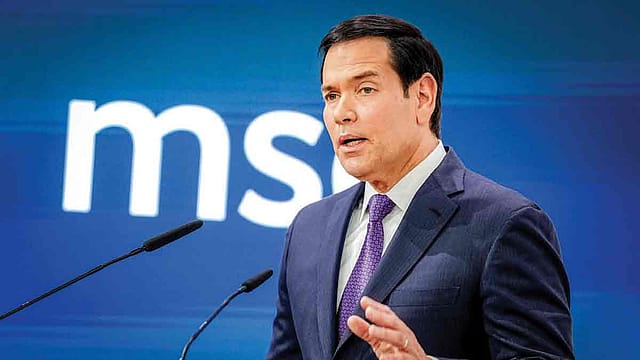
US Secretary of State Marco Rubio’s address at the Munich Security Conference was conciliatory and warm enough to earn him a standing ovation after Vice President JD Vance’s frontal attack last year but it changes little. Calling America the “child of Europe” and talking about “intertwined destinies” is one thing; warning about Western “civilisational erasure” against the backdrop of immigration is another. Europe simply doesn’t see itself as fundamentally white and Christian any more, unlike MAGA’s idea of America.
As German Chancellor Friedrich Merz and the UK’s beleaguered Prime Minister Keir Starmer made clear, certain red lines had been crossed (on Greenland and Ukraine) and the rulesbased, US-sponsored postwar order is dead. Europe must be more independent, spend more on defence— European Commission President Ursula von der Leyen talked about the mutual defence clause and Merz revealed Franco-German plansforanucleardeterrent— and on this the US and the EU areinagreement.
Washington may not want to be the caretaker of the West’s “managed decline” but Rubio’s strategic silence on Russia and China was evidence enough of reprioritised US interests. None of that changes the bottom line though: Europe can deploy words; the US will wield the power.
Alexei Navalny and the Kremlin’s Kill List

Sergei Yushenkov (politician, gunned down in April 2003); Alexander Litvinenko (FSB defector, died of polonium-210 poisoning in November 2006); Anna Politkovskaya (renowned investigative journalist, shot dead in October 2006); Sergei Magnitsky (lawyer, died in prison in November 2009); Natalya Estemirova (human rights activist, shot dead in July 2009); Boris Berezovsky (oligarch, Putinsponsor-turnedcritic, probablemurderinMarch 2013); Boris Nemtsov (opposition leader, shot four times in the back on a Moscow bridge in February 2015); Yevgeny Prigozhin (leader of the Wagner Group whose private jet exploded midair soon after his armed mutiny).
If that’s how Russian President Vladimir Putin’s prominent enemies exit the world, the evidence laid out by leaders of five European nations at the Munich Security Conference—that smuggled biological samples from Alexei Navalny’s body revealed epibatidine, a lethal neurotoxin found in poison dart frogs from South America— is more credible than Moscow’s allegations of propaganda. As is the conclusion that only the Russian state had the “means, motive and opportunity” to administer such a toxin from a source not native to Russia in a high-security prison and that it has violated the Chemical Weapons Convention. Only the naïve would have believed Navalny’s death in February 2024 in his arctic hell had nothing to do with the Kremlin.
China Misses Its Chance
Chinese Foreign Minister Wang Yi’s address at the Munich Security Conference presented Beijing’s competing vision against Washington’s, emphasising “harmony without uniformity” and insisting that China and Europe were not “systemic rivals” while the US and China needed to cooperate with “mutual respect”. But combined with Wang’s wolf-warrior warning to Japan over Taiwan— nobody really buys the fear of an expansionist Tokyo returning to militarism—European reception was mixed, reiterating that Europe’s ties to America were stronger, with Germany and France particularly sceptical about dependency on China despite the cordial talks on trade. At the end of the day, the melodramatic attack on Japan lost Wang an opportunity.