The Limits of Anti-Americanism
“W E’RE ALL ANTI-AMERICAN TODAY.” Thankfully no French newspaper has headlined the mindset of a world united by Trump tyranny with a modification of its famous 9/11 line: “We’re all American today.” Instead, it took the Canadian prime minister, one of the American president’s bona fide victims, to move the Trump-scarred liberal world with the eloquence of a morally lofty Lilliputian, styling himself as a representative of the “powerless” exuding the “power” of dissent, with a nod to Václav Havel. The Great Wall Against Trump Untamed has not materialised yet despite such a war cry, and despite words such as Venezuela, Greenland and NATO becoming synonyms for geopolitical rampage. There was the customary harrumphing in European capitals, and we read about a new resolve to unite and resist. Nothing more. Still, the rage against Trump has spawned the biggest wave of anti-Americanism with endorsements from world leaders.
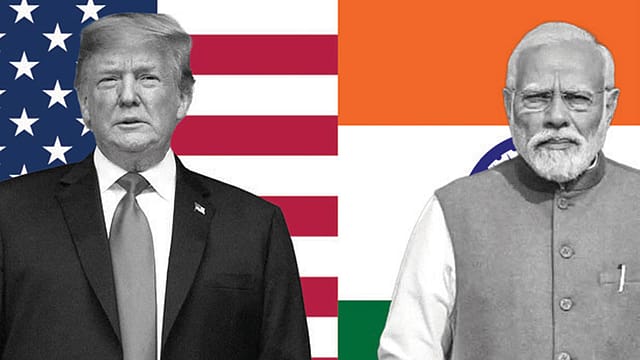
India was not out of it. When Donald Trump boomed in the aftermath of the Obama era, the Indian Right, thrilled by the sight of another outsider taking on the bloated establishment, was in the forefront of his global cheerleaders. The American too played his friend-of-India part to spectacular effect, what with his Houston appearance with Modi. For a while, he was India’s natural ally. In the larger storytelling of national conservatism, one could spot Trump, along with Orbán, as a consequential character, and there were any number of eager defenders of the MAGA faith from the Indian Right out there. It was as if Trump added an extra dimension of national interest to an ideology in search of icons. We were all Trumpistas, stressing the redundancy of anti-Americanism, and it was very conservative to be so.
It all changed with Trump redefining national interest with a tariff war he was determined to win, and he knew that a dealmaker would ultimately win any war in a world that values transaction over transnationalism. Instantly the Indian Right, too, became wilful subscribers to the so-called Trump Derangement Syndrome, and let loose their briefly suppressed anti-Americanism. Was it a case of the fickle ideological core of a supposedly intellectual community that made their faith conditional on the policy exigencies of a government they were obliged to support—and to the fluctuating nationalist extremism of a foreign government? Or was it that Americanism and anti-Americanism were convenient tags that can be attached to the shifting moods of power?
They seem to have abandoned anti-Americanism again after the government has reached a trade deal with Trump. The American president has been un-demonised overnight by the same people who, for a while, seemed to be working hard to reclaim the space long vacated by the Third Worldists of the Soviet era. It was not that Trump’s America was spared the rhetorical purgatory; it was that certain things remained constant even as the prefix to Americanism changed according to the political weather.
One such constant was the Modi government. Unlike some of its supporters from the rightwing chattering class, it has never shown itself to be an advocate of anti-Americanism, even after Trump’s tariff attack. Modi’s India stood up to Trump’s bullying with its national honour intact, without joining the international chorus on the American threat to the world order—or without mouthing platitudes on international law. They were two nationalists at play. The American, epitomising kitschy flamboyance, took such a view on national interest that the traditional American ideals of internationalism suddenly looked outdated. For him, a full realisation of America’s power required a president like him who was not apologetic about America First—and Foremost. The Indian, unarguably the most popular leader in a liberal democracy, is a nationalist with patience, a long ranger playing to history, not to the next headline. Modi, wiser than most of his supporters, refused to match Trump’s extreme Americanism with anti-Americanism. Modi’s India has gone past that ism, Trump or no Trump.
Elsewhere in Europe, anti-Americanism, despite its cultural roots, is maintained by leaders who are fast losing the ground beneath their feet. The laboured unity on Trump Unhinged has no practical relevance as it amounts to nothing more than anti-Americanism as political desperation. Trump may have fetishised ‘strength’; anti-Americanism’s European apostles have institutionalised weakness.
Unity in Europe, even if it excludes Trump as a catalyst, doesn’t translate into power, and not merely military. Isn’t the EU a fine example of the most regulated union of nations? Now it is faced with an America that, defying tradition, dares to regulate freedom under a president with a monarchical ego. It is an unequal face-off, and, at most, Europe can win an argument with no impact on the ground. Maybe we are back to the old salon of dissent, whether in the East or the West, talking anti-Americanism with an American accent. An ism that has been rejected by civil societies and cultural choices is left with only a battle as temporary as Trump to win.