The Globetrotter: A New Front in Europe?
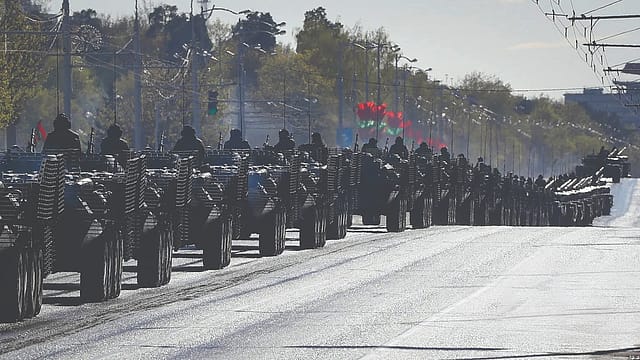
Something has shifted in Europe. Not war itself but the anticipation of it. Belarusian troops massed near the Suwalki Gap this week, the 65-mile seam stitching the Baltic states to the rest of NATO, a corridor where Russia doesn’t need a blitz but just fog, forest and time. European capitals reacted promptly with French President Emmanuel Macron convening intelligence chiefs while the UK told its citizens to stockpile tins and water. Germany readied hospital beds. Switzerland, neutral for centuries, drafted a defence doctrine. However, it’s Estonia that keeps the closest watch, sitting nearest the border, thinnest on strategic depth, within artillery reach of a great power that has never fully reconciled itself to Baltic independence. Analysts have long argued that Moscow need not invade outright. A probe, a provocation, an ‘accident’ could do the job. This is the doctrine of ambiguity: sabotage, drones, denial. Test NATO’s nerves without tripping its treaty. Deterrence, then, becomes rehearsal. NATO now studies Kyiv’s improvisations under fire: grids, hospitals, communications, a society built to absorb shock without fracture. Whether Washington still means its guarantee remains the unspoken question. But Europe, for the first time in 30 years, isn’t waiting to find out.
German Reckoning

September 20 delivered Chancellor Friedrich Merz humiliation, not merely setback. His Christian Democrats were shut out of Mecklenburg-Vorpommern’s parliament, a first for the party, as the AfD claimed its second state triumph this month. Berlin told a different but equally uncomfortable story, with far-left Die Linke’s resurgence eclipsing a diminished CDU. Merz himself conceded the results amounted to disaster, his party ground down between opposing extremes. Calls for his resignation have already begun though he shows no sign of yielding. What matters beyond Germany is the pattern: a centre unable to hold, flanked on both sides, in the continent’s most consequential democracy and biggest economy.

Zeroing In on ECI
09 Oct 2026 - Vol 05 | Issue 41
Constitutional legitimacy versus political opportunism
The Resurrection of Liberace
His trick was glitter as armour. A boy from Wisconsin, raised on hard graft and a father's French horn, turned himself into a spectacle so total nobody thought to look beneath it. Capes. Rhinestones. A grand piano lit like an altar. But Wladziu Valentino Liberace, who became music’s most famous mononym, could play. He debuted with the Chicago Symphony before turning 21, and then chose glitz over the concert hall—coldly and commercially. Critics sneered and called him vulgar. Audiences, mostly women, mostly older, didn’t care. They adored him because he seemed safe—with his secret hiding in plain sight. The lie cost him nothing in his lifetime and everything posthumously. Liberace had sued the Daily Mirror, lied under oath, and won in 1959. He denied his homosexuality till death—from an illness he refused to name—forced the truth into daylight. I’ll Be Seeing You, a major new stage play written by Martin Sherman and co-directed by Alan Cumming, exploring Liberace’s life, was overdue. In an age loosened from the shame that built Liberace’s cage that life reads ifferently. Not as tragedy. Nor farce. But as something closer to defiance: a performer who understood exactly what his audience needed and gave it to them while keeping his real self his own.