The End of NATO?
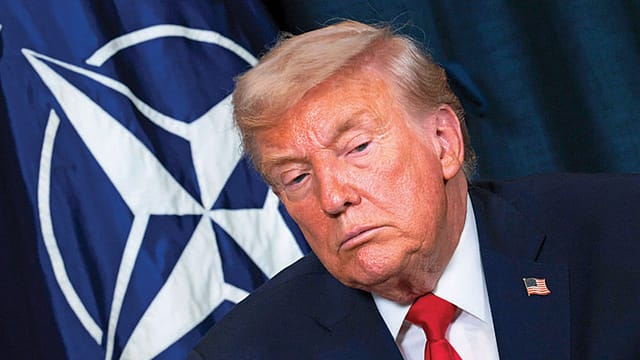
Donald Trump’s repeated attacks on the North Atlantic Treaty Organization (NATO) have acquired a sharper edge since he returned as US president. In his first term, Trump’s grouse against NATO and its member countries was that they were not spending enough on defence and were “free riding” on the US to get security in Europe.
In Trump’s second term, these attacks have taken a wayward direction. Just months earlier, Trump’s plans to take over Greenland from Denmark, the country that exercises jurisdiction over the territory, put NATO into an unprecedented crisis. What would, or more precisely, what should, the group do in case two member countries came to blows? That moment of peril passed without a test. But that does not mean NATO is out of the woods.
On April 1, British Prime Minister Keir Starmer openly said the US-Israeli war on Iran is not Britain’s war. Similar sentiments have been expressed in different forms by other NATO members. It is not that “mission creep” is unknown to NATO. Its nearly two-decade-long involvement in Afghanistan, a theatre of war removed from Europe, and its defence is a well-known example. But involvement in Afghanistan could be justified even if the logic behind it was stretched. After all, Al Qaeda and its form of terrorism threatened the entire West. It’s not sure if this can be applied to Iran, a “war of choice”.
Perhaps the world is now entering a phase of competition between nation-states after globalisation had reduced the salience of inter-state competition. At one level, there is room for collective security between like-minded countries. But at another level, inter-state competition is going to re-acquire its pristine, dog-eat-dog, nature that realist scholars of international relations had always highlighted. The problem for NATO is that it is an organisation geared towards a threat from a single source—Russia—that was almost eliminated but again brought back to life due to American mistakes in the 1990s. Now a very different American leader wants to weaken the organisation that is best suited to manage that threat.