The End of a Romance: Washington is rewriting its India playbook
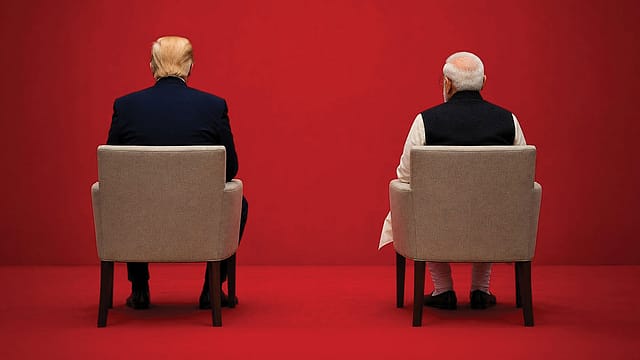
GRAND STRATEGIES OFTEN evolve through quiet policy adjustments long before they are openly articulated. That is what is now happening to America’s India policy, which is quietly but fundamentally being rewritten.
For over two decades, a rising, democratic India was viewed by Washington as an inherent good—an economic and military counterweight to an expansionist China. Successive US administrations forged closer ties, making the relationship a rare pillar of Washington bipartisanship.
The strategic romanticism that characterised the Indo-US partnership has given way, with Washington rewriting its India playbook. The shift is marked by coercive diplomacy, a revived US “tilt” toward Pakistan and a structural accommodation of Beijing. India’s role is beginning to shrink in American strategy.
Under successive governments this century, New Delhi has invested heavily in the strategic partnership with Washington, betting that closer ties would aid India’s economic and strategic rise and translate into greater American sensitivity toward India’s concerns in its own neighbourhood.
India still sees the relationship as vital to its long-term interests. It shares important geopolitical interests with the US—from combating terrorism to managing China’s rise to preserving stability in the Indo-Pacific, a region that already generates about half the world’s GDP in purchasing-power terms and over a third in nominal terms.
Washington, in turn, has long recognised India’s importance: its size, geography astride vital sea and energy lanes, military reach, and achievements in space and science make it central to any stable balance of power in Asia. At a time when other important economies are slowing, India remains the world’s fastest-growing major market—a magnet for American exporters.

Starting with Bill Clinton, successive US presidents deepened ties with India, creating one of the few reliably bipartisan threads in American foreign policy. Relations peaked during Donald Trump’s first term, aided by his rapport with Prime Minister Narendra Modi, whom he visited in February 2020 for the largest rally any American president has addressed.
More consequential than the personal chemistry was the substance: Trump’s first administration gave India pride of place in its Indo-Pacific strategy, reversed 45 years of American policy by naming China a strategic adversary, and cut security aid to Pakistan over its terrorist ties.
Trump’s return to the White House in January 2025 was expected to build on that legacy. Instead, ties have sharply deteriorated, as even sympathetic observers acknowledge.
A US Congressional Research Service brief notes that “President Trump since May [2025] has taken actions that observers say put the partnership at risk.” Jarringly, this shift has coincided with a more accommodating Trump approach toward China and an embrace of Pakistan—a striking reversal of his first-term posture.
MUCH HAS BEEN said about how Trump’s public insults and tariff weaponisation have strained ties with India. But the relationship was already under pressure before his return to the White House.
The first cracks appeared under President Joe Biden. Biden’s abrupt decision to withdraw US forces from Afghanistan and thereby cede the country to the Pakistan-backed Taliban, followed by a US-led proxy war against Russia over its invasion of Ukraine, created strains in the relationship between the world’s most powerful and most populous democracies.
India, like US partners such as Israel and Turkey, stayed neutral on the Ukraine war—as it had during the earlier US-led invasions of Iraq and Libya. Washington nonetheless tried to bully New Delhi: Biden’s top economic adviser Brian Deese warned that “the costs and consequences” for India’s neutrality would be “significant and long-term.”
India’s neutrality in the Ukraine conflict marked just the beginning of a series of disputes that roiled the bilateral relationship. Despite greater US weapons sales to India, like the $3.8 billion drone contract in 2024, it became apparent that the once-blossoming strategic partnership between Washington and New Delhi was fraying.
The bilateral tensions burst into the open when India’s governing BJP publicly accused the “US deep state” of using “false narratives” to destabilise India and its business conglomerates. Some US statements during India’s months-long 2024 national election process, by echoing Indian opposition parties’ positions, were viewed by the BJP as an unacceptable attempt to interfere in the world’s largest democratic exercise.
Biden may have praised Modi’s role in strengthening ties, but he and other prominent Democrats barely disguised their antipathy toward what they saw as his Hindu-nationalist brand of politics.
After Modi’s re-election in mid-2024, the Biden administration’s final months brought further strain, including its support for the violent overthrow of Bangladesh Prime Minister Sheikh Hasina’s India-friendly government—seen by many in India as a US-sponsored “colour revolution.” Bangladesh’s descent into Islamist violence since then has threatened India’s security, given that India already hosts millions of undocumented Bangladeshi migrants.
Other US moves also cut against India’s regional interests. While propping up Pakistan’s military-backed government after the ouster of elected Prime Minister Imran Khan, Washington sought to topple Myanmar’s junta through sanctions and “non-lethal” military aid to rebels, whose cross-border arms smuggling has fuelled ethnic conflict in India’s Manipur state.
Two US indictments deepened the mistrust. In October 2024, the US filed an indictment against a former Indian intelligence officer over an alleged foiled plot to kill Gurpatwant Singh Pannun, a New York-based Khalistan militant wanted in India on terrorism charges. Weeks later, Pannun openly warned Air India passengers that their lives were at risk while threatening not to let the flag carrier operate anywhere in the world.
The Pannun case came a year after Canadian Prime Minister Justin Trudeau’s bombshell accusation, made on the basis of US-shared raw intelligence, of a “potential link” between Indian officials and the 2023 killing of Hardeep Singh Nijjar, another Khalistan militant India had designated a terrorist.
Washington’s clumsiness peaked in September 2024, when the White House hosted and briefed US-based Khalistan separatists hours before Modi arrived for the Quad summit in Biden’s hometown of Wilmington, damaging strategic trust.
Weeks after the Pannun indictment, Washington charged Asia’s second-richest man, Gautam Adani, chairman of the Adani Group, with fraud centred on alleged bribery in India—a move widely read in New Delhi as an indirect strike at Modi, given the tycoon’s role in showcasing India’s global rise through major infrastructure projects at home and abroad and his personal ties with the prime minister.
Together, the Adani and Pannun cases hardened a view in India that the US legal system had increasingly become an instrument of Biden-era foreign policy.
These strains in ties with Washington reinforced New Delhi’s imperative for strategic hedging. They also helped spur an agreement with Beijing in October 2024 to ease the prolonged Himalayan standoff triggered by China’s stealth territorial encroachments in eastern Ladakh in April-May 2020.
Any expectations that Trump’s return would revive the halcyon days of his first term were quickly shattered. Instead, Trump has directly overseen a rapid deterioration in bilateral ties.
The defining turning point occurred in May 2025 during Operation Sindoor—a calibrated Indian military response to a brutal Pakistan-sponsored terrorist attack. Rather than supporting a partner fighting cross-border terrorism, Trump boasted that he deployed coercive leverage to force India to halt its counter-offensive in just three and a half days.
This heavy-handed intervention shielded America’s longstanding major non-NATO ally from the consequences of its cross-border terrorism and severely undermined the foundation of Indo-US strategic trust.
Pakistan, a hub for UN-and US-designated terrorist groups, remains an epicentre of international terrorism. The US softening toward Pakistan was visible within weeks of Trump’s return. Indian euphoria over Modi’s February 2025 White House visit, however, obscured the signs.
Trump’s global aid freeze that same month carved out a conspicuous exception of $397 million in security assistance for Pakistan. His March 2025 address to Congress pointedly praised Pakistan for helping arrest a wanted terrorist. Then came an investment deal in April 2025 between Pakistan and World Liberty Financial, a crypto firm largely owned by Trump’s family. And when Trump unveiled his travel curbs targeting 39 countries, Pakistan was oddly exempted.
The classic balance-of-power playbook is being resurrected. By propping up Pakistan financially through IMF bailouts and modernising its F-16 fleet (which also serves as Islamabad’s nuclear delivery vehicle), Washington is consciously reviving Pakistan as a subcontinental counterweight to block India’s regional pre-eminence.
Operation Sindoor thus only confirmed the return of the Cold War-era US “tilt” toward Pakistan—one dating to 1971, when President Richard Nixon’s administration was complicit in Pakistani military genocide during the Bangladesh war of liberation.
THE MOST PROFOUND indicator of India’s strategic demotion in America's Asia strategy is conceptual. The Pentagon’s recent removal of the prefix “Indo” from “Indo-Pacific” marks a shift from a decade of values-based coalition-building toward a narrower and more overtly transactional framework.
The colder, transactional approach to India is also underscored by Trump’s second-term National Security Strategy, which—unlike its 2017 predecessor—barely mentions India or the Quad, framing the relationship with New Delhi in narrow terms of “improving commercial relations.”
Nothing illustrates the shift better than US Deputy Secretary of State Christopher Landau’s blunt admission in New Delhi in March that Washington will not repeat its China mistake by letting India freely develop and outcompete the US economically. According to the State Department transcript of his remarks, Landau declared: “India should understand that we are not going to make the same mistakes with India that we made with China 20 years ago in terms of saying, ‘we are going to let you develop all these markets,’ and then, the next thing we know, you are beating us in a lot of commercial things.”
For two decades, the dominant Washington narrative held that a rising, democratic India was inherently good for the free world—a counterweight to an increasingly autocratic China. Landau’s remark shattered that romanticism. Washington now views China’s US-aided rise as a strategic blunder that hollowed out America’s industrial base, and it does not intend to repeat that mistake with India.
Put simply, India is no longer viewed in Washington primarily as a strategic partner to be promoted, but as a potential economic rival whose rise is to be quietly constrained, lest it threaten long-term US interests. This harder line is apparent well beyond economic and trade issues. Across India’s immediate neighbourhood, US policy no longer hesitates to work against India’s regional interests.
In effect, Washington is declaring that “America First” applies to friends as much as foes.
Rather than treat India’s rise as good for Asia’s balance of power, the US now aims to manage that rise so India does not become another China. India is to be cultivated as a captive market for American weapons, energy, electronics, consumer goods, and farm products, but restrained—through tariffs, tech-transfer limits, regional balancing and direct geopolitical pressure—from becoming an independent power that undercuts American manufacturing and strategic interests.
The “shared values” framing (the world’s oldest democracy meeting its largest) was useful for building consensus during the partnership’s build-up phase, but the current US administration has no appetite for values-based diplomacy.
The era when India could assume that deepening its partnership with Washington would guarantee advanced technology is over. This reliability crisis is vividly evident in the defence-industrial sector. The failure of General Electric (GE) Aerospace to deliver contracted jet engines has severely crippled India’s indigenous fighter programmes (Tejas Mk1A, Tejas Mk2, and Advanced Medium Combat Aircraft, or AMCA).
Hindustan Aeronautics Limited (HAL) has physically built and flight-tested about 30 brand-new Tejas Mk1A airframes that are sitting on the tarmac, completely finished, yet lacking engines. With fewer jets on the flight line, the Indian Air Force has been compelled to employ heavier and far more expensive twin-engine fighters like the Su-30MKI to fly routine Combat Air Patrols (CAP) over contested borders like the Line of Actual Control (LAC) with China. This burns through their airframe life prematurely and stretches India’s regional aerial deterrence dangerously thin at a time when neighbouring air forces are rapidly inducting modern 4.5 and 5th-generation platforms.
The irony is bitter: while India’s deterrence is undermined by broken US commitments, Washington has actively modernised Pakistan’s F-16s, making them more lethal against India.
To a transactional Washington, India’s insistence on strategic autonomy, particularly its refusal to cut historical ties with Russia, no longer reads as a defensible diplomatic tradition. It is viewed as fully justifying Washington treating India as a giant market to be deeply penetrated, not a partner whose rise deserves encouragement. The deeper shift, then, is fundamental, not simply a loss of romanticism.
By dropping “Indo” and treating New Delhi with transactional bluntness, Washington signals that its goal is also to use India just enough to keep China occupied—without letting India rise too far.
It is, thus, scarcely a surprise that Washington has systematically deprioritised the Quad. It now favours newer plurilateral groupings with a clear military orientation, like the “Squad”. Unlike India in the Quad, the “Squad” members—the US, Japan, Australia and the Philippines—are all formal treaty allies explicitly aligned on hard defence.
The Quad was conceived as a strategic bulwark against Chinese expansionism. But with Trump pursuing a bilateral accommodation with Xi Jinping—symbolised by his May 2025 Beijing visit—America’s broader Indo-Pacific strategy has been quietly sacrificed.
The bluntest reality is India’s demotion in US strategy from “linchpin” of the Indo-Pacific order to “localised actor” in South Asia and the Indian Ocean.
Under the “free and open Indo-Pacific” framework championed by the late Japanese Prime Minister Shinzo Abe and embraced by Trump’s first administration, India was elevated to a global player and treated as a necessary counterweight to China across the commons. Dropping the prefix “Indo” from “Indo-Pacific” lowers that expectation.
As Defence Secretary Pete Hegseth noted at the Shangri-La Dialogue, Washington now sees India as a strong country “acting in its own self-interest” to maintain a local balance of power in South Asia and the Indian Ocean. In other words, India is no longer a central pillar of a grand Asia-Pacific strategy, but a player confined to the subcontinent and the Indian Ocean.
For nearly a decade, New Delhi used the “free and open Indo-Pacific” strategy to press Washington to respect its regional red lines, including sidelining Pakistan until it cut ties with terrorist proxies. By quietly dismantling its Indo- Pacific strategy, Washington has freed itself of the obligation to show such sensitivity. And for more than two years it has pursued policies in India’s neighbourhood that cut against core Indian interests.
Washington has gone further still, re-embracing Pakistan as a “pivot state” and signalling support for a US-China “G2” that would jointly manage the global order. Since last autumn, Trump has repeatedly referenced a “G2” framework.
The deterioration is now unmistakable—from Trump’s 2025 launch of an economic war on India by imposing 50 per cent per cent tariffs to the US Navy’s recent killing of three Indian sailors in international waters. Ironically, the US Navy enjoys peacetime logistical support at Indian ports under the 2016 Logistics Exchange Memorandum of Agreement (LEMOA).
Washington is meanwhile pressing New Delhi to finalise a bilateral trade agreement that would open India further to American exports even as US policy weakens India’s economic strength, regional security and strategic autonomy. This leaves India little choice but to hedge by accelerating self-reliance and courting alternative partners.
THE US ASSISTANT secretary of state for South and Central Asia, S Paul Kapur, has repeatedly said Washington’s primary regional objective is to prevent any single power from dominating the subcontinent—an objective many in India see as mirroring China’s own strategy of keeping India boxed in. That objective also closely fits the textbook definition of offshore balancing: a great power relying on regional proxies and strategies to check the rise of a potentially dominant regional power.
Across India’s own neighbourhood, the US and Indian interests are diverging sharply—in Nepal, Bangladesh, Myanmar, Sri Lanka, the Maldives, Pakistan and Afghanistan alike. The paradox is stark: the two countries remain global partners, yet their interests clash in India’s own strategic backyard, raising an uncomfortable question: how can the US be a true global partner if it works against India’s core regional interests?
In India’s own backyard, Washington is positioning itself as a counterweight not only to Beijing but increasingly to New Delhi as well. One telling example is Nepal, a country linked to India by a nearly 1,800-kilometre open border, deep cultural and economic ties, and millions of resident migrants. Nepal has long been central to India’s security calculus.
Yet Washington is increasingly treating Nepal as a standalone priority rather than an adjunct to India policy, with senior US official visits to Kathmandu growing more frequent and often bypassing the customary diplomatic stop in New Delhi.
Washington’s policies in India’s immediate periphery are increasingly at odds with New Delhi. India’s regional influence has already been eroded by China’s expanding footprint across the subcontinent, and now it faces America’s lengthening shadow as well.
Washington views a more pluralistic subcontinental order as more conducive to its interests, aligning with its broader preference for balancing rising powers. It is thus staking out its own space and leverage in countries that India has traditionally seen as within its exclusive sphere of influence.
That logic helps explain why Washington endorsed Bangladesh’s 2024 regime change, even as New Delhi recognised the risks it posed to India’s eastern flank, given the porous border. Bangladesh’s slide into Islamist violence, including attacks on religious and ethnic minorities, has deepened those concerns. The February 2026 election—held after the Awami League, the party that led Bangladesh to independence in 1971, was banned outright—lacked any semblance of democratic legitimacy, yet Washington stayed conspicuously silent.
Compounding these concerns is Washington’s re-embrace of Pakistan, despite the country’s longstanding nexus with terrorist groups. As the Trump family’s crypto venture secured lucrative deals with Islamabad, Pakistani army chief Asim Munir staged what amounted to a constitutional coup. Closer US-Pakistan ties are reviving strategic dynamics that India had hoped were permanently receding into the past.
It appears that Washington is dusting off its Cold War-era balance-of-power playbook, rediscovering Pakistan’s value as a subcontinental counterweight to India, which also explains the Biden administration’s modernisation of the Pakistani F-16 fleet. No wonder the F-16 modernisation evoked Cold War memories of the US arming Pakistan against India and supporting the initial development of the Pakistani nuclear weapons programme.
Washington’s leverage over the IMF has repeatedly rescued cash-strapped Pakistan from default—25 IMF bailouts since 1958, including a $7 billion programme in 2024, more than any other country. With American and Chinese support, Pakistan also exited the “grey list” of the Paris-based Financial Action Task Force (FATF), the inter-governmental agency combating terrorist financing and money laundering.
Unsurprisingly, Pakistan’s salience in US policy has been rising, which also facilitated Islamabad’s recent role as a US backchannel to Tehran. Meanwhile, Western actors have begun rehyphenating India and Pakistan, including under the guise of promoting India-Pakistan dialogue through sponsored Track II initiatives.
Compounding the uncertainty is Trump’s more conciliatory China policy since mid-2025. Trump has largely moved away from the US strategy of countering the challenge from an expansionist China with support from allies and strategic partners. Indeed, Trump’s talk of a US-China “G2” may have led directly to the Pentagon’s name change from Indo-Pacific to Pacific, a term long preferred by Beijing, making the US decision look like a major concession to China’s worldview.
Lopping off the “Indo” and narrowing the horizon back to the Pacific conceptually pushes India out of the primary equation, moving the US closer to the bilateral, transactional theatre that both Trump and Xi Jinping are more comfortable navigating. Washington today may no longer see its role as the anchor of a vast democratic coalition, signalling instead an acceptance of a more concentrated bilateral competition and cooperation directly with Beijing.
THE ERA WHEN India could assume that closer ties with Washington would advance its economic and strategic rise and boost its regional influence across Asia and the Pacific is clearly ending.
The US, instead of continuing to view India’s rise as advantageous for a stable balance of power in Asia, is veering toward an approach intended to manage India’s rise so that it does not emerge as another big-power competitor. Washington, in short, is shedding its benign view of a rising India.
For New Delhi, adapting to the new realities, including a diminished standing in US strategy, will require a significant change in thinking and approach. US policies perceived in New Delhi as systematically undermining India’s position in its own neighbourhood risk feeding tensions in a relationship still central to Asia’s future balance of power.
To advance its interests, New Delhi must urgently diversify its geopolitical portfolio and accelerate self-reliance. India’s influence in its neighbourhood will increasingly hinge on sustained economic engagement, political sensitivity toward adjacent states, and the ability to deliver tangible public goods that subcontinental countries find attractive. Such an approach offers the most credible way to push back against the expanding US and Chinese strategic shadows in its backyard.
Horizontal coalitions across the Indo-Pacific are also vital for New Delhi to enlarge its influence. India’s proactive engagement with important states across the Indo-Pacific will help it to play a bigger strategic role in this vast region, which is emerging as the world’s economic and geopolitical hub.
As governments across Asia and the Pacific seek to diversify rather than choose between Washington and Beijing, India’s independent posture makes it an exceptionally attractive partner. Modi’s recent trip to Indonesia, Australia, and New Zealand—securing missile exports and critical mineral pacts—exemplified the demand for a powerful, independent partner that refuses to force nations into a binary choice between Washington and Beijing.
Even without the US, India can help anchor a stable Asian balance of power by deepening hard strategic partnerships with other regional powers like Japan and Australia, who similarly fear a US-China “G2” framework. Japan remains indispensable to East Asian security; Australia is a vital strategic anchor in the southern Pacific; and India alone is capable of constraining China from the latter’s southwest. No US-China “G2” can substitute for that wider strategic geometry.
Washington’s India playbook has changed, and the romanticism is effectively dead. A realist India must now treat the US not as an assumed ally, but as a powerful, transactional actor to be managed alongside the other shifting variables of a multipolar Asia.