The Assassin’s Republic: Imran Khan is probably safer in prison than outside
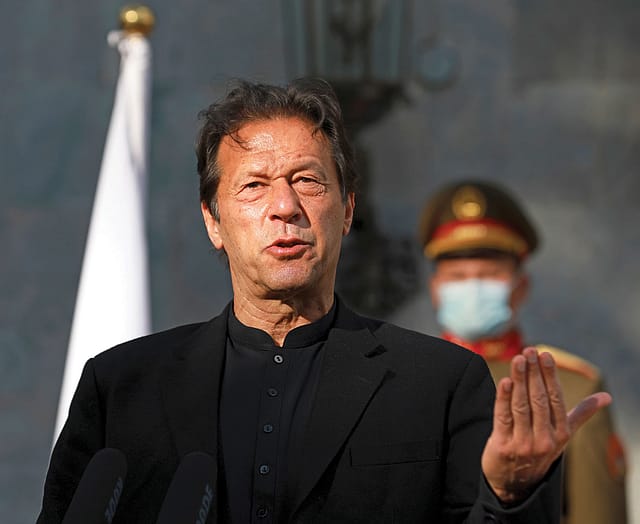
THERE MAY NOT BE SMOKE WITHOUT FIRE, but there can be fire without smoke. In the history of assassinations in Pakistan, no evidence is ever found of crime.
Fears about Imran Khan’s life are based on fact, not presumption. Every civilian prime minister of Pakistan has been killed, imprisoned, or exiled since its army seized power in 1958.
Sudden death begins at the beginning. The first prime minister, Nawab Liaquat Ali Khan, a Westernised aristocrat from Uttar Pradesh, was stopped by a bullet while trying to frame a democratic constitution. Shuja Nawaz, a historian whose brother rose to become Pakistan army chief, writes in Crossed Swords: Pakistan, Its Army, and the Wars Within that Liaquat was challenged by a coalition of army officers, bureaucrats and Punjab landlords who labelled him a weak ‘outsider’, a muhajir (refugee from India) with no base in the Pakistani provinces. He was neither a Punjabi nor a ‘tough’ autocrat, of the kind that appealed to the military-bureaucrat-landlord phalanx which argued that democracy was too ‘soft’ for an incipient, fragile nation. In parenthesis, Islam as a glue of unity began to wither from inception.
On October 16, 1951 Liaquat Ali Khan landed in Rawalpindi in the state Viking aircraft to address a public meeting at Company Bagh. He had just begun the speech to his “Muslim brethren” when one of the brothers in the crowd fired two shots. Khan was rushed to hospital. He did not survive. Police caught Said Khan, a resident of Peshawar. Instead of taking Said Khan to prison and trial, they killed him instantly. Said Khan was described as an Afghan militant, but no one bothered to explain what precisely this alleged militant was militant about.
Scotland Yard was asked to help in the subsequent inquiry commission, but its full report was never published. The chief investigator, Nawab Aitzazuddin, was killed in an “aircraft accident” just a few days after a synthesised “public version” of the report was released. The government said that all documents of the inquiry were destroyed in this air crash.
As conspiracies go, this was written in capital letters, with fingerprints removed.
Huseyn Suhrawardy and Liaquat Ali Khan, both Anglicised aristocrats who enjoyed a drink, were the principal civilian leaders of Pakistan after the death of Muhammad Ali Jinnah. They disliked each other. In 1950 Khan described Suhrawardy as the “dog let loose by India”, according to Memoirs of Huseyn Shaheed Suhrawardy. Suhrawardy came from an elite family which had lived in Bengal for two centuries without speaking a word of Bengali. He learnt the local language only when he discovered that Bengali Muslims were as passionate about their language as they might be about their religion. He spoke Bengali with an accent that amused or bemused the peasantry.

Suhrawardy, a democrat, had no chance of finding a berth in the power structure fashioned by bureaucrats and generals after the death of Liaquat. He was resurrected only when their amazingly arbitrary governments, infused with bitter antagonism, became chaotic. In October 1954 the civil servant Governor General Ghulam Mohammad abolished parliament and created a ‘Ministry of Talents’ with army chief Ayub Khan as defence minister, Iskander Mirza as minister for interior, and Suhrawardy as law minister. When this too imploded, Suhrawardy was asked to make sense of the shambles.
During his brief months as prime minister, Suhrawardy tried to empower Pakistan with a constitution and adopt a sensible foreign policy. He scorned the idea of a Muslim bloc, pointing out archly that no matter how many zeroes you added to zero the total would still be zero. The permanent state, not to mention the Islamist doctrinaires, quickly dispensed with a sensible democrat.
Iskander Mirza, who had appointed himself president, forced Suhrawardy to resign in October 1957. Students of Karachi University took out a full-page advertisement in the pre-eminent English daily Dawn inviting applications for the post of ‘temporary’ prime minister from applicants willing to get the boot without notice.
That was prescient. Since Suhrawardy, all civilians who have reached the top have learnt that the boot is worn by the army, and will kick at will.
On October 7, 1958, Mirza imposed martial law and named Ayub Khan Chief Martial Law Administrator. Exactly 20 days later, Mirza was ordered at pistol point to leave the country within 24 hours. He left hurriedly for London instead of an early grave. Suhrawardy was pushed out of Pakistan in 1962 on the charge of being anti-national when he was merely anti-army rule.
He died in a Beirut hospital.
The military-bureaucrat complex which seized power in 1951 has never surrendered it. When suicidal mistakes made army despots or their civilian dummies untenable, outsiders like Benazir Bhutto got brief spells of authority before being removed, and then killed.
The first military dictatorship ended in the misadventure of 1965, when Ayub Khan, encouraged by his egregious foreign minister, a young Zulfikar Ali Bhutto, lost the Kashmir war he had started. The people, fed up with lies, turned against him. Ayub Khan transferred power to the army chief, General Yahya Khan, who promised elections to assuage public opinion and could not survive the consequences. When Bengalis, denied their elected place in government, sought freedom, he ordered massacres, provoking a war with India in 1971 which ended in the triumphant emergence of Bangladesh.
Bhutto, once described by Suhrawardy as “a dock-side bully”, took over in what was now a moth-eaten Pakistan. Bhutto would go on to make more than one mistake but his fatal error was to believe that he had made the army subservient by appointing a seeming sycophant as chief.
General Zia-ul-Haq was a brilliant thespian, hiding his true ideology and intentions behind a mask of submission. In July 1977 he seized the opportunity offered by Bhutto’s growing unpopularity. Blessed with a subdued sense of humour, he called the second coup in Pakistan ‘Operation Fairplay’. His version of fair play was hanging Bhutto after a farcical trial.
THE ZIA CHAPTER ended in 1988 in an inexplicable plane crash. Mystery has become endemic in Pakistan. General Mirza Aslam Beg was the formal Army chief in 1988, reporting to Zia. Just before take-off, Zia asked Beg to accompany him. Beg, never known to say anything but yes to the Big Chief, declined. The inquiry into this crash was little more than an infructuous farce. The truth is clearly too injurious to the health of successors. It is remarkable how quickly a despot is forgotten. No one celebrated Zia’s 100th birth anniversary in 2024, not even the Pakistan army.
Zia had nurtured a young protégé, Mian Muhammad Nawaz Sharif, as the civilian face of army rule. Sharif was appointed finance minister of Punjab in 1981 and chief minister in April 1985. Benazir Bhutto inherited her father Zulfikar’s legacy; her tussle with the army and its acolytes like Nawaz Sharif consumed two decades of political upmanship after Zia’s death.
Aslam Beg, helped by fellow generals Hamid Gul and Asad Durrani, propelled Sharif to office by rigging the elections of August 1990. In 2012 they confessed from the comfort of retirement and sanctuary of old age that the polls had been manipulated. The 1990 honeymoon with Sharif was short. Sharif resigned in 1993. Benazir Bhutto won enough seats in the ensuing election to become prime minister. She could hardly last without the support of the cantonment although she did try to accommodate the generals. Sharif was back by 1997.
If this sounds complicated it is only because it is.
Sharif lost office through folly. He should have known that the generals were masters, not friends. In the spring of 1999, his army chief General Pervez Musharraf started a clandestine war with India by an offensive on Kargil in Kashmir. When, once again, Pakistan was defeated, Sharif presumed that he could hold a weakened military leadership accountable. On October 12, 1999 Musharraf’s troops climbed the walls of the prime minister’s residence and that was that. The third coup took Sharif to prison. He survived a death penalty only because of American President Bill Clinton’s intervention. King Fahd then brokered a deal by which Sharif was exiled to Saudi Arabia after promising to abandon politics. Naturally, that was easier promised than done.
The challenge to Musharraf, who led Pakistan into a putrid mess, came from Benazir Bhutto. In 2007 she was 54 years old. The people were elated by her return; the generals apprehensive. The unprecedented crowds at her rallies sent shivers across the officers’ club. She escaped an attempt on her life on October 18. Benazir told colleagues and journalists that if she lost her life, the true assassin would be Musharraf.
Rawalpindi is a cantonment city, home to the general headquarters of the Pakistan army. Two men, one armed with a gun and the other with bombs, killed Benazir Bhutto on the evening of December 27, 2007 while she was campaigning for the January 8 elections.
No one knows their names, and no one will. The street on which her blood was spilt was hosed clean with water soon after the attack. No traces. No evidence. Benazir Bhutto’s party won the elections and a non-entity, Yusuf Raza Gilani, was sworn in. Musharraf resigned in August 2008 before he could be impeached. Gilani lasted till disqualified by the Supreme Court in June 2012.
Nawaz Sharif had also tried to return in 2007 but failed. By 2011 he had made a deal with the permanent establishment and was back in Pakistan. He won the elections in 2013 with help from his old friends. Once again, the equation soured over the next thousand days; corruption was added to the usual reasons.
The generals needed a new face as much as the people, who were weary of shenanigans. Imran Khan, debonair cricket hero and London socialite in his youth, now a convert to “Islamic pseudo-socialism” in his rhetoric, was the only card left in a tired pack. Imran Khan has had a phenomenal life, but the biggest phenomenon might be his third marriage, to Bushra Bibi, née Bushra Riaz Wattoo, then 47 years old, on February 18, 2018. Bushra claims to be a mystic who brings good luck. She persuaded Imran Khan that he would never become prime minister until he married her. He did, breaking a few Sharia taboos along the way. Six months later he was prime minister. He won the August 2018 elections through what his opponents described as a “manufactured verdict”. In Pakistan, security at voting booths is controlled by soldiers, not the police.
Among his first appointments was an unknown General Asim Munir, who became head of ISI on October 25, 2018.
Imran Khan has enormous self-belief layered on exceptional charisma and courage but does not quite possess the acuity of the political class or a deep understanding of Pakistan’s complex power system and the international forces that have helped to keep Pakistan intact. He began to believe that he could govern on his own terms, backed by popular support. There will be another occasion to examine his years in office, if not always in power, but since August 2023 he has been in jail, serving a 14-year sentence for corruption.
Imran Khan ventured into territory that made his survival incompatible with seven decades of Pakistani foreign policy. Carried away by an immature Islamism he sought to dilute his country’s dependent relationship with America. He described the terrorist icon Osama bin Laden as a martyr, shaheed, and blamed America for the wars in Afghanistan and Iraq.
President Donald Trump, then in his first term, lashed out, saying Pakistan had not done “a damn thing” for America. Trump, unable to resist hyperbole, was articulating the growing frustration in the Pentagon and the State Department. In Imran’s calculation, Pakistan had lost 75,000 lives and $123 billion in American causes, although of course he never detailed the arithmetic of either.
Imran Khan departed from the Jinnah doctrine when he rashly asserted that Pakistan would no longer act as America’s “hired gun”: Jinnah and his successors had exacted a high price for this hire. In August 2021, Imran celebrated America’s hurried departure from Afghanistan as liberation from the “shackles of slavery”. The alarm in Washington grew when Imran Khan became the first Pakistan prime minister to visit the Kremlin in two decades, on February 23, 2022. The timing could not have been worse. It was at the onset of Russia’s war against Ukraine. On March 7, 2022 Washington conveyed its concerns about Imran Khan’s neutrality on Ukraine.
On March 8, Shehbaz Sharif, the present prime minister, moved a no-confidence resolution in the National Assembly against Imran Khan. On March 27, Imran alleged a foreign conspiracy to remove him, describing the new ally of the Sharifs, Asif Zardari (husband of the late Benazir Bhutto) as a “Mir Jafar”, the Bengali Nawab who supported Robert Clive during the battle of Plassey in 1757. In April 2022 the Sharifs and Bhuttos were in office. In January 2024 Imran Khan was convicted of betraying secrets, corruption, and unlawful marriage to Bushra.
Moscow is not on Field Marshal Asim Munir’s travel schedule.
The army’s verdict has also come in. On December 5, 2025 their spokesman Lt General Ahmed Sharif Chaudhry said that Imran Khan was “mentally unstable” and a “narcissist” because he had “spread poison against the army”. You must be a bit mad in Pakistan not to recognise the place of the army in the power structure.
Imran Khan is probably safer in prison than outside. The street, as his Oxbridge colleague Benazir Bhutto discovered, is crowded with assassins.