The Age of Coercive America
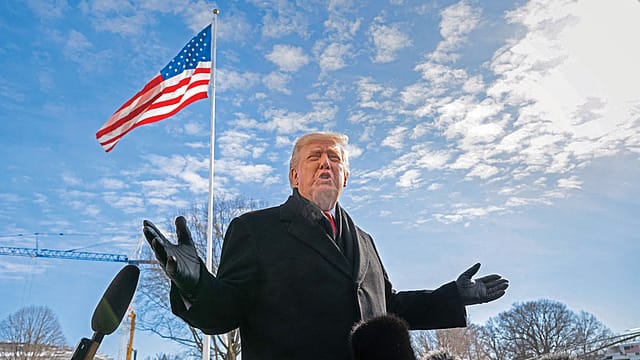
WHEN DONALD TRUMP RETURNED to the White House, many foreign governments assumed his second term would simply mirror the first—more noise, more tariffs, more brash moves, but no fundamental break. They misjudged him. In its first year itself, Trump’s second presidency has redefined the norms, institutions and expectations that have governed international politics since the end of the Cold War.
What once looked like impulsive theatre has hardened into a governing philosophy. Unpredictability is no longer a quirk of Trump’s personality; it is a strategic tool he deploys openly. Norm violations are no longer tactical deviations; they have become a defining feature of American policy.
The result is a more transactional, coercive and personalised global order. In this order, power is asserted directly, institutions are circumvented or stripped of authority, and stability is offered only in exchange for submission.
More fundamentally, Trump is not simply eroding the international order. He is attempting to construct an alternative in its place.
FROM DISRUPTION TO DOCTRINE
During Trump’s first term, allies and adversaries alike learned to discount much of what he said. Tweets contradicted policy. Threats were issued and withdrawn. In his second term, however, the pattern has changed. Disruption itself has become US doctrine. His administration now treats uncertainty not as a risk to be managed, but as leverage to be exploited.
This shift is visible across domains. Trade policy is no longer governed primarily by economic logic but wielded as an instrument of political coercion. Diplomacy is no longer mediated through institutions but centralised in the president himself—his whims and fancies, and his efforts to expand an already-sprawling personal business empire. Military power is no longer restrained by concerns of legitimacy but openly deployed to assert control over other states’ resources and territory. Soft power—the quiet, accumulative influence of norms, culture and credibility—has been dismissed as weakness.
The pattern is unmistakable. Trump no longer seeks to lead the international system; he seeks to dominate it, transaction by transaction, deal by deal.
Nowhere is this shift clearer than in trade. By weaponising tariffs, Trump has ushered in an era of what Western executives now call “tariff roulette”.
Tariffs have been moved from the margins of economic policy to the centre of American statecraft. On April 2, 2025—branded by the White House as “Liberation Day”—he invoked America’s International Emergency Economic Powers Act (IEEPA) to impose a universal 10 per cent tariff on all imports. This was not a negotiating tactic aimed at reforming rules; it was a unilateral assertion of power.
Targeted tariffs have gone even further. These measures are not calibrated responses to unfair trade practices but punitive tools meant to force capitulation. Worse still, they are unpredictable. Announcements are frequently made with little warning, often through social media, leaving governments and firms scrambling to respond.
Months after concluding a trade agreement with South Korea, Trump abruptly raised US tariffs on South Korean goods from 15 per cent to 25 per cent. His tariffs on India now exceed even those imposed on China, America’s principal strategic rival. Agreements offer no insulation; strategic partnerships provide no security.
The economic effects are already evident in the US. Business confidence has been shaken by the inability to plan investment or supply chains amid sudden policy reversals. Inflationary pressures have intensified, with US personal consumption expenditures projected to rise by more than three per cent. Confronted with policy-driven volatility, the Federal Reserve has kept interest rates on hold to avoid amplifying uncertainty.
The deeper damage, however, is systemic. The global trading system depends less on low tariffs than on credible commitments. Trump has shattered the expectation that the US will adhere to predictable, norms-based processes. In its place, he has delivered a stark message: stability is available only through direct, bilateral concessions to Washington. Multilateral rules no longer protect; they merely delay punishment.
RULES GIVE WAY TO RAW POWER
If weaponised trade represents the economic pillar of Trump’s new order, the creation of the ‘Board of Peace’ is its institutional centrepiece. Launched at the World Economic Forum in Davos, the Board is presented as a bold alternative to what Trump calls the United Nations’ (UN) “permanent failure” to resolve modern conflicts.
The contrast could not be sharper. The UN, for all its flaws, derives legitimacy from process: universal membership, formal rules and a (sometimes paralysing) commitment to sovereignty and law. The Board of Peace rejects this model entirely. Membership is selective, reportedly contingent on substantial financial contributions. Decision-making authority is centralised. Trump himself holds absolute veto power over its agenda, decisions and membership—and even the designation of his successor. In other words, the Board is effectively a one-man show.
What is being set up is privatised global governance. Conflict resolution becomes a pay-to-play enterprise, overseen by personal authority. Trump has said the Board will “work with” the UN. Yet he has also openly suggested that it could replace it. In practice, the Board is already a mechanism to bypass international law rather than enforce it.
Actions speak louder than words. When Trump arbitrarily rescinded Canada’s invitation to join the Board soon after its launch, he revealed its true nature: not a forum governed by rules, but a court governed by favour. The message to the world is that peace is no longer a collective good. It is a commodity, dispensed at the discretion of Washington.
Another dramatic shift in Trump’s second term has occurred in the Western Hemisphere. Long portrayed as an isolationist, Trump has in fact embraced a form of aggressive expansionism. The US is no longer merely asserting influence in the Americas; it is asserting ownership.
On January 3, American forces abducted Venezuelan President Nicolás Maduro by carrying out the first bombing of a South American capital in modern history. Trump subsequently declared that the US would “run the country and take its oil.” The statement was not a gaffe. It was a declaration of intent that is now being implemented. Proceeds from selling stolen oil are being deposited in a US bank account in Qatar, to be spent without US congressional approval. Venezuelan oil worth $500 million has already been sold, according to the White House.
The military action against Venezuela followed America’s largescale naval deployments in the Caribbean, its unilateral renaming of the Gulf of Mexico as the “Gulf of America”, and renewed discussions about annexing Greenland and reasserting direct control over the Panama Canal. These moves reflect a coherent worldview of the Trump administration: North and South Americas constitute a privileged zone of US control.
Trump has revived the Monroe Doctrine not as a warning to external powers, but as a licence for military intervention or political interference in other nations’ domestic affairs. Sovereignty, in this framework, belongs not to states but to those strong enough to enforce it. The language of partnership has been replaced by the language of possession.
As hard power has been elevated, US soft power has been systematically dismantled. Funding for USAID has been slashed. Voice of America has been effectively shuttered. Cultural diplomacy has withered.
Soft power does not coerce, but it shapes preferences. It reduces the cost of leadership by making influence appear legitimate. The Trump administration, however, does not regard soft power as an asset.
The US withdrawal from the World Health Organization (WHO) is emblematic. For decades, global health was one domain in which US leadership was uncontested. That leadership is now gone, surrendered not after debate, but by presidential decree.

America’s relations with Europe have also deteriorated sharply. The 2025 US National Security Strategy (NSS) describes Europe as a victim of “civilizational erasure” and calls for alignment with “patriotic” movements there rather than mainstream governments. Such ideological interference signals that, even in the Western bloc, shared values no longer bind. What matters is ideological affinity and transactional utility.
A WORLD REMADE
Taken together, these shifts amount to more than a change in tone. They represent a transformation in how power is exercised and justified. Trump’s second term has accelerated the erosion of an international system built on norms, institutions and predictability. In fact, he has stepped up efforts to replace it with one organised around coercion, personal authority and short-term gain.
In effect, Trump has not merely taken the world by storm; he is reshaping the environment in which global politics operates. And unlike the social-media posts that signal these changes, the consequences of his reshaping of international relations will endure.
It is against this backdrop that Canadian Prime Minister Mark Carney became the star at this year’s World Economic Forum at Davos with his remarkable candour in exposing longstanding Western hypocrisy and describing what a Trump-reshaped world meant.
Delivering a prepared speech, Carney declared, “We knew the story of the international rules-based order was partially false. That the strongest would exempt themselves when convenient. That trade rules were enforced asymmetrically. And we knew that international law applied with varying rigor depending on the identity of the accused or the victim. This fiction was useful. And American hegemony, in particular, helped provide public goods: open sea lanes, a stable financial system, collective security and support for frameworks for resolving disputes. So, we placed the sign in the window. We participated in the rituals. And we largely avoided calling out the gaps between rhetoric and reality. This bargain no longer works. Let me be direct: We are in the midst of a rupture, not a transition.”
The plain fact is that the new, Trump-driven order is not stable. It invites emulation by other strongmen. It encourages pre-emptive defiance by smaller states. It fragments global cooperation into spheres of influence governed by fear rather than trust. Yet it is coherent. And that coherence is precisely what makes it dangerous.
The most consequential legacy of Trump’s second term may not be the policies he enacts, but the precedents he sets. Even if a future US administration seeks to restore the old order, it will confront a world that has already adapted to its absence. Once credibility is lost, it cannot simply be reclaimed by presidential proclamation.
INDIA AS THE PIVOTAL SWING STATE
No country is more exposed to—or more consequential for—the world Trump is remaking than India. As the world’s largest democracy, its fastest-growing major economy, and a central node in Indo-Pacific strategy, India now finds itself cast not as a partner in a US-led order but as a swing state in a coercive, transactional system.
Trump’s second term presents India with a paradox. On one hand, Washington sees New Delhi as indispensable to balancing China. On the other, it treats India less as a strategic partner than as a negotiable asset—subject to tariffs, pressures and episodic favours. The result is a relationship marked by simultaneous courtship and coercion.
Trade policy illustrates the dilemma starkly. India has sought deeper economic integration with the US but instead it has faced some of the steepest tariffs imposed by the Trump administration—higher even than those levied on China. Market access is dangled not through long-term accords but through ad hoc bargaining. Stability in the bilateral relationship is conditional.
Strategically, India is being pulled into a vision of order that sits uneasily with its own traditions. Trump’s disdain for multilateral institutions and his open embrace of unilateral force clash with India’s longstanding emphasis on strategic autonomy and international law. The creation of new international bodies such as the Board of Peace, governed by personal veto rather than collective legitimacy, places India in an awkward position: participation may offer influence, but at the cost of endorsing a precedent that weakens the very norms India has relied upon as a post-colonial power.
There is also a deeper reputational risk. As Trump reframes global politics as a contest among civilisational strongmen, democracies are valued less for their institutions than for their utility. India is courted not as a democracy but as a counterweight. This instrumentalisation erodes the moral capital that once distinguished democratic alignment from mere alliance.
Trump’s second term is also reshaping the triangular dynamic among China, India and the US—a strategic triangle that is central to Indian interests. Washington now frames its India policy almost exclusively through the prism of countering Beijing while simultaneously undermining the norms and institutions that once sought to constrain Chinese power. The contradiction is stark: the US asks India to assist American strategy in Asia even as it legitimises unilateral pressures on New Delhi to compel shifts in trade, energy and strategic policies.
For China, Trump’s unilateralism is an opportunity to step up its own coercive and expansionist policies, especially against its neighbours, including India. It is also an opportunity for China to quietly expand its influence in institutions the US has vacated.
For India, the triangle is more perilous. It faces sustained pressures from China along the Himalayas and via surrogate Pakistan, yet it is being asked by Washington to align with an American strategy that normalises spheres of influence and transactional dominance. In such a world, today’s partner can become tomorrow’s pressure point.
The erosion of a norms-based order challenges all middle powers like India that rely on predictability to balance asymmetry. As China’s immediate neighbour, India’s challenge is also to navigate this triangle without becoming locked into a logic where raw power becomes the only currency that matters.
India is not without agency. Precisely because Trump’s world is transactional, India’s choices carry outsized weight. Accommodation would signal that even the world’s largest democracy and most populous country sees no alternative to coercive bilateralism. Resistance—through diversification of partnerships, renewed investment in multilateral forums, and strategic patience—would suggest that the erosion of the old order is not yet complete.
More broadly, Trump has made one reality unmistakably clear: the post-World War II international order is no longer being quietly eroded; it is being openly displaced. Norms are giving way to deals. Institutions are yielding to personalities. Predictability is being replaced by leverage. This is a structural shift, which could gain permanence.
In this emerging order, the world’s future direction will not be determined solely by Washington or Beijing. It will also be shaped by the choices of key states that still retain strategic autonomy. Among them, none matters more than India.
India’s response to Trump’s world will signal whether the country that is home to 18 per cent of the global population believes that power without restraint is inevitable—or whether it still sees value in preserving norms that protect the weak from the strong. Alignment driven purely by fear or expediency would accelerate the very transformation that leaves all democracies more vulnerable. Strategic patience, diversification and selective resistance are likely to slow it.
Whether the 21st century tilts decisively towards coercion or retains space for constraint and norms may well depend on middle powers like India. India is no longer merely rising. It is deciding—by its economic and strategic partnerships and policy choices alike—what kind of world will rise with it.