Standing Up to Trump
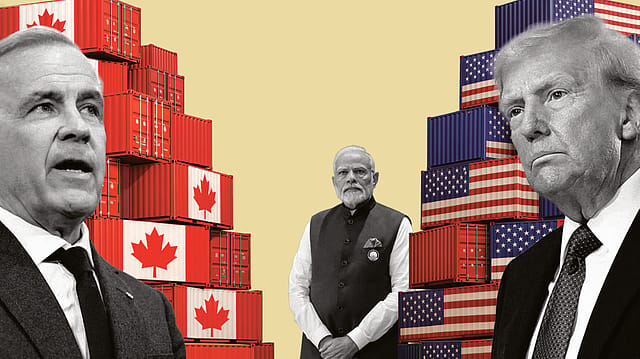
CANADA’S Finance and Revenue Minister François-Philippe Champagne has announced dollar-for-dollar and rate-for-rate tariff measures against American goods exported to his country. From September 8, Canada will impose counter-tariffs of up to 15, 25, or 50 percent on $27.6 billion worth of imports from the U.S. The statement, issued on August 26, comes just a week after Canada withdrew its negotiators from the now defunct trade deal being thrashed out in Washington DC.
This spat between allies turned into bitter neighbours should not be seen as a one-off event in an isolated geographic region. The way real (hot) wars and trade wars are being ignited across the world, at some point the risk that these events will become conjoined with other flashpoints should not be ruled out. The idea is no longer a far-fetched one.
What makes matters worse is the manner in which American leaders now blame other countries for their (US) problems— problems that are their own creation. To give one example, in an interview, former US Secretary of State Hillary Clinton commented that the key to Donald Trump to extricate himself from the West Asia war is India and China. “If you look at who buys the most oil and gas from Iran, it is China and India…it seems to me that’s where the best pressure will come from.”
The multiple inaccuracies and interpretative errors in the statement show how distorted the American worldview is when it comes to understanding the causes of their problems. For one, India bought an exceedingly small fraction of hydrocarbons from Iran during a 60-day waiver period earlier this year. Otherwise, it has not purchased any Iranian hydrocarbons since 2019 when the Obama administration, with Clinton as secretary, devised and implemented the restrictions on buying Iranian oil and gas. Most importantly, this is akin to blaming secondary reasons for America’s woes in West Asia while ignoring the primary cause: it was a war of choice, not necessity.
The example illustrates the wider problem: the US has too many issues on its plate and now these problems are likely to get entangled. The US’ primary problem is that it wants to limit China’s economic and military influence in the world. But China is now a near-peer in both. The US can no longer directly confront China and hence has to take recourse to ‘secondary’ measures. One alleged reason the trade deal with Canada collapsed was the American insistence on limiting Canada’s options on third-country trade deals. Given the history of Trump’s entanglements with Canada—from calling Canada an American state to the trade war—Ottawa is sensibly seeking to diversify away from the US. In the past year, Canada has signed multiple trade and security deals with different partners, a pace that was scarcely imaginable in an earlier era. There is no doubt that Canada will face economic pain in case of a trade war with the US. But the issue is now more than just a trade deal gone sour: the political friction now dominates the trade issue.
India faces the same situation. It was one of the first countries to approach the US on finalising a trade deal last year. Now, a year later, the deal remains in limbo even as bilateral relations have frozen in a manner that could not be imagined even five years ago. India is hardly an ‘accomplice’ with China in causing American woes, but it is treated at par with, if not worse than, China.
One could list numerous geographic locations where the US has created frictions with its friends—Europe (Denmark), Latin America (Brazil is an example), Asia (India), Canada and more— and none of these countries acted against American interests. Similarly, the hot wars where the US is involved directly and indirectly involve more countries and theatres of action than the US can effectively manage.
What began as a series of actions against China’s trade surpluses during the first Trump administration has now mutated into attempts to derail virtually any functioning economy on which Trump has set his sights. China not only has huge inventories of almost all varieties of goods but also has overcapacity in almost every part of its industrial sector. To top it all, Beijing believes only in selling to the world and not buying finished goods from anywhere.
Such imbalances in the global economy cannot be resolved by bluster or by harassing one’s trading partners and allies. Yet, that is what the US has done and now its political elite seeks to use coercion and diplomacy on third countries to overcome the primary problem.
There was once scope for concerted action to arrive at a solution to the world’s trading problems. This would have required US cooperation with multiple partners and a mix of carrots and sticks to China. Instead, what transpired were Trump’s incompetent attempts to get a ‘deal’ from China. This was nothing more than a combination of bluster and capitulation. Predictably, that went nowhere. It is unlikely to change, as long as Trump remains in command. He will continue doing more of the same.
Other countries, especially the “middle powers” like India, Brazil, Canada, and Finland are now exploring their options and cooperating with each other. They recognise that the architecture of global governance put in place after 1945 has all but collapsed. Yet, instead of adopting a dog-eat-dog approach, these middle powers seek a cooperative order. There are, no doubt, political differences between these countries, for instance, over the place of liberal democracy in the world. Yet, these are hardly deal-breakers. In a world where give-and-take must prevail over unilateral commands, respect for political differences is the starting point for moving ahead. Such political Manichaeism was one of the root causes of the current turbulence in the world. There are signs of greater understanding among the more rational Western countries on this front. Who knows? The world may heal itself.