Soul Searching In Japan
MOST JOURNEYS through Japan keep to Tokyo, Kyoto and Osaka, three cities within easy reach of one another, each burnished by the attention of millions. We spent 17 days in Japan this spring, and while the blossoms of Tokyo and the temples of Kyoto have already faded a little in memory, what has stayed is the country in their midst. We made our way slowly eastward through what the Japanese call the roof of their archipelago: the snow-bound spine of Honshu, where the rivers run icy with March melt, and many houses still wear thatch. When we arrived in Kaga from Kanazawa, the cherry trees were still holding their breath, and the willows were beginning to mist with new green. A shuttle from Kaga station delivered us to Yamashiro Onsen, a small spa town that has been receiving the weary for some 1300 years, and to Araya Totoan, a ryokan or inn that traces its history back some 800 years. It has hosted the lords of the Maeda clan, who governed Kaga as the wealthiest domain in feudal Japan, and the artist Kitaoji Rosanjin, who lived in Yamashiro in 1915 and carved its signboards. The rituals of arrival and departure here seem not to have changed for centuries—the shoes arranged toes-out by an unseen hand, the tea served on a lacquered tray, the bow at the threshold—even as the staff now carry small translation devices that murmur English back at our questions.
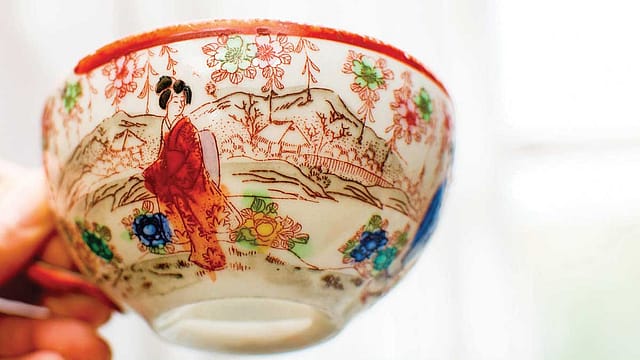
About a hundred thousand litres of water rise daily from the source of the onsen beneath the inn. Our room came with a Yoshino cypress wood bath of two tiers, fed from the spring, and set against a window that looked onto a small wooded slope. The water came in slightly mineral, slightly soft. Later, pliant from the heat, we worked our way through the ritual laid out at the vanity—milky toners, fine mists, drops of tsubaki, the camellia oil that has soothed Japanese skin and hair for centuries—before slipping into soft cotton yukata. Breakfast, the next morning, was a bowl of glossy white rice, a square of warm tofu with a curl of grated daikon, a small painted dish of bright pickles, a generous pot of miso soup with root vegetables simmered until they had given up their stubbornness, and a careful procession of vegetables. A Kutani teapot, striped in red, green and blue, sat to one side, ready to pour the Kaga bocha, the local tea made from the roasted stems of the first harvest.
Yamashiro is built around its source. A small fan-shaped plaza at its centre, paved in pale stone, holds the original spring, now a free foot-bath, and around it the willows and pines stand watch. The Kosoyu, the town’s restored Meiji-era bathhouse with a faintly stage-set air to it, dominates the scene. Here, a Japanese woman with a tripod was filming herself for an audience we could not see. Restaurants advertised elaborate coastal fare. Only a couple of shops sold expensive Kutani ware, a 17th-century porcelain mysteriously abandoned within 50 years and revived a century later in the bold five-colour palette it still wears today. At Araya, one quickly understood that the meal and the vessel are not separable propositions. The bowl proposes the dish. The dish honours the bowl. Together, they make an argument about a region. Kaga’s other great craft, Kaga Yuzen—the silk-dyeing tradition that has flourished here from the early 18th century—uses its own five-colour palette, indigo, crimson, ochre, dark green and purple, and paints its eaves with the small blemishes of real leaves, the insect bites and the natural imperfections, in the conviction that beauty without imperfection is not really beauty at all.

In the morning, we took the road south and east, toward the mountains. The drive from Kanazawa to Takayama is one of the most beautiful traverses in inner Japan. The road winds through Gokayama, through the Sho River valley, past clusters of gassho-zukuri farmhouses with their steep thatched roofs joined at the apex like hands in prayer. The name means exactly that: prayer-hands construction. The pitch of these roofs, at 60 degrees, is a lesson in physics. The valley gets two to three metres of snow each winter, and a sloping roof sheds the load before it can become a burden. Inside, the upper stories were historically used for sericulture—silkworms eating their way through stacked trays of mulberry leaf—while saltpetre was leached on the ground floor. The Kaga domain, in fact, accepted taxes from these mountain hamlets not in rice, but in paper, in silk, in ensho (saltpetre).
By afternoon, we were in Takayama, in the old merchant quarter of Sanmachi-suji, in the heart of what the Japanese call Hida, an old province name, still in current use, that gathers the mountain-locked country of northern Gifu under a single identity. The Hida region is famed for three things: its carpenters, whose skills were so prized that the Imperial court once demanded them as a form of tax in lieu of rice; its cattle, the marbled and butter-soft Hida beef; and its sake, brewed from rice and the clean, cold water that comes off the snowfields. Even in the shoulder season, Sanmachi-suji and its three preserved streets of dark cedar townhouses were full of tourists. The buildings themselves, some four centuries old, bore this attention with a slightly tired dignity. Sake breweries hung sugidama—great browning balls of cedar branches— from their eaves to signal the readiness of the year’s brew. Mid-afternoon hunger was then tackled with rice crackers and streetside mitarashi dango, small skewered balls of rice grilled and brushed with a sweet-salty soy glaze. In every shop window, at every corner, sat the region’s mascot: the sarubobo, a small limbless red doll with no face. The name means “monkey baby” in the Hida dialect. They were traditionally made by grandmothers for the children of the house as talismans. The absent face is deliberate: a sarubobo mirrors back whatever mood you bring to it, sad to the sad, glad to the glad. Our four-year-old, who has strong opinions about most things, approved immediately of a doll that withholds its own.
That evening, we drove into the high country to Hirayu, the oldest of the five hot-spring villages of the Okuhida Onsengo, where the Hoshino Group opened a new property in 2024. Kai Okuhida sits at 1,200 metres in a basin of the Northern Alps, and even in late March, the snow lay piled along the courtyard’s edges in soft grey ramparts, slowly conceding to the lengthening light. The inn is a thoughtful piece of regional showmanship. The headboards of the rooms were made of bent cypress in graceful, looping arcs; the cushions on the sofas wore a pattern called Hida-zome, dyed by a fifth-generation house in Takayama; the walls of certain rooms displayed fringe-edged panels in the translucent Hida-shunkei lacquer that lets the wood grain show through. Out front, a small foot-bath steamed into the cold air. At a short workshop one morning, the staff offered us a lesson in the technique of bending wood by steam and water. We each held up a thin slat of hinoki, dipped it into a basin of hot water, and waited. The aroma came up at once: clean, resinous, sweet, smelling like a temple just after it has been mopped. After a few minutes, we lifted the strip out and pressed it slowly against a wooden arch until it yielded. We had made a handle, which was the first half of an object. The second half was a furoshiki, the traditional wrapping cloth of Japan, printed here in a pattern called enishidare, suggesting the forests and mountains of Hida. Knotted through the handle’s holes, the cloth became a bag.
That evening, the inn prepared for us a vegetarian kaiseki of remarkable invention. A grilled tofu appetiser shaped like a flower, plated in a blooming caprese style. A clear soup of deep-fried tofu and burdock. A bejewelled platter of small seasonal delicacies—grilled green onion cake, steamed cake of tofu and Japanese yam, kanoko-style mashed green soy beans, kiwifruit dressed with creamy soy and sesame, mozuku seaweed in vinegar. Deep-fried tofu in rice batter, crunchy fried maitake, tempura, then a donabe with toasted crackers topped with rice and miso soup. Soy milk cheesecake and black sesame crumble, followed by a toasted marshmallow with sweet soy glaze, completed the meal. All served with a hospitality that ensured that even vegetarian guests in the high mountains did not feel out of place.
The next day, we drove higher still, to the Shinhotaka Ropeway, which climbs in two stages from the valley floor to a station at 2,156 metres—Japan’s only double-decker gondola, an engineering charm of the late twentieth century, still operating exactly as it ought. Through the windows, the Hotaka range opened out: Yari, Kasa, Nishi-Hotaka, peaks of three thousand metres draped in unbroken white, their snow-corniced ridges sharp against an immaculate blue. At the top, the network of walking trails was icy and unnavigable without crampons. That evening, slipping back into a hot spring for the third time in 12 hours, we warmed to the rhythms of Japan’s onsen country. You bathe before dinner. You bathe before bed. You bathe in the morning, before the light is fully up. After three days of this, your skin smells faintly of sulphur. To soak is to remember that you are made of water. To be heated, very slightly, beyond comfort, and then to return to coolness, is to undergo, in miniature, the entire human exercise of being alive. Travel of this kind does not deliver the obvious souvenirs, but one’s sense of a country begins to thicken. The roof and the heart of Japan, the inner provinces, the small towns kept warm by water from the earth, remind you that a country, like a person, is mostly what it does when no one is watching.