So Long, Marianne: France Is Falling, Again
The French are supposed to be pragmatic: when the going gets tough, it often helps to pack up and run. Or surrender. If you love your beautiful buildings too much, you may choose to let the Wehrmacht march in. That’s too harsh and not exactly how it happened, but the Third Republic was a nation divided at its darkest hour in June 1940. There’s no comparison between then and now, and yet the Fifth Republic—built to last—is facing its toughest test, an existential crisis, right now. And that isn’t an exaggeration.
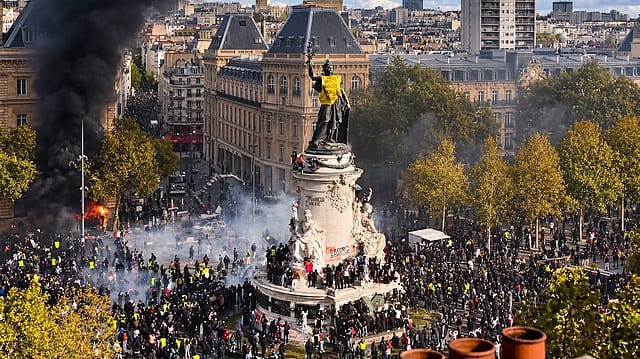
It began with leaking roofs. In mid-September, students in Paris started barricading their lycées over crumbling buildings, holes in classroom walls and too few teachers. It was a modest and specific grievance. Within weeks it had spread to other cities and drawn in teachers, pensioners, unions and the resurgent Gilets Jaunes (Yellow Vests). In places it curdled into violence: on October 5, a 15-year-old lost a hand in a clash with police. France was already on the edge but it still wasn’t Saturday, October 17.
When Saturday came, more than half-a-million marched, most of them peacefully. But by nightfall, the country was reliving something it believed it had outgrown.

Around 1,500 shops and businesses were looted or wrecked, nearly 2,400 people were arrested, and about a thousand police officers were injured, seven seriously. A 19th-century town hall in Limoges was gutted; a historic tourist office burned in Lyon; and in Marseille, a bust of Marianne, the personification of France, was thrown from its plinth. Disorder at such scale stunned the Republic as it woke up on Sunday to pick up the pieces. This time, the mayhem had reached far beyond the suburbs.
Zeroing In on ECI
09 Oct 2026 - Vol 05 | Issue 41
Constitutional legitimacy versus political opportunism
Precision is usually the first casualty of such days. There were actually two protests on Saturday. One was a democratic assembly of citizens exhausted by rising prices and failing public services, grievances the government itself concedes are real. The other was a parallel enterprise of black-clad militants and, by late afternoon, opportunist looters, who treated the marchers as cover. There’s nothing pedagogical about smashing a bank. Those who walked peacefully were robbed twice: of their safety and then of the argument they came to make.
The state failed in its job again even if it wasn’t exactly caught napping. Interior Minister Laurent Nuñez’s teams had forecast 200,000 demonstrators; more than 550,000 turned out on the streets. In Marseille, one company of riot police, about 85 officers, faced some 30,000 people in the city centre. Nuñez conceded a “lack of anticipation” and that police lost control in some cities. He offered his resignation, which President Emmanuel Macron refused to accept.
Nuñez’s gesture was honourable, but Macron’s refusal tells another story. A president short of allies cannot afford accountability. So, he defers it. The National Assembly’s speaker has naturally called for an inquiry.
But it is the far-left that has drawn the worst kind of state and public attention to itself. It cannot escape scrutiny after Saturday. Prime Minister Sébastien Lecornu accused Jean-Luc Mélenchon’s La France Insoumise (France Unbowed) of spending weeks sowing distrust of the police among students, and of an “ultra-left” that struck before the marches had even begun. Mélenchon, for his part, did condemn the looting but in qualified terms, saying it has no place in the left’s fight. Within hours he was blaming the government’s “incompetence”. Not every broken window is his doing, but a movement that trades in contempt for the police cannot feign surprise when contempt transmogrifies into a crowbar.
The rhetoric of rupture is not without consequences and the arsonist’s defence that he only supplied the matches never convinces anyone, certainly not a scared and scarred public.
The riots also showed that the street is now the presidential campaign.
With the election some six months away, Marine Le Pen, who leads the polls, posted a presidential-style address before the tricolour, denouncing a “Macronist administration that is out of steam” and a left that “legitimises violence”. Mélenchon, on the other hand, blames incompetence or a cynical bid to manufacture a “party of order”. Each narrative and narrator feeds on the other. One offers discipline, the other offers fury, and the exhausted centre supposed to be represented by the man in Élysée offers neither.
That centre has largely been Macron’s creation, and his undoing. In 2017 he was the right man for a tired republic: young, fluent, unencumbered by party. France wanted a jolt, and got one. Then the promise rusted. Tax cuts favoured the wealthy; the state was spared its reckoning. Pension reform, the one measure the arithmetic demanded, was forced through and then softened. The snap election of 2024 destroyed his residual authority, leaving a paralysed parliament, six prime ministers in five years, and debt heading beyond 120 per cent of GDP. On Sunday, a lame-duck president offered few specifics, and flew to the Gulf on Monday to secure fuel while his own cities were still smouldering. The man who vowed to save France from the extremes may have delivered it to them.
France, of course, is not alone, though that thought brings no joy from Montmartre to the Catacombs. Across the West, nationalists are emboldened by a Trump administration that treats them as kin. The AfD has won in Thuringia in a nightmarish recall of another electoral ‘first’ almost exactly a century ago. It could produce a German chancellor soon. And while Poland and Hungary have shown that the ballot box can beat the far-right, Marine Le Pen’s Rassemblement National (National Rally) has a genuine shot at the Élysée next year.
Yet the lesson of Saturday is that the far-left, increasingly antisemitic and always anti-democratic, is no better. Its contempt for institutions mirrors that of its mirror image, and both profit from the disorder.
In the last analysis, the warning from history is of anarchy. It can suddenly appear and swiftly become the Ding an sich. A protest becomes a riot in the space of one afternoon; a riot becomes a vacuum the same night; and vacuums are filled by those who, in our time, despise the institutions of liberal democracy. Schools, police, parties and parliaments are failing, again and again, to answer legitimate anger, and each failure invites someone worse to answer the same questions. India should heed this as behind every student agitation there usually lurks a genuine grievance but also something darker. Dissent deserves answers, not batons. But lawlessness deserves neither indulgence nor the protection that dissent ought to enjoy. That is also the message of those who peacefully protested in France on Saturday, only to see extremists and criminals delegitimise their sincerity.
Order without liberty may be a barracks but liberty without order is a bonfire. France is learning again how little lies between them. Unfortunately, it might be getting a bit late for de Gaulle’s Republic.