Sleeping on Taiwan
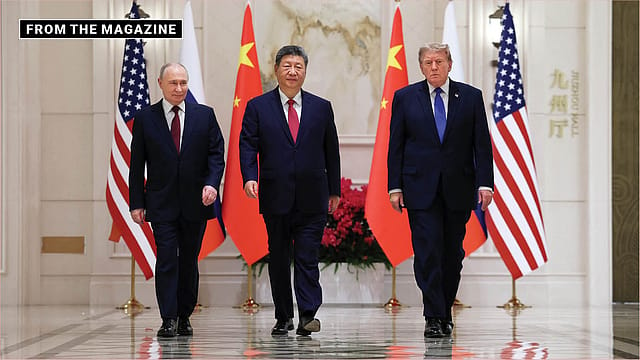
The best comment on the lukewarm APEC plenary and tepid trilateral at the Kylin Villa in Shenzhen may have come from Donald Trump. He fell asleep.
The difference between the advertising and the product was embarrassing. When leaders of the universe meet, they should discuss Star Wars, or at least World Wars, or World Fears. Instead, they gathered to reiterate a banal warning on nuclear weapons, a matter that was settled with the SALT treaties between America and the Soviet Union in 1972 and 1979; discuss immunity for state officials, a subject which is generally left to mid-level bureaucrats; and pontificate upon United Nations reform, which will never happen in their lifetime.
The non-event was confirmed by a non-statement. A joint statement would have further exposed the vacuity of the formal agenda. The Chinese have a phrase for non-events: all thunder and no rain. They did not use the metaphor in their obituaries of the summit because Beijing still likes being polite.
Why did President Xi Jinping host this summit of three powers? He had a purpose behind the banality. He achieved an important objective of Chinese diplomacy without placing it on the agenda. Xi manoeuvred the focus from the familiar to the preferred in the off-camera dialogue. By the time the superstar guests left, Taiwan had risen from a wispy footnote to the central focus of attention.
The Shenzhen summit will be remembered for one sentence: Xi Jinping’s four-word warning to Trump: “Be sensible on Taiwan.”
During the post-mortem, Beijing let it be known that Trump had shown flexibility on Taiwan. We do not have the American version of this assertion. As was famously said in a different context, memories might vary. One interpretation is however indisputable. China is telling Trump to begin a dialogue on Taiwan with a deadline. Shenzhen was Xi’s chosen stage to launch the final stage of his campaign for the reunification of China.
President Xi seems compelled to deliver China’s national dream by 2028. It may be a coincidence that Trump will remain in the White House till January 2029; or, Xi may have calculated that he will never get as transactional an American president as Trump. Taiwan survives as a quasi-independent entity purely because of American military support.
Taiwan has been the principal military objective of the Chinese Communist Party (CCP) since it seized power in October 1949, and its adversary Chiang Kai-shek fled to the island, set up a parallel “nationalist” government, and effectively partitioned China. China will never accept a partition imposed by Western powers, which India did in 1947.
Mao Zedong was thwarted in the 1950s by America, which has maintained military bases in Japan since 1945 and South Korea since the Korean War armistice of 1953. Strategic equations have changed. The only country at the trilateral table which retains a robust, deployable military power is China; Russian might has been frayed by almost five years of fighting in Ukraine, and the projection of American invincibility took another battering in Iran this year.
If Xi succeeds, he will be a 21st-century Mao Zedong. If he fails, he will be as forgotten as every predecessor since Deng Xiaoping.
Xi would prefer to achieve unification without war in the Pacific but seems ready to risk the consequences if one becomes necessary. China has kept its powder dry, adding high-quality technology to an indigenous arsenal. But powder was not created to remain dry.
China has 400 main warships, including three aircraft carriers and 64 submarines, in an operational fleet of 700. The American count, for a much larger area of mobilisation, is 286 battle-force ships, with plans to raise the strength to 381 over the next 30 years. China is preparing for the next 30 months.

Taiwan has been the principal military objective of the Chinese Communist Party since 1949 when its adversary Chiang Kai-shek fled to the island, set up a parallel government, and partitioned China
At home, Xi needs to negotiate his election at the party congress in 2027. While this may seem perfunctory, Taiwan is an important justification for an unprecedented fourth term.
Flattery may not work, but it never hurts. For Xi, Shenzhen was about Trump. He went to the airport to receive the American president, an honour last witnessed when Chairman Mao received the Soviet Union supremo Nikita Khrushchev in 1959. It may or may not be a coincidence that Sino-Russian relations went downhill from there, hitting an abyss in 1969 with the six-month war between the two countries along the Ussuri river and Xinjiang, and the Sino-American rapprochement of 1971. That age has passed. China and Russia are firm allies.
Xi and Putin can now live without ceremony: the airport formalities for Putin were done by Cai Qi, ranked fifth in the CCP Politburo. Putin came to see an “old friend”, whom he has met fifty times since Xi became president in 2013. Do the maths. Words are incidental now to Putin’s strategy for American endorsement of his gains in Ukraine. He will let developments on the battlefield and in chanceries speak for themselves. Russia is at war with the whole of Western Europe over Ukraine. France and Britain have troops on the frontline; Germany pitchforks money. Putin needs to show the world that China is steadfast in its support for Moscow. He did that at Shenzhen.
In Shenzhen Trump left looking bemused. He wanted China and Russia to put pressure on Iran to accept terms which he can describe as victory, and found that they had no interest in bailing him out of a self-created mess
Trump arrived like a lion. He left looking bemused. Iran was at the top of his concerns. He wanted China and Russia to put pressure on Iran to accept terms which he can describe as victory, and found that they had no interest in bailing him out of a self-created mess. He told media before leaving the summit that he did not need Russia and China in his plans for Iran. He does not need them because he did not get them.
One parallel purpose of Xi’s diplomacy has been to ensure that Chinese capacity is concentrated to the extent possible on a single front. His equation with Putin eliminates the minimal possibility of tension along the fault lines of Xinjiang and the Ussuri river. A few days before Shenzhen, Trump threw into the air the possibility of a fourth guest. He might meet North Korea’s leader Kim Jong-un, he said. That did not happen, but it is only China which could have suggested a meeting on the sidelines. It is in China’s interest to push for American recognition of North Korea, which would in turn reduce the American military presence to its south.
In the south, Xi will preserve the status quo in the Himalaya until Taiwan is resolved. Circumstances have come to his help, most notably Trump’s miscalculations in South Asia. Relations between India and the US have noticeably cooled with Trump trying to eliminate India from the security and stability architecture of West Asia and the Indo-Pacific. Prime Minister Narendra Modi and Trump were in Manila, but there was no bilateral meeting.
Why did China agree to discuss nuclear weapons when it dislikes homilies on disarmament, given that America and Russia are so far ahead in numbers? China has 600, which it plans to increase to 1,000 by 2030; Russia has 4,000 and America 3,800. It could be a very Chinese way of telling America not to risk nuclear war over Taiwan.
If persuasion was the policy towards America, then there was total disdain for Japan, which is Taiwan’s principal champion and home for America’s largest base in the Pacific region. There was no one to receive Japanese Prime Minister Sanae Takaichi at the airport; there was no meeting with the host. As signals go it was fairly brutal. The only mention of Japan came in an oblique reference by Trump, who tried to sell the summit to the American people by saying he had stood up straight before Xi, in contrast to Barack Obama, who bowed before Japanese Emperor Akihito during a state visit in 2009. There is no record of any laughter echoing through Beijing. They must have imposed censorship.
In the hype that preceded Shenzhen, there were many references to Yalta, where the three victors of World War II, Roosevelt, Churchill and Stalin, gathered in 1945 to carve up Europe. The analogy was fanciful, of course. The world is not available for distribution in 2026 as it was in 1945. There is one echo. In essence, Stalin told Roosevelt to be sensible about the future of Europe, and understand that if the Soviet Union’s objectives were denied there would be another war. Roosevelt understood, while Churchill remained helpless. Eight decades later Xi Jinping has asked another American president to be sensible, this time about Taiwan.
(MJ Akbar is the author of, among several titles, Tinderbox: The Past and Future of Pakistan. His latest book is After Me, Chaos: Astrology in the Mughal Empire)