Seattle: Rewinding Americana
THERE IS A CITY beneath Seattle. Not metaphorically but literally. In 1889, a fire tore through the original downtown and reduced it to cinders. When the city rebuilt, it raised the street level by a full storey, constructing new buildings directly on top of the ruins of the old ones. The original ground floors, including shop fronts, doorways, and cobbled passageways, were sealed off and left underground, perfectly preserved in the dark. Today, you can descend into them on the Seattle Underground Tour, walking streets that exist twelve feet below the city above: a place that buried its own past and built a new identity on top of it.
I had arrived in Seattle since it was the most convenient airport to fly in at. My plan was to pick up the car and drive east at once. But Seattle, in the manner of places that know their own worth, made sure one night was not quite enough.
So I stayed a day and went for a meander around town.
Outside a bar on Post Alley, a busker was working through a fluid Hendrix riff. It was an appropriate tribute, since James Marshall Hendrix grew up a few miles away in the Central District, left for London at twenty-three, and changed the sound of the electric guitar. Remember that iconic shot of Jimi Hendrix giving the Stratocaster a Viking funeral at the Monterey Pop Festival in 1967? Yes, that’s a local Seattle boy. This town claims him with the understated pride of a city that has produced more than its share of things the world went on to claim as its own. Grunge was born in the clubs around Capitol Hill where locals, including Kurt Cobain, Eddie Vedder, and Chris Cornell, performed. The Pacific Northwest in the early nineties sounded like nothing else on Earth, and then it sounded like everywhere.
Starbucks started here too, in a modest corner of Pike Place Market in 1971 with three men selling coffee beans, loose leaf tea and spices, by the bag. Today, the original store always has a crowd in front of it and the window features the old style logo—that of a siren that seems to beckon the sleepy rather than sailors. A short walk away on Pike Street, the Starbucks Reserve Roastery tells you where that small beginning eventually led: a vast, warmly lit space of copper and raw timber where industrial roasting machinery works behind glass in full view of the customers, filling the room with the smell of something rare being transformed. It is simultaneously a factory, a laboratory and a piece of theatre. I had a cup of coffee there too. Those two cups of coffee, sandwiched fifty years, and an entire global culture between them.
The next morning, before driving east, I stopped at the Museum of Flight south of downtown. A B-17 Flying Fortress filled its hangar with the quiet authority of something that has seen the worst of what history can do. These aircraft were assembled in Seattle, shipped to England from where they flew missions over Nazi-occupied Europe, and came back—or didn’t. The museum, like the city, doesn’t need to raise its voice.
A guide on the Underground Tour had told me: “We didn’t start over. We just went up a level.” That idea—of not starting over but building on what’s already there—was about to follow me east.

The Washington state is cleaved in two by the Cascade Mountains. The western side is what most people picture— Seattle, the Puget Sound, the rainforest-draped Olympic Peninsula. Cross the mountains and everything changes: the rainfall drops away, the sky doubles in size, and the landscape opens into a sunlit country of volcanic peaks, wide river valleys and small towns with outsized stories. I crossed over on State Route 20, the North Cascades Highway, a route that threads through mountain passes above glacial lakes of impossible turquoise and up to a summit at nearly five thousand feet where the October air carries a serious and specific cold. The highway closes every winter, locked under snow from November to April. In early October, I had long stretches of it to myself.
The Methow Valley opens up on the far side, broad and agricultural and full of light. Thirty-five miles along it I came to Winthrop and stopped the car on the main street to properly take it in. The town appears to have arrived fully formed from another century. The saloon has a wooden porch and a hand-letteredha sign. The general store has a facade that looks like a film set built by someone who had studied the genre obsessively. Every building on the main strip follows the same unspoken grammar of timber, weathered paint and covered boardwalks. A notice near the entrance politely requests that horses be kept off the pavement. I chose to believe it was not entirely ceremonial.
Winthrop began as a frontier settlement serving nearby mining camps, ranches and logging operations in Washington’s Methow Valley. As the mining boom faded in the early 20th century, the town drifted into decline, and by the 1960s it seemed destined to join the long roll call of fading Western settlements. What saved it was an act of collective imagination. Anticipating the opening of the North Cascades Highway in 1972, local residents led by Otto and Kathryn Wagner reinvented Winthrop as an Old West town, complete with wooden boardwalks and frontier facades.
At dinner that evening in Three Fingered Jack’s Saloon, the menu ran to elk and pints from Old Schoolhouse Brewery. I sat across from a woman who had grown up here. I asked whether there was ever any tension between living in a town that was, at least partly, a performance.
She thought about it with the seriousness it deserved.
“My kids went to school here,” she said finally. “My parents are buried in the cemetery up the hill. The boardwalks are real wood. The mountains behind them are real mountains, not filled in on a green screen in post-production.” She took a long draw of her pint. “The only thing we invented was sticking to a style of architecture.”
That last line is particularly strong because it quietly admits the artifice while defending the soul of the place. Like a cowboy taking off his hat and revealing he’s actually an accountant from Tacoma but still ropes cattle on weekends.
LEAVENWORTH SITS 142 miles south, and I was not remotely prepared for it.
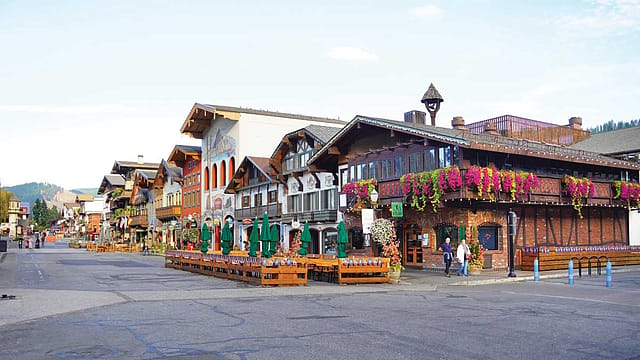
By every geographical measure you are still in the American Pacific Northwest. But the town is emphatically, extravagantly Bavarian. The architecture is all steep gables and painted shutters, the facades decorated with murals in the Lüftlmalerei tradition, the same trompe l’oeil fresco style you find in Oberammergau. The restaurants serve schnitzel and spätzle. There is a Christmas shop that operates year-round. A man in a feathered hat was playing an accordion outside a delicatessen when I arrived, and nobody else seemed to find this remotely unusual.
Leavenworth’s story is even more audacious than Winthrop’s. It had once been a thriving lumber and railroad town until the Great Northern Railway shifted its rail yards to Wenatchee and rerouted the line away from Leavenworth in the 1920s. The commerce that had built the town simply flowed elsewhere. What followed was a long, slow subtraction of businesses, families and reasons to stay, until a handful of determined residents committed to a full Bavarian reinvention, complete with formal architectural guidelines. The result is a place that should not work and somehow entirely does.
In a cheese shop on Front Street, I spoke with the owner, a woman who had lived in Leavenworth her whole life. I asked whether it felt strange inhabiting what was, essentially, an elaborate collective performance.
She wrapped my cheese without breaking rhythm.
“Is Edinburgh strange?” she said. “Is Salzburg performing?” She handed me the parcel. “Every town has a character. Ours just has a dress code.”
Mount Rainier has been drawing people for longer than any of this.
At 14,410 feet, the dormant volcano is the highest peak in the Cascades and the most heavily glaciated mountain in the contiguous US. The Lushootseed-speaking people of the region call it Tahoma, the mother of waters, and the Nisqually, Puyallup and Yakama communities formed relationships with this mountain thousands of years before the national park arrived in 1899 with maps, boundaries and entrance fees. I drove in from the southeast before dawn, the road narrow and winding through forests so old the trees had begun to take on the quality of architecture. Their trunks rose like columns. Their bark looked load-bearing. Even the silence felt structural.
At Reflection Lakes, I arrived just as the darkness was thinning at its edges. The water was perfectly still and, in it, Rainier floated upside down. The reflection was so exact that for a moment the surface looked less like water than polished stone. Mist drifted slowly across the lake. The first light struck the upper snowfields and began working its way downward, as though the mountain were being developed gradually in a darkroom tray.
That night I returned after dark. Curious about strange flashes in the sky the evening before, I had learned that a solar storm had been building for days, a coronal mass ejection throwing charged particles toward Earth. Photographers I met on the trails told me to watch the northern sky after ten. So I drove back in with packed sandwiches, coffee in a thermos and enough layers for the alpine cold, parked well away from artificial light, and waited.
The Northern Lights arrived cautiously at first, pale green smudges above the horizon that looked almost imagined. Then the sky gathered confidence. Curtains of green and violet unfurled above the mountain, rippling silently between the stars. I sat with the engine off and the windows down and watched the sky perform something ancient and inexplicable above a mountain that had been watching skies like this for considerably longer than any of us.
In the morning, I pointed the car back towards Seattle. But it was a long time before the mountains stopped appearing in the mirror.
Washington, I kept thinking during the drive back, has an unusual relationship with the past. It doesn’t demolish it. Seattle built over its ruins and then started selling tickets to them. It doesn’t abandon it either. Winthrop and Leavenworth took histories that had stopped paying the bills and refashioned them into something still capable of supporting human life, beer taps and mortgage payments. Reinvention, Washington seems to understand, is not the same thing as erasure. You do not start again from scratch. You add another layer. You keep the foundations.