Schrödinger’s Army: The PLA’s prowess is likely to shape the next crisis
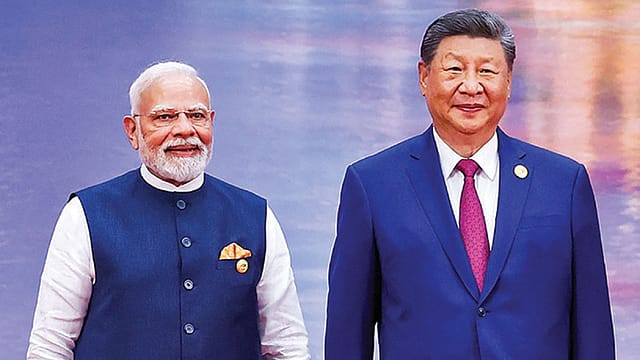
THE CAUTIOUS RECONCILIATION between India and China, launched at the Prime Minister Narendra Modi and President Xi Jinping summit in Kazan, Russia, in October 2024, continued in 2025, with deliberately modest expectations. Both states have enhanced risk reduction on the Line of Actual Control (LAC) by creating non-patrolled and cross-patrolled buffer zones while reopening tourism and direct flights, and reviving business-to-business contacts. Nevertheless, the fundamental structural competition endures. New Delhi and Beijing have divergent strategic ambitions, continued and substantial forward deployments on the LAC, deepening partnerships with rival powers, and recurrent frictions on economic and security issues. This uneasy engagement and rivalry raise two crucial questions: what kind of power disparity is emerging between China and India? Can the disparity aggravate existing structural competition between the two states?
BORDER STABILITY
Since the Galwan clash in mid-2020, over 50,000 troops from each side have remained deployed on the LAC. Despite prolonged negotiations on de-escalation and de-induction of troops, neither has taken place as geography is the crucial factor here. On the Chinese side, the Tibetan plateau and better border infrastructure allow rapid redeployment to the LAC at short notice. India, in contrast, has to navigate the high Himalayas with less-developed border connectivity, which slows mobilisation. As a result, an equal spatial pullback would not be suitable for India; instead, a temporal de-induction, calibrated to each side’s ability to return forces, will be a better approach. However, an agreement for such an arrangement has proved difficult, and the stalemate endures.
In parallel, the People's Liberation Army (PLA) has been expanding airbases, helipads, and advance landing grounds (ALGs) along the LAC, while preparing for front-loaded readiness. The aim is to fight short, sharp local wars aimed at securing political objectives, under its doctrine of multi-domain operations in intelligent conditions.
As per Xi’s repeated directives for the PLA to remain always ready to fight, this strategy puts a premium on rapid readiness, fast reaction, preferably to seize the initiative in the first 24–48 golden hours through integrated joint operations and conclude the conflict before external forces can intervene. The PLA Navy demonstrated these capabilities in the recent Justice Mission 2025 drills, which rehearsed blockade and decapitation strike options on very short notice.
Additionally, the PLA’s army units feature better mobility through mechanisation and operate as agile combined-arms brigades connected by integrated battlefield networks. These formations are capable of conducting rapid air-land operations and provide swift concentration of force. The constant induction of advanced weapon platforms, reinforced by regular high-tempo military drills, is institutionalising combat preparedness and sharpening Beijing’s war-waging proficiency every day.
DOMINATING TWO ADJACENT OCEANS
The PLA Navy is today the world’s largest by number of warships, and it continues to outproduce the US in this domain. China’s network of modern shipyards has outpaced the US Navy across most surface and sub-surface combatant categories, while Beijing dominates the global commercial shipping sector and wields an extensive maritime militia. The cumulative effect is that the US Navy considers the East Asian waters effectively bipolar. US strategists have even considered retrenching operations back to the Second and even Third Island Chains in the Western Pacific, and to the west of the Malacca Strait, especially when Washington shifts its strategic attention to the Western Hemisphere.
Consequently, the PLA Navy has become increasingly assertive in the Indian Ocean, especially as observed in 2025. Whenever India issues a Notice to Air Missions (NOTAM) for a missile test, a Chinese intelligence-gathering vessel almost invariably appears on the horizon to collect telemetry and related data. Moreover, Beijing has secured a permanent military foothold in Djibouti, expanded access to ports, namely, Gwadar, Chittagong, and Hambantota, and deepened politico-military ties with most Indian Ocean littoral and island states to facilitate naval reach. China’s outreach to the Global South and its port development projects, along with broader initiatives like the Global Development Initiative, further consolidate this access, facilitating a sustained Chinese presence in the region.
Even though the Indian Ocean is the Indian Navy’s home waters, where the PLA Navy would normally face distance, logistics, and sustainment issues, Beijing’s proactive approach is increasingly narrowing India’s manoeuvring space. China is moving faster, expanding deployments and access agreements, whereas India continues to dither and delay. The problem is acute in undersea warfare and offensive naval aviation, where the slow procurement cycle has shown its worst effects. Therefore, China is exploiting both time and momentum, while India risks conceding strategic space in its backyard.
HIGH-TECH BATTLE
The power disparity is equally evident in the aerospace, information, and autonomous domains. China’s induction of advanced fourth- and fifth-generation fighters, alongside development of sixth-generation combat aircraft, is gradually tilting the airpower balance over the Himalayas. Long-range air-to-air missiles, autonomous ISR platforms, strategic airlift, and aerial refuelling can enable sustained operations and deep strike options. The PLA has also fielded several drones and autonomous weapon systems that can function efficiently in complex and high-altitude terrain.
Simultaneously, Beijing’s inventory of supersonic and hypersonic missiles, together with its growing nuclear warhead count, has grown significantly. The 2025 military parades highlighted this progress, which can complicate the offensive and defensive calculations of China’s adversaries.
IMPLICATIONS
An uncomfortable question consistently hangs over China’s vast military-industrial complex: how reliable are its weapons in reality? In brochures and on parade, Beijing’s defence products look formidable. However, the real-world performance is less forgiving. Operational experience and even occasional PLA reporting identify recurring problems with quality control, maintenance, and systems integration. Some air-defence systems and counter-stealth radars, including the JY-27, have gained a particularly poor reputation from Operation Sindoor and Operation Absolute Resolve. Those same systems are deployed across the LAC in the Himalayas for China’s own air defence.
The doubt runs deeper than technology. Xi’s sweeping purge of senior PLA officers on corruption charges raises uneasy questions over procurement integrity, testing standards, and basic readiness. The question is: has China bought prestige weapons faster than they can actually work? Can they deliver when Beijing demands it? If doubtful, then this reveals a core vulnerability with real consequences in future conflicts.
Herein lies the mismatch. On paper, the PLA looks formidable; its doctrine, arsenal, exercises, access agreements, comprehensive national power, and grey-zone operations all demonstrate strength. However, its actual combat performance remains uncertain. In sum, the PLA appears as Schrödinger’s military, simultaneously powerful and fragile, competent and flawed, depending on where one looks. India needs to account for these factors when assessing its security posture and formulating responses to China in 2026.