Restraint before Peace: India offers attainable objectives for both Russia and Ukraine
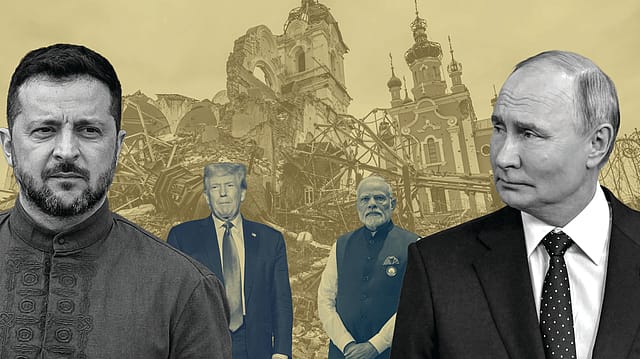
India’s emerging peace initiative on the Russia-Ukraine conflict reflects a calibrated shift from diplomatic advocacy to more targeted, interest-driven engagement. Rather than attempting to broker a comprehensive political settlement to a war that has repeatedly defied diplomatic intervention, New Delhi appears to be pursuing a more attainable objective: limiting the conflict’s disruptive consequences for energy security, food supplies, and maritime commerce. Conveyed during External Affairs Minister S Jaishankar’s visit to Kyiv in September, the proposal has reportedly been described by Ukrainian Foreign Minister Andrii Sybiha as the “most comprehensive” among four international initiatives, alongside those advanced by Türkiye, Egypt, and the US.
The proposal rests on three interconnected pillars: a mutual cessation of attacks on energy facilities and other critical infrastructure; the uninterrupted movement of grain and energy supplies through Black Sea ports; and an end to attacks on commercial shipping in the Black Sea. Taken together, these measures represent an attempt to identify areas of limited convergence between Moscow and Kyiv without requiring either side to make immediate concessions on the fundamental political and territorial questions underpinning the conflict.
India is not offering a grand diplomatic formula for ending the war. It is seeking to establish a measure of predictability in sectors where the costs of continued hostilities extend well beyond the immediate belligerents. Food security, energy flows, and the safety of civilian seafarers constitute practical points of engagement around which a limited understanding might be constructed. Reports of Russian and Ukrainian acknowledgements of India’s efforts, alongside President Vladimir Putin’s praise for Prime Minister Narendra Modi’s ideas and the Kremlin’s stated appreciation of Delhi’s willingness to contribute, suggest that India retains diplomatic space with both sides. Whether that space can be translated into concrete outcomes, however, remains an open question.
For much of the conflict, India’s approach has been defined by a consistent emphasis on dialogue and diplomacy. Modi’s assertion that this is “not the era of war” has become emblematic of Delhi’s effort to preserve strategic autonomy while signalling its preference for a negotiated outcome.
India’s more recent engagement suggests an effort to move beyond advocacy towards selective problem-solving. Jaishankar’s reported conversations with both Moscow and Kyiv on Black Sea shipping, grain and energy exports, and the possibility of reciprocal non-attack arrangements point to a more operational understanding of what Indian diplomacy might realistically achieve.
Several considerations explain this evolution. The Russia-Ukraine war increasingly intersects with India’s economic, security, and diplomatic interests. First, Russia’s role as a major supplier of discounted crude oil makes disruptions to Black Sea shipping, attacks on port infrastructure, and risks to commercial vessels direct strategic concerns for India. Threats to Indian seafarers also add a significant humanitarian and consular dimension. Second, instability in the Black Sea disrupts supplies of grain, sunflower oil, and fertilisers, potentially raising global commodity prices and threatening food security across developing economies.
Third, the initiative supports Delhi’s diplomatic balancing act between maintaining ties with Russia and strengthening partnerships with the US, Europe, and Ukraine. By promoting practical measures to reduce economic and humanitarian harm, India can demonstrate that strategic autonomy need not imply diplomatic passivity and reinforce the role of non-Western powers in international crisis management. Finally, intensifying attacks on Black Sea infrastructure create urgency for targeted cooperation. Unlike general appeals for restraint, an arrangement focused on specific, mutually beneficial interests may offer a more practical starting point for cooperation, provided both parties recognise tangible incentives to comply.
India remains careful, however, not to assume the mantle of formal mediator. This distinction is consequential. A self-appointed mediating role would expose Delhi to expectations that it may lack the leverage to fulfil, while potentially compromising its relationships with one or both parties. By emphasising practical assistance rather than mediation, India is attempting to preserve diplomatic flexibility and keep its ambitions proportionate to its capabilities.
The Trump administration’s push for an energy ceasefire introduces both opportunities and complications for India’s Black Sea initiative. Last week, Trump announced an immediate ceasefire between Russia and Ukraine covering energy infrastructure. The proposed truce overlaps with the first pillar of India’s framework and could provide a stepping stone towards a broader arrangement covering commercial shipping and grain and energy flows through the Black Sea. India’s proposal is more comprehensive, linking the protection of energy infrastructure to maritime security and the uninterrupted movement of essential commodities.
However, Washington’s greater economic, military, and diplomatic leverage could overshadow India’s efforts, while competing initiatives risk fragmenting negotiations and allowing Moscow and Kyiv to avoid broader commitments. The central challenge remains enforcement: an announced ceasefire does not guarantee reciprocal restraint on the ground. At the same time, US efforts to facilitate Russian diesel supplies could ease pressure on India over its purchases of Russian crude, providing Delhi greater diplomatic room to pursue its energy-security interests. Ultimately, India’s ability to advance its proposal will depend on whether it can leverage its relationships with both belligerents to complement, rather than compete with, American diplomacy while sustaining a broader focus on Black Sea trade and maritime stability.
India’s initiative should not be mistaken for an ability to compel Russia or Ukraine to change their military calculations Delhi’s influence rests on diplomatic access, economic relevance, and its commitment to dialogue, rather than the coercive leverage available to the US or, in different ways, China. Moreover, implementing a mutual non-attack arrangement would require clear definitions of critical infrastructure, credible mechanisms for attributing violations, and agreed rules for protecting commercial shipping in contested waters. Past ceasefires demonstrate how divergent interpretations, weak monitoring, and the desire to preserve military options can undermine even diplomatically attractive agreements. India’s challenge, therefore, is not merely to secure rhetorical acceptance but to make reciprocal restraint verifiable and politically worthwhile. Its diplomatic influence will be most effective when applied selectively, recognising that facilitating a limited arrangement is a meaningful contribution, but not a guarantee of success or a resolution of the wider Russia-Ukraine conflict.
India’s Black Sea initiative reflects a pragmatic recalibration of its approach to the Russia-Ukraine conflict, moving beyond rhetorical appeals for peace towards a targeted effort to safeguard energy security, food supplies, maritime commerce, and seafarer safety. Trump’s reported energy ceasefire could provide an opening for advancing this broader agenda, though competing diplomatic initiatives may also marginalise India’s efforts if Washington prioritises a narrower arrangement. For New Delhi, the challenge is to leverage its relationships with Moscow and Kyiv to promote limited, achievable cooperation without overstating its influence or assuming the role of formal mediator. Ultimately, the initiative’s success will depend on the belligerents’ willingness to observe reciprocal restraints.