Oil Tankers: Choked by Hormuz
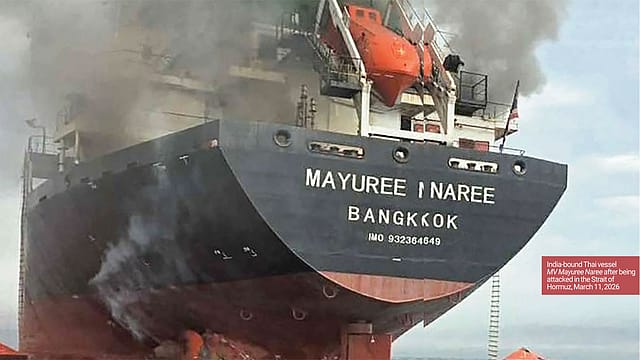
THE SPATE OF attacks by Iran on ships in the Strait of Hormuz has set fire to more than metal. Soon after the attack on the Thailand-flagged MV Mayuree Naree, crude oil prices resumed their upward march. One can sketch a neat graph between the march of events—from Donald Trump’s statement that war will be over “pretty quickly” on March 8 to the attack on multiple ships by Iran—and the wild gyrations in oil price movements.
This was not the end of attacks on ships. The Thai ship was on its way to Kandla in India. Another ship, the Japan-flagged One Majesty that was on its way to Mundra, was attacked soon afterwards. In the last 24 hours, five different vessels have been attacked by Iran in the territorial waters of different countries, effectively closing the Strait of Hormuz. The blockade is absolute. This can be gauged from the fact that there are 28 Indian ships in the strait, 24 in its Western part and 4 on the Eastern side. There has been no movement in these ships. At the same time, a number of ships bearing energy products have begun docking in Indian ports.
These events have cast a shadow on countries that are large consumers of hydrocarbons that flow through the Strait of Hormuz. Asian economies like India, South Korea and Japan have been forced to scramble for supplies in a world where oil and gas are available in plenty but the key route to dispatch them to these countries remains blocked. While the costs will become evident a bit later, the dislocation is being felt almost in real time.
Within days of the conflict spreading, India took multiple steps to protect its interests and those of consumers at home. On March 9, the Ministry of Petroleum and Natural Gas (MoPNG) issued orders to all petrochemical companies to maximise their production of low-carbon hydrocarbons (propane, butane and propylene, among others) and divert the entire output for the production of Liquefied Petroleum Gas (LPG) and make it available to three public sector oil marketing companies (OMCs).
OMCs, in turn, were asked to supply the LPG procured in this process solely for domestic consumers. Given the supply constraints, allocation and utilisation of natural gas have been reoriented. The first priority is the production of LPG, Compressed Natural Gas (CNG) and piped natural gas for domestic consumers. They will get 100 per cent of their average consumption in the last six months. The second priority is fertiliser manufacturers, who will get 70 per cent of their average consumption in the last six months. Other industrial consumers are being placed in different levels of prioritisation.

Quick reorientation in the use of natural gas is necessary for economic reasons. LPG and Piped Natural Gas (PNG) are now supplied to 34.5 crore households in India. Roughly 10.33 crore consumers of these clean fuels fall under the PM Ujjwala Yojana (PMUY), an ambitious programme to provide these fuels to people from underprivileged backgrounds. In the first half of fiscal 2025, OMCs sold 16 million metric tonnes of LPG. Unless this large consumption is managed carefully, the economic dislocation would be severe. Similarly, prioritising the fertiliser sector is essential as that is necessary for India’s food security. While India produces 76 per cent of the nitrogenous fertilisers it consumes, it produces just 60 per cent of the phosphatic fertilisers it needs and has to import 86 per cent of the potassic fertilisers it consumes.
These are tough choices for the government but the options are clear: give priority to households and what the farmers need. Otherwise, the risk of inflation rearing its head is almost certain. The trade-off involved is that other, economically important, sectors have to take a backseat.
What are the risks for India if the current conflict is prolonged?
One hint was provided in the inter-ministerial briefing on the developments in West Asia on March 11. The concerned spokesperson said the government had approved ` 30,000 crore in compensation for OMCs for under-recoveries from LPG. In FY25 under-recoveries from the sale of LPG stood at ` 41,270 crore for three major OMCs. This figure was expected to come down by 25 per cent in FY26. Now, with the current turmoil in energy markets, this figure is certain to go up instead of coming down anytime soon.
IN 2025, INDIA’S oil imports totalled 3.1 per cent of GDP. An estimate by Nomura Securities states that a 10 per cent increase in global crude oil prices worsens India’s current account deficit (CAD) by 0.4 percentage points. In the third quarter of 2025-26, India’s CAD stood at 1.3 per cent of GDP, up from the 1.1 per cent for the same period a year ago (Q3, 2024-25). In January this year, the price per barrel of the Indian crude oil basket was $61.95. Currently, prices are hovering around $90 per barrel, an increase of around $28 per barrel. If these prices continue at this level, the hit to India’s CAD will be substantial.
Broadly, there are three risks if the situation in the Persian Gulf and the wider West Asian region continues to be inflamed. First, fuel prices in India are a politically sensitive matter. The ability of governments to pass through increases in costs to consumers is limited. In the past one decade the ‘pass through’ has been better than before but there is an upper limit to what the government can do. In the present case, where prices of crude oil have shot up by as much as $30 per barrel, it is impossible for the Centre to fully pass through these increases. Second, the government will become the “price absorber of first resort.” This will increase not just the CAD but also the fiscal deficit, making the task of macroeconomic management more difficult. Third, a higher CAD leads to pressure on currency. On Wednesday, the Indian rupee briefly touched a low of ` 92.38 against the dollar before recovering a bit. A better gauge is the 40-currency Real Effective Exchange Rate (REER) that stood at 94.76 for the rupee in January. This only adds to the burden of oil imports by the government. Fourth, in an ideal situation higher global oil prices should lead to a commensurate reduction in demand. But because of the imperfect pass through, demand for oil products does not fall in India.
What are the options before India? In the otherwise bleak scenario, two pieces of positive news have emerged in recent days. For one, India has started ramping up its purchases of energy products from Russia. These purchases had been reduced a bit since January this year. But with the West Asian situation deteriorating, India has once again increased its purchases from Russia. At its peak, India was purchasing two million barrels per day from Russia in mid-2024. This fell to around a million barrels per day in February this year. A Bloomberg report said that after the so-called “waiver” from the US, Indian refiners have agreed to buy 30 million barrels from Russia this month. The US, which had targeted India for buying oil from Russia and imposed an additional 25 per cent import duty on Indian exports to it, recently said that it realised India was an important contributor to oil-price stability worldwide as it exported a large volume of refined oil by processing crude sourced from Russia.
For another, on March 11, 32 members of the International Energy Agency (IEA) agreed to make 400 million barrels of oil available to the market to address the disruptions caused by the conflict in West Asia. This oil, from the reserves of these countries, “will be made available to the market over a timeframe that is appropriate to the national circumstances of each Member country and will be supplemented by additional emergency measures by some countries,” the IEA said in a statement. While India is not a full member of the IEA, it has welcomed the agency’s decision to release emergency oil stocks. Any addition to the current global oil stocks reduces the overall pressure on oil prices and stabilises energy markets.
There are two further steps India can take. It should negotiate a safe passage agreement with Iran that allows tankers to reach Indian shores via the Strait of Hormuz. India’s External Affairs Minister, S Jaishankar has been in touch with his Iranian counterpart. But as can be imagined, solving this problem will be a challenge as Iran is in a somewhat turbulent situation with multiple actors calling the shots over different aspects of policymaking and implementation. This was part of the design to ensure continuity in the functioning of government there in case of efforts to decapitate its governance structures. In this decentralised environment a multiplicity of officials and agents make this a tough security and diplomatic situation.
The second—probably the most vital—step that India should take is to continue buying more oil and LNG from Russia. India has a policy of buying oil from a diversified pool of sources to minimise its dependence on one country or a group of countries. So far, this policy has stood it in good stead. Russia, a dependable supplier of various goods—raw materials, energy and military equipment—has always helped India in a tough spot. It is important that this dependable source not be abandoned under external pressures. That would not be worth India’s while for whatever it is trying to secure from another country or a set of countries. It may be useful for India to secure a long-term energy supply deal with Russia. In these unpredictable times, that may be a useful option.