Nepal Flood Death Toll Hits 469; over 1,000 Missing as New Barrier Lake Raises Fresh Alarm
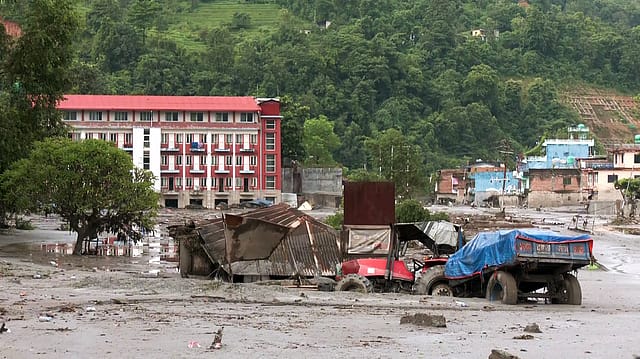
The river has carried bodies more than 150 kilometres from where the disaster began.
By Thursday night, recovery teams had found 389 bodies across eight Nepalese districts, stretching from Rasuwa on the Tibetan frontier to Chitwan and the Nawalparasi districts farther downstream. Another 977 people remained missing, according to the sixth situation report released by Nepal’s National Disaster Risk Reduction and Management Authority.
The missing include tourists, pilgrims, migrant Nepalese returning home, hydropower workers, customs and immigration officials, and members of the security forces who had been stationed along the border.
They also include 517 foreign nationals.
That number has transformed the Bhote Koshi flood from a national catastrophe into an international search operation involving more than 30 countries. Families thousands of kilometres away are now waiting for names to emerge from a landscape of collapsed bridges, severed roads and deep deposits of mud, rock and debris.

Zeroing In on ECI
09 Oct 2026 - Vol 05 | Issue 41
Constitutional legitimacy versus political opportunism
The confirmed death toll could climb sharply as search teams reach communities cut off by the flood. Authorities must also contend with a second danger: a rapidly expanding lake created when debris blocked the river upstream near the Nepal-China border.
Nepal’s disaster authority has warned people living along the Bhote Koshi and Trishuli rivers to remain away from riverbanks. Rescue personnel working downstream have also been placed on alert in case the natural barrier breaches and releases another wall of water.
A Flood That Travelled Through Nepal
The disaster began on Wednesday morning when a violent mass of water, ice, rock and sediment surged from the Tibetan frontier into Nepal’s Bhote Koshi River.
It raced through Rasuwa before entering the Trishuli and Narayani river systems, striking settlements, security posts, hydropower facilities, highways and bridges as it travelled south.
A preliminary report by Nepal’s Flood Forecasting Division estimated that around 20 million cubic metres of excess water entered the river system. The surge reportedly travelled about 168 kilometres to Devghat, reaching a peak discharge of approximately 5,850 cubic metres per second.
Automated monitoring stations at Syabrubesi, Betrawati and Malekhu stopped transmitting as the flood swept through. Officials sent more than 679,000 emergency text messages to communities downstream, an intervention that may have prevented an even larger loss of life.
Initial reports described a magnitude 4.4 earthquake shortly before the flood. Subsequent assessments, however, indicated that seismic instruments may have detected the collapse of a glacier rather than a conventional earthquake.
Reuters reported that preliminary geological assessments pointed to an ice avalanche triggering the destructive flow. Scientists cautioned that the precise sequence still required investigation, although rising Himalayan temperatures and unstable glaciers have intensified concern over similar high-altitude disasters.
The scale of the destruction became clearer as bodies surfaced downstream. According to an updated Nepal Police report, Chitwan had recorded 137 deaths, while 87 bodies were recovered in Nawalparasi East. Dhading recorded 33, Gorkha 32, Nuwakot and Tanahun 28 each, Nawalparasi West 27 and Rasuwa 17.
The district-wise figures remain subject to revision as identification continues and agencies reconcile overlapping lists.
Nepal’s disaster authority said 13,295 police, army and Armed Police Force personnel had been mobilised. Fifteen helicopters, including six operated by the Nepal Army, were involved in rescue and relief missions.
The official situation report said 1,976 people had been rescued through helicopter operations, while roads were being cleared to reopen access to isolated areas.
The devastation has also struck Nepal’s economic infrastructure. Preliminary estimates reportedly suggest that dozens of bridges and around 40 kilometres of road have been damaged or destroyed. Twelve operational hydropower plants with a combined capacity of 431 megawatts have been disconnected from the national grid, according to Nepalese officials.
517 Foreign Nationals Missing
The flood struck during a busy period for tourists, trekkers and pilgrims travelling through Nepal towards Mount Kailash and Lake Mansarovar.
Nepal’s latest disaster report listed 517 foreign nationals among the missing. It also recorded 127 Nepalese citizens living abroad who had returned to the country.
The Associated Press reported that citizens of more than 30 countries were unaccounted for across Nepal and Tibet. Separate country-wise lists have changed repeatedly as rescued travellers re-establish contact and tour operators correct passenger records.
Reuters reported that Indians formed the largest group of missing foreign nationals, followed by travellers from countries including the United States, Malaysia, Ukraine, Britain, Australia and Canada.
Nepal’s Ministry of Foreign Affairs has established an Emergency Control Room to coordinate searches, verify information and provide consular assistance. It has asked families and diplomatic missions to avoid relying on unverified social-media lists as officials work to reconcile names supplied by hotels, tour operators, employers and security agencies.
India’s Ministry of External Affairs said 84 Indian nationals had been rescued, including 63 people working at the Trishuli-I hydropower project and 21 travellers from Tamil Nadu who had entered Nepal for the Kailash Mansarovar Yatra.
India was continuing efforts to trace other nationals whose whereabouts remained uncertain. Communication failures across the disaster zone have complicated the distinction between those physically missing and those merely unable to contact their families.
The flood also struck the Tibetan side of the frontier. Chinese authorities reported three deaths and 558 missing people in Gyirong County, including 260 foreign nationals, according to Reuters and the Associated Press.
The Gyirong border crossing, an important trade and travel route connecting China with Nepal and the wider South Asian region, suffered extensive destruction.
Another Lake, Another Warning
Even as teams search for survivors and recover bodies, the mountain above the disaster zone continues to threaten communities below.
Rock, mud and glacial debris have blocked the upper river and formed a barrier lake. Satellite imagery showed that the lake was expanding, Nepal’s disaster authority said, citing information supplied by China.
Chinese estimates indicated that the lake had accumulated roughly two million cubic metres of water, with another three million cubic metres potentially flowing into it over the following days.
A breach could send another surge into the Bhote Koshi and Trishuli corridors, strike rescue teams working close to the water and further damage already weakened bridges and roads.
Nepal’s Flood Forecasting Division has urged residents, travellers and rescue personnel to stay away from riverbanks and remain in safer areas until the threat subsides. Chinese authorities were carrying out modelling to estimate how a breach might move downstream, Reuters reported.
The warning has forced Nepal to conduct rescue operations while preparing for another possible evacuation.
Prime Minister Balendra Shah said the situation remained challenging and that the state machinery was operating at full capacity. Saving lives, locating the missing, treating the injured and providing immediate relief remained the government’s priorities, he said.
International Aid Begins to Arrive
Foreign governments and humanitarian organisations have begun sending money, medical supplies, equipment and rescue assistance.
The United States announced $500,000 in immediate humanitarian support and deployed a disaster-response adviser. The assistance will provide emergency shelter, relief supplies, water, sanitation and hygiene support in affected communities.
US Under Secretary of State for Political Affairs Allison Hooker said Washington was also working urgently to locate missing American citizens.
The World Health Organization said it had dispatched medicines, multipurpose tents and other emergency medical supplies to help Nepal maintain essential health services. Its teams were working with Nepalese authorities to assess public-health risks, strengthen disease surveillance and prevent disruption to treatment in isolated communities.
Reuters reported that India had sent nearly 50 tonnes of relief supplies. South Korea pledged $1 million and deployed a response team, while Britain announced £5 million and offered emergency personnel. The International Federation of Red Cross and Red Crescent Societies released emergency funding, and Médecins Sans Frontières dispatched a medical team.
King Charles III said he and Queen Camilla were “heartbroken” by the loss of life and expressed particular sympathy for the families of police and military personnel killed while carrying out their duties.
Nepal has released NPR 25 million for immediate relief in Rasuwa, Nuwakot and Dhading. Twelve emergency coordination teams have been assigned responsibilities ranging from health services and communications to power restoration, road clearance and international assistance.
Yet the most urgent work remains brutally simple.
Helicopters continue to circle isolated valleys. Search teams walk riverbanks where roads once ran. Sniffer dogs probe fields of wreckage. Officials compare lists containing hundreds of names. And above them, another lake continues to rise.
With inputs from ANI