Narendra Modi: Prime Diplomat
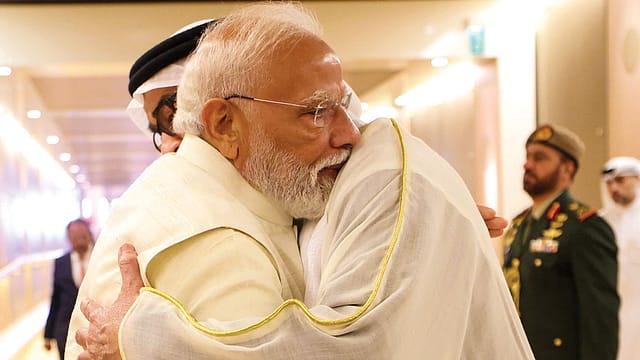
PRIME MINISTER NARENDRA MODI’S visit to the United Arab Emirates (UAE) at the start of his five-nation tour on May 15 began with walking out of his aircraft and hugging Emirati leader Sheikh Mohamed bin Zayed Al Nahyan who warmly reciprocated the gesture. A little more than four months earlier, Modi had greeted the UAE’s president in a similar manner at Delhi airport when the Sheikh had arrived on his third official visit to India after assuming office. The cordiality and the bond the leaders share is evident. It conveys much more than optics. The personal chemistry reflects the close cooperation between India and the Gulf states that has evolved since Modi made the Middle East a lynchpin of Indian diplomacy.
There was an added urgency to Modi’s visit as he set foot in Abu Dhabi, his eighth trip to the UAE as prime minister, as he had recently sounded a warning on a likely economic tightening in light of sustained high oil prices due to the Iranian blockade of the Strait of Hormuz and an American counter-siege. Modi’s pivot after the elections to five state Assemblies signalled a new phase in India’s economic management where the austerity mantra—considered near-obsolete after the end of the Covid pandemic—surged back in circulation. With an estimated 4.3 million Indian nationals living in the emirates, UAE was an important destination. So far, there has been no exodus of workers returning to India and this is in no small measure due to Modi’s personal connect with Al Nahyan and the burgeoning bilateral commerce that has seen the UAE government signal employers to try and not lay off Indian workers. Such favours are not easily given and Modi’s visit saw the UAE agreeing to expand its participation in India’s strategic petroleum reserves to 30 million barrels and also set up a gas reservoir. Modi was indeed meeting a friend in times of need.
The tour of the UAE and European nations took place at a time when US President Donald Trump had just concluded a visit to Beijing where he seemed to have ceded the upper hand to Chinese President Xi Jinping who successfully lectured his guest on Taiwan. It also came when a BRICS meeting was concluding in New Delhi where the presence of Iranian Foreign Minister Abbas Araghchi was a highlight. The two days he spent in India must mark a rare foray outside Iran for Araghchi apart from visits to Pakistan for negotiations with the US which, to date, remain deadlocked. The prime minister’s agenda, with energy security initiatives with the UAE, the Tata agreement with Dutch semi-conductor giant ASML, infusion of Dutch technology in the ambitious Kalpasar project in Gujarat—Modi visited the Afsluitdijk dam in the Netherlands— and defence cooperation were running themes in the visits that lasted six days. Indian officials noted that the India-Nordic nations’ summit was a significant opportunity to tap finance and technology as the Arctic countries are strongly placed in blue, green and conventional economies. The defence aspect of the visits was also seen in the context of Pakistan’s security cooperation with Saudi Arabia. The European Free Trade Association (EFTA) and the operationalisation of the European Union Free Trade Agreement (EU-FTA) were important drivers of cooperation.
Modi and Sheikh Al Nahyan reviewed the entire gamut of the India-UAE relationship with a focus on the effects of the war in the Middle East and the shared objectives of opening the Hormuz and ensuring there are no attacks on civilian and economic infrastructure. The pressure of Gulf states for a more durable peace and their strong resistance to support any fresh aggression is an important reason why Trump has held back renewing attacks on Iran. India’s concurrence with the Gulf viewpoint reinforces the argument and though New Delhi has no direct role to play in the region, it is a large and important stakeholder. The newer aspects of the energy partnership reflect India’s need to increase its resilience to oil shocks and takes into account the UAE’s decision earlier this month to leave the Organization of Petroleum Exporting Countries (OPEC) which frees it from having to adhere to quotas largely set by Saudi Arabia. The $5 billion investment in India by UAE entities will be channelled into infrastructure projects prioritised by the National Infrastructure and Investment Fund Limited (NIIFL). The pledge to deepen defence industrial cooperation includes secure communication and cyber defence but the maritime component is an acknowledgement of the growing imprint of the Indian Navy in safeguarding the waters from Gujarat to Somalia.

Modi’s tour included visits to the Netherlands, Sweden, Norway, and Italy as well as the India-Nordic summit, a surprisingly strong platform given the political and cultural dissimilarities and the geographical distance between the Arctic nations and India. India has observer status in the Arctic Council and disruption in its activities due to the Russian invasion of Ukraine has led to a stronger recognition of other partnerships. Indian scientists underscore the importance of the Arctic regions for space research and observations. The leaders acknowledged the growing interlinkages between the Arctic and Indo-Pacific regions. They recognised the potential for further enhancing cooperation in the Arctic, particularly in the fields of polar research, climate, and environmental issues. The India-Nordic summit joint statement noted that the “leaders also expressed their shared commitment to advancing dialogue and collaboration in the Arctic in accordance with established multilateral frameworks.”
Participation in the Arctic is important for India as studies show the weather in the region has a bearing on the Indian monsoon and the Himalayan ecology. With China seeing itself as a “near-Arctic nation”, India’s presence in the discussion and its permanent research station at Svalbard are as important as other aspects of cooperation. Both sides agreed to accelerating cooperation on renewable energy, zero and low-emission technologies, such as carbon capture, utilisation and storage, green hydrogen, and critical minerals to support clean energy transitions and sustainable economic growth,” the statement said. It was again an important area of cooperation in the context of the current energy crisis. It is evident that the Nordic nations accept India’s ties with Russia—despite their deep dislike of Russian President Vladimir Putin—but Norwegian Prime Minister Jonas Store said India could use its leverage with Moscow to consider negotiations more seriously.
SPEAKING TO THE media after Modi ended his tour with an eventful visit to Italy where his gift of Melody toffees to Italian Prime Minister Giorgia Meloni took social media by storm, Ministry of External Affairs (MEA) spokesperson Randhir Jaiswal said Modi has met CEOs of 50 large companies during his tour and invited them to either invest or increase commitments in India. “The cumulative investment of many of these countries already invested in India stands at around $180 billion. Several of their projects are in the pipeline including in the areas of semi-conductors, logistics, green infrastructure and technology… Their fresh commitments stand at around $40 billion,” Jaiswal said. The outcomes the MEA highlighted were specific— the Dutch returning valuable cultural artefacts like Chola-era royal copper plates, faster and more flexible visas, launch of semi-conductor partnerships in Dholera in Gujarat, technology transfers in mining and critical mineral supplies, coastal engineering projects, green hydrogen markets and industry partnerships. Dutch expertise in horticulture will see a flower centre being established in Tripura. At the European round table in Sweden, Modi noted the time he spent at the country’s industrial heartland of Gothenburg and identified AI, health technology, and green mobility as areas of fruitful cooperation and outlined the vision of a Sweden-India tech corridor. “The India-EU trade and technology council has further deepened our cooperation and we are working together in digital technology, clean energy, semi-conductors, supply chains and innovation,” Modi said.
Modi emphasised his commitment to public life and his government’s programmes at a diaspora event in the Netherlands where he said that being in office for 25 years, first as Gujarat chief minister and then as Indian prime minister, was not a mere statistic. “It is your blessing, and it is my greatest strength. The love and blessings of the nation inspire me every moment of my life to work towards fulfilling the dreams of the people of India,” he said. It was an unequivocal message that Modi has his eyes set on the next steps in India’s rise, beyond the immediate challenge of the Hormuz energy blockade and the adjustments in economic policies it entails.