Mojtaba Khamenei: The Man Who Terrifies the Liberal Iranian
WHAT HAPPENED IN Iran after Ayatollah Ruhollah Khomeini returned from exile in France on February 1, 1979 was a counterrevolution that soon killed the hope of the early phase of the 1978-79 upheaval that had overthrown the Shah. Instead of a liberal republic with a religious foundation, what Iranians ended up with was an Islamic theocracy. It was Khomeini’s coup. Under his successor, the recently assassinated Ali Khamenei, Iran became a theocratic security state, with the Bayt-e Rahbari, the Supreme Leader’s residence-cum-office, calling every shot and the indoctrinated Islamic Revolutionary Guards Corp (IRGC) making sure the Bayt’s word was law.
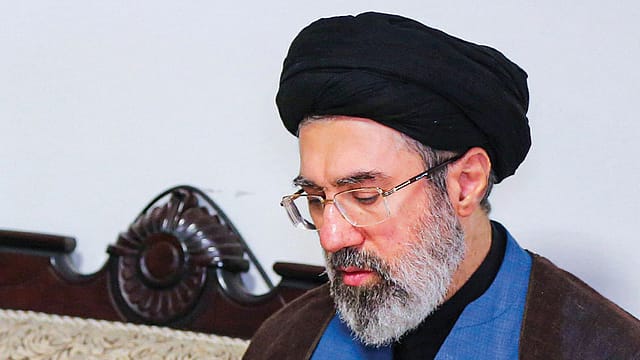
The man who has now succeeded to the bombed-out Bayt was called the “power behind the robes” in leaked US diplomatic cables published by WikiLeaks after the crackdown on the protests in 2009 triggered by Mahmoud Ahmadinejad’s second presidential triumph. But for Mojtaba Khamenei, Ali Khamenei’s second of four sons whose life was spared by his absence from the Bayt on February 28, Iran’s most reactionary and reckless president may never have made it to office, not even once. In 2005, when a relatively unknown Ahmadinejad had won for the first time, Mehdi Karroubi, the opposition candidate, had written an open letter to the Supreme Leader accusing Mojtaba of interference. This was Khamenei Jr’s own political coup with irreversible consequences. The IRGC and the notorious Basij militia were Mojtaba’s tools of terror, the same IRGC that has just bullied the clerical council into electing him.
The Abandoned Kejriwal
01 May 2026 - Vol 04 | Issue 69
Brain drain from AAP leaves Arvind Kejriwal politically isolated
A mid-ranking cleric, Mojtaba Khamenei’s theological credentials, when he was made Supreme Leader on March 8, were even worse than his father’s in June 1989. Of course, he too was immediately called an ayatollah by the official media just like his father was made one overnight. Curiously, Mojtaba went to the seminary of Qom, the heart of Shia theology, as late as 1999 when he was already 30. Till then, he hadn’t shown much inclination towards formal religious education, nor did he wear a cleric’s garb. Significantly, one of his masters was Ayatollah Mohammad Taqi Mesbah Yazdi, a cleric who used to call for the execution of all Iranian youth who promoted Western decadence. More than a decade before he went to Qom, Mojtaba had served in a non-combatant capacity during the Iran-Iraq war of 1980-88. But evidently it was Qom that made all the difference.
By 1999, Ali Khamenei had already transformed the Supreme Leader’s office from a religious bureau to a micro-managing behemoth that oversaw foreign policy, military affairs, intelligence, and also the economy. That’s to say nothing of moral policing. Mojtaba took on the position of a deputy chief of staff to his father for politics and security in 1999 and had worked in that capacity till Khamenei Sr was killed. Mojtaba never held government office, choosing to keep a low profile and operate from the shadows. He never gave speeches or interviews. The IRGC ensured very few photographs of him circulated. In other words, he had all the makings of a paranoid security czar. Not for nothing did rumour-fed Iranians begin calling him the “mini Supreme Leader”, whose first major public statement on March 12 warned the Gulf again of Tehran’s vengeance.
Yet it would be a stretch to call Mojtaba the architect of Iranians’ oppression. Oppression was built into the system Khomeini had created, deceiving a country with false promises. Mojtaba was his father’s perfect instrument but with a sinister bent all his own. In his lifetime, Ali Khamenei had reportedly made it clear he was not in favour of Mojtaba succeeding him. US President Donald Trump wasted no time in making his disappointment public but calling Mojtaba a “lightweight” is only theologically correct. He hasn’t been a political lightweight since 2005. The Israeli defence minister has warned Mojtaba won’t last. Even as the conservative Iran of small towns and villages celebrates the advent of the new Supreme Leader and liberal urbanites dread what’s in store, it should be remembered that Mojtaba Khamenei is not inheriting the war-devastated Iran of 1989 his father did. He has in his hands something immensely worse.