Letter from Tel Aviv: With cluster munitions, the missiles can land just about anywhere
I HATE GETTING PHONE CALLS early in the morning. When working with Indians, it happens quite often, they miscalculate the time difference, and more than once, I’ve been woken up at five or six, when it’s already the middle of the workday in India.
Last week, I got a call at 6:49AM. It was my brother. When my brother calls that early, something’s wrong. “It’s dad,” he said. “He fell down the stairs during the siren, on the way to the shelter. He’s hurt and wants to go to the emergency room.”
With my hypochondriac dad, we always hesitate, whether to take him seriously when he complains about something medical. A visit to the ER can take an entire day, and the risk of viruses and contamination isn’t something to take lightly. In this case, I told my brother to take him to the hospital. We couldn’t take chances, he needed a proper diagnosis.
Don’t be mistaken, my father is not an old man. He is 87, but even today he can run faster than me and logs at least 10,000 steps a day. It doesn’t matter whether you’re 17 or 87, when you are jolted awake by a siren and rushing down the stairs to a shelter, you are disoriented, dizzy, and unsteady.
In my article ‘The Siren and the Bait’ (Open, March 16, 2026), I wrote that the chances of my 90-year-old mother-in-law falling down the stairs during a siren were higher than the chances of a missile hitting her house. It turns out I was right, just not in the way I expected.
My father became part of the statistics. A casualty of the war that no one talks about. The scans showed three broken ribs and a small puncture in his lung. He was admitted to Ichilov Medical Center in Tel Aviv to monitor his breathing for a few days.
At the hospital, he was asked to fill out a social security form. In Israel, victims of terror or war are entitled to compensation under the Compensation Law for Victims of Hostile Actions. Apparently, if you fall down the stairs because of a siren, that counts too.
We joked with him that he has always liked jumping, not just down stairs but out of airplanes too. My father’s claim to fame is his military service as a paratrooper in Battalion 890 of the Paratroopers Brigade. In 1956, his battalion was dropped at the Mitla Pass, about 70km east of the Suez Canal. The operation marked the opening of the Sinai Campaign and was the first and largest combat parachute drop in the history of the IDF.
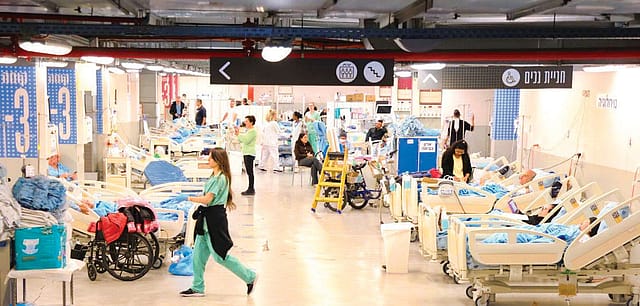
Ichilov Hospital is one of the largest in Israel, with 1,500 beds. It sits just 300m from the IDF headquarters, one of the primary targets of Iranian missiles. Within hours of the start of Operation Roaring Lion, the entire hospital moved underground. The parking structure had been designed for exactly this purpose, to convert it into an emergency hospital.
When I came to visit my father, it looked like a cross between an indoor summer camp and a field hospital. Three levels of parking had been transformed into a fully functioning medical facility, partitioned by curtains into different wards. Above his bed, a sign read: ‘Reserved for the Center’s CEO.’
A friend of mine who works at the hospital came by and took me on a grand tour of this underground world. Those ordinary-looking parking spaces, it turns out, are anything but ordinary, each one is equipped with access to electricity, oxygen, and all the necessary connections for a hospital bed. On every level, they had set up reception stations and WiFi. Management had moved underground as well, operating from a fully equipped command-and-control centre. Even the operating rooms had been relocated below ground. Despite the frequent sirens in Tel Aviv, the hospital continues to function almost seamlessly.
On March 20, I picked my father up from the hospital and brought him to stay with us. We have a safe room at home, so at least he wouldn’t have to deal with stairs on the way to a shelter. I could also keep an eye on his recovery. On the way home, we stopped at my favourite hummus place to pick up food for the weekend. The line was long. Just as I reached the counter, I heard the alert on the app. The most popular one these days is the Home Front Command app, which warns you before and during a siren. The alert beeped, signalling that the siren would start in a few minutes. I looked around. No one moved. I asked the owner where the shelter was. He pointed to the convenience store next door. I hesitated. Do I give up my place and run to the shelter, or stay put and hope that neither a missile nor falling debris from an interception lands on me? It feels like Russian roulette here. The missiles come from Iran and Lebanon, and with cluster munitions and explosive drones, they can land just about anywhere. In the end, my father and I ran to the shelter, along with others caught mid–pre- Shabbat shopping when the siren went off.
Our house became a safe haven for the extended family. In addition to my mother-in-law and her caregiver, who arrived on the first day of the war, our three kids, and a friend who felt safer staying with us, my father has now joined the club. My brother played a joke on me. He called, sounding serious, and said the Israeli tax authorities had contacted him to complain that I was running a business. I told him, “Of course, I run a business, what’s new about that?”
“You’re running an elderly care facility now,” he said. “You need to report it.”
There is a Jewish tale about a man who complained to his rabbi that his house was too small and unbearably crowded. The rabbi told him to bring a goat into the house, and the man did as he was told. A week later, they met again, and the man said the house had become even more crowded. The rabbi then told him to take the goat out into the yard. Once the goat was gone, the man felt immediate relief, the house suddenly seemed spacious. That’s how I imagine I’ll feel when the war is over, and the “goats” (my guests) go back to their homes.
My story isn’t very different from that of many other families. Those who don’t have an accessible shelter within a few minutes’ reach, move in with relatives who do. In the big cities, people spend the nights in public underground parking lots, some even set up tents and keep their essentials there. In my brother’s building in Tel Aviv, most of the tenants are young, living the dream of the big city. In typical Tel Aviv fashion, they have managed to turn lemons into lemonade, or even limoncello. As they rush down to the shelter, they bring pitchers of cocktails and bottles of wine. Interesting to note, sales of nightwear have surged in recent weeks. When people know that their pajamas are their special outfit for the nightly neighbourhood gathering, they make sure to dress properly.
It rained heavily in Israel this week, rain of water and rain of missiles. The joke here is that when it pours, Israelis call it a storm, but when a few missiles fall, we call it a drizzle. That’s Israeli humour.