Kazakhstan: A Taste of the Steppe
I AM NOT ACCUSTOMED TO taking photographs of mouthwatering dishes and splashing them on social media. However, after a recent trip to Almaty and a few other locations in Kazakhstan, I had an epiphany: I must acquire this predominantly Gen Z habit, because, after all, food is the fingerprint of the soul of a nation and its people. Therefore, any such documentation helps showcase history and culture. In Kazakhstan, some food items are to be eaten with your hand, and the taste of it all, as they say, is first felt on the fingertips. Samsa, very similar to our Indian samosa, which in this Central Asian country is filled with meat, is one example of a dish that is meant to be savoured finger-first.
I was in the Central Asian nation this spring with a group of friends—all of Indian-origin, but based in various parts of the world. We had our first exposure to Kazakh cuisine, in which horse meat dominates everything else, at the famous Sandyq restaurant that serves authentic local food along with live performances of bands playing traditional music. We were hosted there by a friend of a Dubai-based buddy: an Indian-origin businessman named Noushad Abdurahman, married into an influential Kazakh family. At Sandyq, which stands for a chest or box used for storage, I had horse meat for the first time and really loved it. Most of my group, however, refused to experiment and stuck to lamb, chicken, beef and the like.
My logic was: why travel this far if you still want to eat what you always eat—although it is just over three hours from New Delhi and just thirty minutes behind Indian Standard Time. Which was why three among the 10 of us also gulped down bowl after bowl of kumis (also spelled as kumyz and called airag), which is a traditional fermented drink made from mare’s milk and contains up to 2.5 per cent alcohol. We were warned to drink and eat responsibly or else the stomach would revolt the next day. But nothing untoward happened. On the other hand, horse meat, which is lean, low-fat, low-cholesterol and high-quality protein, gave us more energy to argue on our way to Saty Village the next morning that horse meat was the “best meat” also because it produced far less methane per kilogramme of meat than cattle.

On the road, we realised that being an Indian who doesn’t understand or speak Russian is a huge disadvantage, unlike in other countries in the region, for instance, Uzbekistan or Azerbaijan, because once you leave Almaty and its tony parts, people mostly speak Kazakh or Russian. Translation apps help but then our countrymen’s reputation precedes us. Whether it is racism or the notorious ugly Indian tourist behaviour of talking loudly and disregarding etiquette or a mix of all of these that make people cold is a matter of perception. And then you find the need to assert yourself to at least get your money’s worth. Early on in the tour, our guide Lola warned our team leader: “I can’t help you with translation, and please tell your friends I am your guide, not your servant.” Our team leader made the smart decision of not telling us what transpired until hours later—long after we survived on chocolates and coffee for lunch, visited the Black Canyon, a stunning deep gorge with dark basaltic rock walls, and reached Saty village inside the Kolsai Lakes National Park, a protected area. In the days of the Soviet Union, which Kazakhstan was part of, this area as well as the Black Canyon were out of bounds of the common man, announces Lola, adding that Kazakhs had a tough time under the USSR. In Kazakhstan, which is immensely rich in natural resources and boasts of 99 of the 110 elements from the Mendeleev periodic table, “don’t be a Russian” means don’t be arrogant, she adds.
I checked some websites to know more about the lake, and came across an epithet: Pearls of the Northern Tien Shan, the mountain range that stretches from China to Uzbekistan. I immediately remembered a US-based friend who had scaled the Victory Peak (Jengish Chokusu), the highest summit on Tien Shan located in neighbouring Kyrgyzstan.
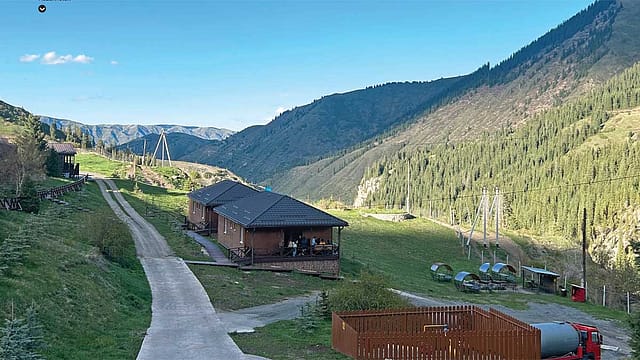
We had carried all our bags from Almaty to Saty because there was no other option. The van stopped at a certain point and beyond that we had to avail of the hotel’s conveyance—the driver was rude and impolite, frustrated possibly with having to make three rounds to take all our bags to the hotel, essentially a collection of cottages with a view of the gorgeous snow-capped mountains. For dinner, we had to walk a bit up in darkness to an Indian restaurant named Namaste and because the air was thin, it was not an easy climb while also carrying bottles of single malt whisky. I was a bit disappointed about having Indian food here. Things would have been worse if they had not agreed to make non-vegetarian food for us, after initially confusing us for a large Jain family for whom they had prepared a meal without onion and garlic.
An early morning walk along the Kolsai Lakes was an ethereal experience and since we wanted to have the best of Almaty, we decided to skip Kaindy Lake—of which we had already seen plenty of pictures of tree trunks submerged in the turquoise water. These are places where in summer hikers and mountaineers descend in large numbers with ample campsites and guesthouses to accommodate them. These scenic areas appear almost celestial and it is no wonder they are a big draw among adventure tourists from across the world, especially the Chinese and Europeans. The Indians we found there were either all-male groups like ours or families with kids whose idea was mostly to travel to a new place, take photographs and collect loud memories, not quiet adventure. These are places where, in the pre-Soviet era, people would die in the cold winters since their homes did not have foundations.
On our way back, we were again prepared to skip lunch and substitute with chocolates, biscuits and dry fruit because there weren’t good restaurants on the way back to Almaty. We did spend some time at Charyn Canyon in southeastern Kazakhstan, near the Chinese border. But we didn’t stay long as we were in a hurry to reach Almaty where we wanted to explore nightclubs, restaurants and enjoy street food. I was also given instructions by my family to make sure to bring back Kazakhstan’s famous pine nuts, walnuts, figs and chocolates—my earnest hunt for these souvenirs inspired most of my group to shop for these as well.
Besides samsa, Kazakhstan is famous for dumplings and sweet and fried flatbreads. We happened to find dumplings named manti, which are filled with meat and pumpkin. Beshbarmak (five fingers) comprises horse meat, onion broth and noodles; there are also many meals with horse meat sausage and biryani-like preparations (called plov, like pilaf). Among the names of dishes I had noted down from the menu at various eateries are lagman, shashlik and so on, all meat-based, besides grilled meat kebabs. Interestingly, since a large number of Indians travel to the country, there are Indian snack outlets at most tourist hubs; the menus in each restaurant announce that they also offer vegetarian and vegan items. The country offers a variety of tandoor-baked breads and dishes made from curd, mare’s milk and camel’s milk. We did come across sweets, too, the most notable being one made from millet and cheese with raisins in it.
Almaty is considered Central Asia’s party capital with a plethora of sophisticated speakeasies, details of which are available primarily on Instagram. But entry into nightclubs, from our experience, is not easy for Indians. One taxi driver, a Turkish guy, told us: You are discriminated against if you are from Turkey, India, Pakistan or Bangladesh. Why? Maybe due to their behaviour. Maybe it is racism. We didn’t probe further, but recommendations by well-wishers worked. Otherwise Indians are met with statements like: “we have a private party going on”; “we are full tonight”—as we were told at some nightclubs, including the famous Bla Bla Bar. People who have been to such spots tell us that Almaty is known for trendy late-night bars, live music venues and lounges, especially near the avenue named after former President Nursultan Nazarbaev.
We also enjoyed fabulous food at two other restaurants. One was the renowned Georgian restaurant named Daredzhani Kunayeva, and the other the Russian restaurant Marina Roshcha. At Daredzhani, one of our friends who always claims he is an expert on anything and everything Georgian and Arabic, placed the order along with exquisite semi-sweet wine and the night felt luxurious, almost indulgent, wrapped in wine and softened by the cold. Of course, testosterone was high, perpetually, because the 10 of us have 10 different views of how to go about doing things, sending at least one of us into paroxysms of outrage.
At the highly recommended Marina Roshcha, where we were served by an elegant, young Georgian who oozed grace, I decided to order Tsar’s stew, a soup with salmon, shrimps, champignons and cream, and Ribeye steak. It was soul food that tasted unlike anything I had ever tasted before. Even if I never go back to Kazakhstan, its taste will stay with me.