Israel Votes: Netanyahu Faces Eisenkot In High-Stakes Contest; Here's What Exit Polls Show
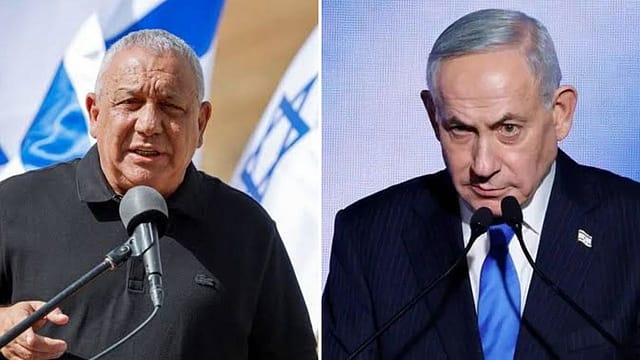
In less than 24 hours Israel goes to the polls in one of its most bitterly contested elections. The final surveys leave the outcome open. Eisenkot’s Yashar party leads Netanyahu’s Likud in the last television polls, while neither bloc reaches the 61 seats needed for a majority.
WHAT THE FINAL POLLS SAY
The three polls, published by Kan, Channel 12 and Channel 13 on Friday evening, show former military chief Gadi Eisenkot’s bloc holding a lead of two to six seats over Prime Minister Benjamin Netanyahu’s coalition.
Yashar gets 22 seats in Kan’s poll, 23 in Channel 12’s and 22 in Channel 13’s. Likud follows with 20, 21 and 19 seats, and Naftali Bennett’s Together party gets 14, 15 and 14. On the bloc count, Channel 13 has the anti-Netanyahu “change” bloc on 54 seats and the Netanyahu camp on 50, and the mostly Arab parties on 16. Channel 12 has the Eisenkot bloc on 56 and Netanyahu’s on 50, and Kan has the Eisenkot bloc on 52.

Losing Memory
16 Oct 2026 - Vol 05 | Issue 42
The making of a medical and social emergency
An average of four recent polls puts Yashar at 22 seats against 19.75 for Likud, with the gap between the two blocs at 4.5 seats. The picture is not one-way, though. In two polls, Eisenkot leads Netanyahu on the question of who is better suited to be prime minister, 44 per cent to 38, while Netanyahu and Bennett are tied.
WHY A LEAD ISN’T A MAJORITY
Leading the polls does not mean forming a government. The Eisenkot bloc’s refusal to work with Arab parties leaves it short of the 61 seats needed. The smaller parties also matter. Several, including the Reservists party and People of Israel, failed to cross the electoral threshold in one of the polls. The outcome could turn on which of them makes it into the Knesset. It is the sixth national election since 2019.
NETANYAHU’S PITCH: ONLY HE CAN HOLD BACK IRAN
For Prime Minister Netanyahu, the message is simple: only he can keep the Iranian threat at bay, a claim he is backing with an endorsement from US President Donald Trump. His coalition is made up of his Likud party, Finance Minister Bezalel Smotrich’s pro-settler Religious Zionism and National Security Minister Itamar Ben-Gvir’s far-right Jewish Power.
On Sunday he used that endorsement to paint a doomsday picture of what happens if his coalition loses. Netanyahu posted an AI-generated image of a nuclear explosion in Tel Aviv, warning two days before the vote that voting for anyone else could expose Israelis to a “second Holocaust.” The post quoted the right-wing activist Yuval Blumberg: “The State of Israel is in real and tangible existential danger. If the Iranians acquire nuclear weapons, nothing will ever be the same again.”
It went on: “We have another two years of Trump to finish the work in Iran... This is the window of time we have left.” That, it said, “won’t happen with a prime minister who can’t pick up the phone and have a continuous, intimate conversation with Trump.”
Trump endorsed Netanyahu for a second time on Truth Social. “When you go to the Polls, please remember that Bibi has been an outstanding Warrior Prime Minister,” he wrote. “Vote for Bibi Netanyahu for Prime Minister, we have to finish the job that we started.”
EISENKOT: ‘THE MAN WHO PRESIDED OVER THE GREATEST DISASTER’
Eisenkot casts himself as a security hawk and a political outsider. He is using October 7, 2023 to portray Netanyahu as weak on security.
“The man during whose watch the greatest disaster in the state’s history occurred refuses to understand that Israel’s security is not a political bargaining chip,” Eisenkot said on X. “The lives of Israeli civilians and IDF soldiers are not forfeit, and the State of Israel is not his personal property.” Israeli citizens, he said, “will put an end to the rule of recklessness and restore responsibility, statesmanship, and Israel’s security.”
THE OTHERS IN THE RACE
The rest of the field includes the alliance led by former prime ministers Naftali Bennett and Yair Lapid, former defence minister Avigdor Lieberman, and a four-party coalition headed by Yair Golan with a significant Arab-minority representation.
HOW ISRAEL ELECTS ITS GOVERNMENT
Israel uses party-list proportional representation. Voters choose a list, and each list gets seats in proportion to its share of the vote. Only lists that win at least 3.25 per cent of valid votes enter the Knesset, which has 120 members.
After the election, President Isaac Herzog gives a Knesset member the task of forming a government. That person must then win a vote of confidence in the Knesset. Every government in Israel’s history has been a coalition.
The victory of either side could reshape not only Israeli politics but the situation across West Asia.
With inputs from ANI