Israel Announces Strike on IRGC Fuel Storage Complexes in Tehran
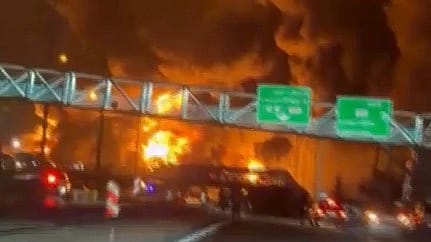
The Israel Defence Forces have announced that the Israeli Air Force conducted targeted strikes against multiple Iranian military assets in the capital city.
In a post on X, the military official account stated: "STRUCK: Several Fuel Storage Complexes Belonging to the IRGC in Tehran."
The operation, "Guided by IDF intelligence," targeted specific locations identified as hubs for distributing resources to various armed units.
The IDF noted that "The IAF struck these complexes, where the Iranian terrorist regime would distribute fuel to multiple military entities in Iran."
Regarding the impact, the military asserted that "The strike significantly deepens the damage to the military infrastructure of the Iranian terrorist regime."
An accompanying graphic highlighted a "fuel storage facility in Tehran used by the military forces of the Iranian terror regime," underscoring the strategic nature of the targets.
In response, the Islamic Revolution Guards Corps declared the commencement of its 27th offensive under Operation True Promise 4, targeting American and Israeli positions following what it termed a new wave of "unprovoked US-Israeli aggression towards the Islamic Republic," Iranian state broadcaster Press TV reported.
How did the IRGC use Kheibar-Shekan missiles in strikes on Israeli targets in Haifa?

I.N.D.I.A. Falling
12 Jun 2026 - Vol 04 | Issue 75
The Unravelling of an Alliance
The IRGC detailed the operation as a series of integrated drone and missile barrages, including counter-offensives against Israeli military infrastructure in the northern regions of the occupied territories.
"In this strategic and multidimensional operation, Zionist military targets in [the occupied city of] Haifa were struck by the IRGC's Aerospace Division's new solid-fuel Kheibar-Shekan missiles, which possess terminal guidance capability up to the point of impact,” the statement added.
Press TV also reported that unmanned aerial systems targeted a site housing American personnel, with the statement noting that drone units "successfully targeted the location where American forces are stationed in 'Marina', in the vicinity of the buildings of the 'Warner Brothers' company."
Simultaneously, the IRGC Navy engaged facilities linked to the US Fifth Fleet in Bahrain.
What did the IRGC claim about strikes on US-linked facilities at Salman Port?
According to the Corps, naval forces hit the command centre for unmanned surface vessels and military support hangars at Salman Port, which they described as belonging to "American terrorist forces."
Commenting on the situation in the occupied territories, the IRGC claimed that their monitoring suggests the Israeli administration is "attempting to create a human shield to protect its military personnel by confining residents of the occupied territories to northern and central areas."
Press TV reported that the persistence of retaliatory strikes has led to continuous emergency sirens across the region.
The IRGC stated that following these "smart attacks," the atmosphere has shifted into a permanent state of "siren after siren."
The military statement concluded by affirming that the Iranian Armed Forces are prepared for a long-term escalation, warning that their units "are lying in wait for American forces with precision and planning."
Operation True Promise 4 reportedly began immediately after the foreign strikes last Saturday.
Since then, the IRGC has launched hundreds of ballistic missiles and suicide drones targeting Tel Aviv, the "holy occupied city of al-Quds," and the technology centre of Be'er Sheva, with previous reports claiming successful engagements against the US aircraft carrier Abraham Lincoln and a destroyer in the Indian Ocean.
Why did the GCC condemn Iran’s strikes on Bahrain and Kuwait?
The ongoing Iranian offensives against Bahrain and Kuwait have drawn condemnation from the Gulf Cooperation Council.
The head of the GCC warned that these strikes represent "dangerous acts of aggression" that jeopardise the security and stability of the region.
Secretary General Jasem Mohamed Albudaiwi expressed in the "strongest" terms the council's "condemnation and denunciation of the nefarious Iranian attack" aimed specifically at Gulf territories.
Albudaiwi condemned the deliberate targeting of vital infrastructure, stating that striking civilian sites "constitutes a flagrant and unacceptable violation of all international norms and charters."
He affirmed that the council remains united in support of affected member states and emphasised that GCC countries stand firmly with Bahrain and Kuwait in protecting their security, safeguarding sovereignty, and maintaining the safety of vital facilities.
(With inputs from ANI)