Is Britain Ungovernable? Seven prime ministers in ten years. The gap between the political and the cultural could be the reason
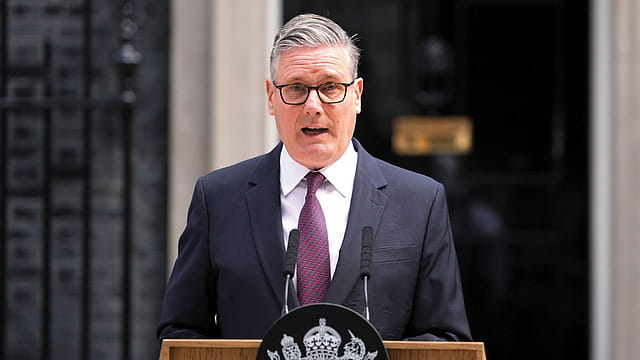
FOR A COUPLE OF CENTURIES, we British went about the world telling everybody else that they didn’t know how to govern themselves, so we would do it for them. But now it turns out that we have rather lost the art ourselves. With the recent resignation of Sir Keir Starmer, we are about to get our seventh prime minister in ten years.
The facts and figures are ugly, and suggest we are suffering from a degree of political instability that we laughed at Italians for. We have replaced four heads of government in the last four years; three were forced out by their own party colleagues, and only one by the electorate. This is an extraordinary rate of attrition for us. In the thirty-seven years between 1979 and 2016 we had only five prime ministers, at an average tenure of 7.4 years. Since 2016 the average term in office has been 2.5 years. It’s hard to dismiss that as a blip; it’s becoming a way of political life.
So, why this is happening, and when will it end?
Briefly put, it is because our two major parties, Labour and Conservative, have lost touch with their traditional electoral bases, a separation exacerbated by the long-term consequences of Brexit. Not Brexit itself, but the cultural impact of embarking on a bitter debate that crossed party lines, and brought so many elements of our political system into question.
Britain really did enjoy a very long period of political stability, and its foundations, long laid, were mutually reinforcing. Any historian worth their salt will trace the roots of Britain’s stable politics to a series of developments going back to the Magna Carta in 1215, the victory of Parliament in the 17th century, an independent judiciary, the culture of nonviolent politics and, not least, a sustained period of national prosperity.
Leaving out the old Whig boast that this was a special achievement unique to Britain, we can see that our politics reflected the country’s social condition in a continuous and flexible manner, with only occasional outbursts of discontent that the system was not able to absorb. The last really sustained bout of deep political protest was the Chartist Movement of 1838-48.
It might seem faintly absurd to look so deeply into history to explain the churn in 10 Downing Street, but there is a point to be made here. The social revolution of the 1960s was a response to social demands and was accomplished with very little protest in the streets. The steeply uneven economic consequences of the global financial crash of 2008, and the painful austerity it prompted, were met with general acquiescence rather than public disorder. But since the Brexit referendum of 2016, we have had violence on the streets in supposedly ‘national’ causes on several occasions, including a severe outbreak of rioting in the summer of 2024, targeted against immigrants, and another smaller bout of violence this June, following the murder of a student in Southampton by a British-born Sikh.
There have, of course, been other examples of rioting in modern British history, such as the Toxteth and Brixton riots of 1981, and a series of destructive rampages in northern English towns such as Oldham and Bradford in 2001. But these were local affairs, triggered by local grievances, and though they may have been exploited by politicians, they were not encouraged by them. By contrast, the recent violence we have seen was related to national political platforms and was incited via social media for party advantage.
The point here is that national grievances used to be recognised and handled by national parties in conventional ways, so that the rhetoric and the actions stayed within clearly defined boundaries of normality. But now, with the rise of populism, this has changed. Populism has many elements, and can be defined in different ways, but the presence of populism is an indicator of dysfunction, a sign that either the political system has become deaf to entreaty, or that the demands of large sections of the population are not being met. This is, in very large part, the legacy of how the Brexit debate invited extremists into the mainstream political arena.

Our politics is also being conducted against a background of deep economic failure and social dislocation, created by the gradual move from an industrial economy to a service economy, then finally to a digitalised financial economy. Along with a shift of economic gravity to the southeast of England, the number of people in well-rewarded employment has steadily declined, while the number of people outside the charmed circle of stable and secure social status has gradually increased.
It is now therefore much easier to assemble a majority out of discontented, disconnected and disoriented people than at any time in our democratic history, and with the decline in support for our two major parties, this majority can now be made to count.
Downstream from the 1999 decision of the Blair government to educate 50 per cent of the population to degree level, only around 35 percent is currently coming out of the university system, leaving a two to one majority without places on the digital gravy train. Our party system was set up to recognise the divide between capital and labour and has proved unable to address a divide between educated and uneducated.
These dislocations have allowed populism to grow, particularly in the light of the mass migration of the last two decades, which was sponsored by capitalists who needed cheap labour, but which opportunistic populists have successfully repackaged as a conspiracy, with shadowy ‘globalists’ in charge of a project to bring down British values and destroy our traditional culture.
Unemployment, social change, inadequate levels of welfare provision and a political system built for other conflicts in other eras has so shaken our traditional electoral loyalties that we are now in an era of ‘five-party politics’, with Labour and Conservatives still major forces, but challenged by populist insurgency, mainly from Reform UK on the right, and to a lesser degree from the Green Party on the left, with the Liberal Democrats still sitting somewhere in the middle, newly strengthened with 71 MPs.
But does this make the country ungovernable? Or is it just that politics has got more difficult for a generation of leaders who thought things were rather simpler?
Some political scientists have expressed a belief that Britain really has become less governable. We are too centralised, our civil service is no longer sufficiently responsive, local government is underfunded, the judiciary is too radical, and the House of Lords is too large and full of cronies, party donors and time servers. All this may be true, but some of the same people were criticising the British state when it was part of the European Union (EU), and for many of the same reasons. Remarkably, most of the griping about the failings of the British state is coming from the political right, and most of it is aimed at hallowed elements of the British constitution which are the result of long evolutionary processes. This is yet another indicator that the right of British politics is no longer conservative in any standard meaning of the word.
Britain is governable, but there are problems at both the apex and the base of our political processes.
The first is consumer culture, which has become a prominent factor in our instability. Consumerism prioritises the need to serve my own interests, imposes short deadlines and fosters low tolerance of imperfection, which produces a constant demand for delivery, change, and satisfaction. Anything less and the public mood will shift. This is why it took only one electoral cycle for the Tories to lose the large majority that Boris Johnson won for them in 2019, and why Starmer was looking at the same outcome within two years of his landslide victory of 2024.
Secondly, changing prime ministers has become a function of political parties, not the electorate. Dropping an unpopular leader before an election worked for the Tories in 1990 when they ousted Margaret Thatcher, but it has now become a reflex as much as a strategy. In 2019, the Tories threw out Theresa May in favour of Boris Johnson, and again it worked. Now Labour has taken up the habit, turning, most probably, to Andy Burnham as a charismatic saviour to follow an unpopular, wooden predecessor.
Burnham, like Johnson, also comes with a new philosophy to throw around. In Johnson’s case it was ‘levelling up’, which was never clearly defined and fairly swiftly began to look like a con trick. In Burnham’s case the new menu item is “Manchesterism”, an idea that also needs some explanation.
Manchesterism is the philosophy of government Burnham employed as metropolitan mayor of Manchester, which revolves around a view of what he calls “the productive state”. He believes he can bring real growth in productivity and a rise in actual prosperity for working people by selective public investment in infrastructure projects, cheap travel and a supply of affordable housing. This is an updated, business-friendly version of socialism, which lays aside much of the cultural agenda of the modern left.
Lastly, many in Britain have become convinced by cynical populists that our political heritage is somehow not connected to our cultural heritage, so they want to throw away our political heritage of acceptance and inclusivity in an attempt to preserve a bespoke version of our cultural heritage, which they see as exclusive, unchanging and xenophobic.
There is undeniably much wrong with Britain and the British state. Everybody says so. But does the new five-way politics offer any way out?
Of the five parties, none can currently muster an approval rating above the mid-twenties. Worse, there aren’t many natural coalitions available between the major contenders, as the three biggest parties are all sworn enemies. This is unquestionably the sign of a divided nation.
It is also hard to believe that any of the five is likely to produce stable, competent government. The Labour Party has problems with its traditional base; it’s no longer clear whom the Conservatives represent; the Lib Dems don’t have a single issue around which voters can coalesce apart from rejoining the EU; the Greens have strong support amongst the young but don’t have a secure policy framework; and Reform UK, the current frontrunners, have serious problems with leadership, policy issues, party structure and a new rival outfit to their right—Restore Britain—led by Rupert Lowe, a former Reform MP. Lowe will not lead his party into government, but he can do serious damage to Reform in any future general election, because he has taken the most radical members of Reform with him, and with support running at a little less than 10 per cent, he can expect to deny victories to Reform all over the country.
So, our major political parties have lost their traditional identities, are out of touch with their support bases and have become addicted to the idea of changing their leaders as a way to fix their problems. Sigh. The history of football tells us that the clubs who change their managers most often tend to be the least successful. Lessons should be learned.
Andy Burnham, our likely next prime minister, appeals to the optimist in every Labour supporter, but no one knows whether he will be any good at running the country, or whether his new raft of policies will be any more effective or work any quicker than previous attempts from both major parties.
As for Reform UK, its leadership is fractious and inexperienced, with a programme for government that changes constantly under pressure from the further right. Its voter base is even more fractious, and highly averse to compromise. To paraphrase Oscar Wilde, Reform’s bid for power looks like the unsuitable in pursuit of the unleadable.
If this were happening two hundred years ago, we would look ripe for invasion and takeover by... the Brits.