Iran War: A Tight Spot In Tehran
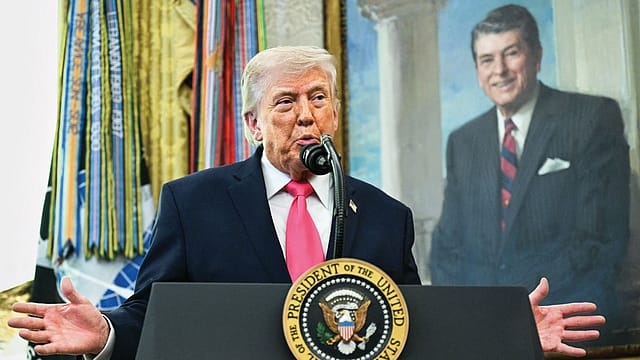
THROUGHOUT HISTORY, leaders have found that it is much easier to start a war than to end one. This is a lesson US President Donald Trump is now learning himself. He has already fought one war recently, in Venezuela, which he brought to a swift conclusion after only a matter of hours. But the enemy was of significantly less power, resilience and offered little threat compared to that the US now faces in the Gulf. Of all of Trump's wars, Iran is the one everyone will remember.
The war that the US and Israel launched against Iran just over a month ago is now entering its second phase. The first involved the initial strike that killed Iranian Supreme Leader Ali Khamenei and many senior officials. This was the first involving rolling waves of air strikes that have continued daily and nightly since February 28. They have continued too since Trump declared a sudden desire for peace last weekend. Statistics show that the attacks have intensified in recent days, in fact.
The first phase also saw retaliation by Iran, which targeted with repeated barrages of drones and ballistic missiles the Gulf, US interests around the region, critical oil and other civilian infrastructure, and Israel. Through the month of hostilities, Iran has made clear that despite the obvious damage it has sustained, its capacity to cause harm remains. We are now moving into the second phase of a conflict that I fear will last in one form or another for many months, if not possibly years.
This second phase has been initiated by Trump’s understanding that the costs of his conflict may well be higher than any presumed benefits to him or to the US or possibly Israel.
With an astonishing lack of foresight, American planners and senior officials appear to have managed to place themselves in a position of weakness. As the global economic consequences of the conflict rise, that position gets ever weaker. This is at the heart of Iran’s strategy, and always has been. It is not a guerrilla strategy, as some have said, but the pragmatic use of the weapons available to the Islamic Republic as it fights what is clearly an existential battle to continue its repressive decades-old rule over 90 million Iranians.
The real problem for Trump is that no plan ever survives contact with the enemy—as military strategists have always warned. What he is doing now is attempting to regain the initiative. That initiative has been lost in military terms, but he is now, in his own idiosyncratic way, trying to regain it through a form of diplomacy. Diplomacy usually involves a conversation, or at least a dialogue. In the case of Trump, it is a monologue, and that is obviously problematic—for those supposedly party to any talks, for those who offer their services as mediators, most recently Pakistan and Turkey, and it is extremely challenging for everyone around the world trying to grasp the various dynamics of this complex and rapidly evolving conflict. Pity, if you will, the energy traders trying to buy, sell or hold stakes in oil or gas or derivatives thereof when faced by an unprecedented crisis in global energy supplies coupled with an extreme unpredictability manifest in the single-most powerful individual who could potentially resolve that crisis.
The second phase of this conflict is going to be defined by the rare, if not unprecedented, situation we now find ourselves in with two actors in a conflict who both believe they are winning. The US has undoubtedly degraded much of the conventional military and many other capabilities of the Islamic Republic of Iran. Its strikes have been more targeted—with some very obvious exceptions—and more intense than probably any other air offensive in history. This is what, their strategists say, will lead to success. And it is difficult to deny that the radical clerical regime in Iran has suffered some significant losses. Of course, its navy was never a major strategic weapon. And its missile launchers could one day be rebuilt. The upper ranks of its military and paramilitary forces can be filled once more. But all of this will take time and in the meantime the regime is weakened. The problem is that it does not weaken the regime enough for the achievement of US war aims, such that we know, amid the confusion emanating from the White House over the last four weeks. As for the Israeli war aims, these have not yet been achieved either. The publicly stated calls for an uprising to overthrow the regime in Iran have clearly gone without response.
That is unsurprising given the risks that any such action would involve for anyone participating. The regime killed somewhere between 5,000 and 30,000 people who took to the streets in January. It has arrested thousands more since and is prepared to take any measure to ensure its survival. From the beginning, this was a regime soaked in the blood of its own people. But however much dissent there may be within Iran, it is unlikely to lead to any significant unrest in the near future.

A secondary objective for the Israelis is simply to degrade Iranian military capacities, whether conventional or unconventional, to the point that the threat posed by Iran to Israel is so limited that it can be usefully ignored for at least several years. This would be in line with the Israeli strategy towards Hamas and Hezbollah and other threats over recent decades which has involved repeated rounds of hostilities where Israel’s overwhelming force can be used to degrade, if not destroy, its enemy. This also, usefully for Israel, means that any serious examination of why these groups exist and the broader political context that fuels their appeal to supporters and sponsors can be avoided. Israeli officials tell me that they want more time to carry out the task of weakening Iran. Whether they get it or not depends largely on Trump.
The Iranians’ belief that they are winning explains why their positions in negotiations, which were maximalist and intransigent to begin with, have become more so in recent days. Trump has reportedly submitted a 15-point plan which involves demands that the Iranians have rejected many, many times, such as abandoning their nuclear programme, or at least all highly enriched uranium; giving up all support for regional proxies; and restricting their ballistic missile programme. Iran has refused these repeatedly before, and there seems no reason why it would accept them now. For its part, Tehran has asked for massive compensation from the US for damage done during the conflict so far, a withdrawal of US bases from the Gulf, if not the broader Middle East, and for Iran to be granted effective control over the vital Strait of Hormuz through which a fifth of the world’s oil and gas supplies flow. None of this is likely to be conceded by Washington.
That they ask at all is an indication of how confident the Iranians currently feel. Not only have they survived nearly a month’s pounding by two of the most powerful militaries that have ever existed, but they appear to be forcing the US president into a bid for peace that can only be explained as a reaction to the pain that Iran is inflicting. This pain is not through military damage, destruction or losses, but through the economic consequences of Iran’s effective blockade of almost all shipping through the Strait of Hormuz. The coming new phase of the war will be characterised by these two opposing forces, a belligerent White House that is now aware of the costs of its own actions, and an Iranian regime that, though fragmented and battered, believes that it has the upper hand.
That is why there will be a third and a fourth and a fifth and probably many more phases of this conflict. They may not all involve US and Israeli air raids on Tehran, or Iranian ballistic missiles falling on Tel Aviv, or its drones striking fuel dumps in Dubai. But the hostilities will continue. It is almost impossible to envisage any agreement that currently both parties could agree that would be durable. This may not bother Trump. The example of Gaza demonstrates what the US president is trying to do now. In Gaza, he proposed a 21-point plan and bullied Hamas and Israel into accepting it. This was meant to proceed rapidly to a second phase and then a third phase, eventually leading to the demilitarisation and reconstruction of the Palestinian territory. One may well ask how that is going. The answer is: quite badly. There has been no progress to a second phase. There is continual violence and loss of life in Gaza itself, where 2.3 million people live in appalling conditions with almost no prospect of these improving for any reason other than that the weather will get better as spring comes. Gaza is unresolved as a conflict. There is a low-level war of attrition which undoubtedly will flare into greater violence at some stage in the not-too-distant future. For the moment, any relative calm is preserved there because Hamas are happy with their recently re-established control over 2.3 million people and Israel is happy with its control of a sizeable swath of new territory.
THE SITUATION IS NOT dissimilar in Lebanon, where both Hezbollah and Israel paid little real respect to the agreement which brought their last round of fighting to an end. Israel has taken advantage of the current conflict in the Gulf to send significant forces into southern Lebanon and to strike across much of the country, killing more than 1,000 people so far, though we don’t have a breakdown of who amongst them were combatants. Even if Israeli claims of 700 dead Hezbollah fighters are true, it is clear that a significant number of civilians have also died and over a million are currently displaced. The question now is whether Israel will attempt to occupy the entirety of southern Lebanon up to the line of the Litani River as a buffer zone. There are reasons to think that this may not occur, at least not in a formal sense. One is that memories of Israel’s previous occupation of a smaller zone which led to a disastrous insurgency and bloody conflict for a total of 18 years are still very much alive in Israel. Another is that the Israel Defense Forces (IDF) may well not want to get involved in what would certainly be another quagmire. The alternative would be to wreak massive destruction on parts of southern Lebanon, particularly along the border, inflicting as much damage on Hezbollah as possible in as relentless a way as possible in the coming days and weeks, and then withdraw partially, once Trump tells Benjamin Netanyahu, the Israeli prime minister, to do so.
It is certainly the case that the Israelis were surprised by the strength of Hezbollah that they thought had been degraded in the previous round of fighting. This explains, to some extent, their determination to continue with what they see as unfinished work in Lebanon. But so does a new security doctrine, which justifies in the eyes of Israeli decision-makers a perpetual series of aggressive offensives. For decades, Israel has depended on deterrence through the use of often disproportionate force. Even that now is seen as a concession and a weakness. Instead, the thinking goes in Tel Aviv and Jerusalem that any potential threat needs to be annihilated whatever the immediate cost politically, diplomatically, or even militarily.
This, of course, is very different from the views of Trump, with his pragmatism, his inconstancy, and his supposed desire for a deal. It will be one reason why the discussions between Netanyahu and the current incumbent of the White House are likely to become more strained as this conflict continues. The Israelis will certainly be concerned by any prospect of a ceasefire negotiation which could lead to an Iran battered and wounded but still very much under the thumb of the current regime, remaining a force in the Middle East. So too will many Gulf States battered and weakened by this war, though publicly they continue to call for an immediate cessation of hostilities and have opposed the US and Iranian offensive. There is no doubt that many in capitals across the Gulf fear that the worst possible scenario would be a conflict that ends with Iran in a new position as an aggressor and a hostile power, with a new hold on key resources such as the Strait of Hormuz. The Saudis, for one, will want this war to conclude with an Iran that can pose no further threat to them. This prospect, however, looks a very long way off.
Thus we are where we are after four weeks of this unnecessary and illegal war. The first phase is over. A new one looms. This one will involve politics and supposed diplomacy and much in the way of public statements that have almost no bearing on reality-and continuing rounds of hostilities at various points across much of the Middle East. The economic consequences will continue to worsen as oil price rises ripple out through the wider global economy. Even in the best-case scenario, these will only be mitigated long after any conflict has ended. This, sadly, is the new chaotic, anarchic, unpredictable normal. For the next few months, possibly longer, we are just going to have to get used to it.