Iran-US peace talks to return? Emmanuel Macron steps in as Hormuz tensions rise
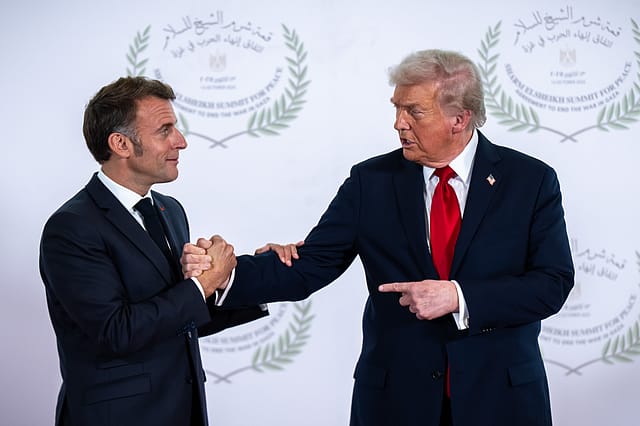
French President Emmanuel Macron has stepped up efforts to mediate between the United States and Iran as tensions escalate in the Strait of Hormuz. The crisis intensified after the US imposed a naval blockade aimed at curbing Iranian oil exports, turning one of the world’s busiest shipping routes into a geopolitical flashpoint.
The situation follows the collapse of earlier negotiations in Islamabad, prompting urgent diplomatic intervention to prevent further escalation.
What is Iran’s current position on talks?
Iranian President Masoud Pezeshkian has indicated a willingness to return to negotiations, but with conditions. Tehran insists that any talks must adhere to international law and include broader regional considerations.
Pezeshkian said Europe could help bridge the divide, noting that France can play a “constructive role” in engaging Washington. Despite setbacks, Iran maintains it is approaching talks with “determination and seriousness,” while stressing that progress depends on US flexibility.
What role is Macron playing?
Macron has held separate discussions with US President Donald Trump and Pezeshkian, positioning France as a key intermediary.
In a post on X, Macron said: “Yesterday, I met with Iranian President Massoud Pezeshkian, as well as with American President Donald Trump. I called for resuming the negotiations interrupted in Islamabad, for clarifying misunderstandings, and for avoiding new phases of escalation."

Open Minds 2026
26 Jun 2026 - Vol 05 | Issue 26
The power of ideas and arguments in 50 portraits
His intervention focuses on restarting dialogue and reducing tensions before the situation spirals further.
What are Macron’s proposals to ease tensions?
Macron has outlined a three-part framework aimed at stabilising the region and restarting negotiations.
“It is essential in particular that the ceasefire be strictly respected by all, and that it include Lebanon. It is equally important that the Strait of Hormuz be reopened unconditionally, without controls or tolls, as soon as possible. Under these conditions, negotiations should be able to resume quickly, with the support of the main stakeholders. France and the United Kingdom will also host this Friday, in Paris, a conference that will bring together by videoconference non-belligerent countries ready to contribute alongside us to a multilateral and purely defensive mission, aimed at restoring freedom of navigation in the strait when security conditions permit," he said.
His plan includes expanding the ceasefire to Lebanon, reopening the Strait of Hormuz without restrictions, and launching a multilateral maritime security mission.
Why is the Strait of Hormuz so important?
The Strait of Hormuz is a critical global energy corridor, and any disruption affects oil supplies and international trade. The current US naval blockade has heightened risks of confrontation, making diplomatic resolution urgent.
While the US sees the blockade as leverage, Trump described it as a way to “work a deal.”
What has the US said about negotiations?
Trump has indicated that Iran is now eager to negotiate.
Speaking at the White House, he said the US received a call “from the other side” and added that “they'd like to make a deal very badly.”
However, he reiterated Washington’s red line on Iran’s nuclear programme, stating that “Iran will not have a nuclear weapon.”
What is happening on the ground?
Despite diplomatic efforts, tensions remain high. The US Navy continues enforcing the blockade, while international actors are exploring independent maritime security arrangements.
France and the UK are set to host a conference to mobilise non-belligerent nations for a “purely defensive” mission to ensure safe navigation in the Strait.
Meanwhile, a second round of US-Iran talks is reportedly being coordinated in Islamabad.
What other tensions are emerging in the region?
Iran has also escalated its rhetoric against regional countries, accusing Bahrain, Saudi Arabia, Qatar, the UAE, and Jordan of enabling “US-Israeli aggression.”
In a letter to UN Secretary-General Antonio Guterres, Iran’s envoy Amir-Saeid Iravani called the US blockade an “illegal act of aggression.”
“The imposition of a naval blockade is a gross violation of the sovereignty and territorial integrity of the Islamic Republic of Iran," Irvani said.
He added that the move violates the UN Charter and constitutes “a textbook example of aggression under international law.”
(With inputs from ANI)