India-Russia: A Friendship for the Ages
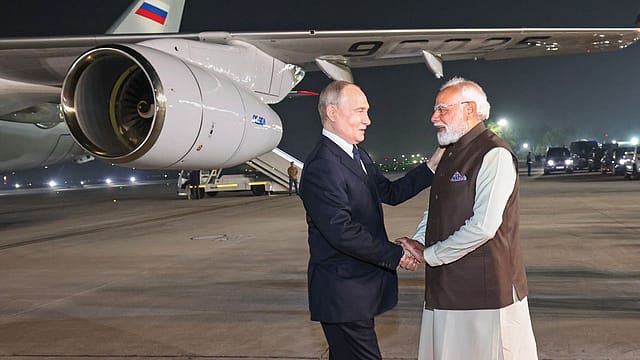
AS EXPECTED, Russian President Vladimir Putin’s visit to India has proved to be successful. There is a tendency in India to measure the ‘success’ of any high-level visit in terms of the number of agreements. That may be true in the case of countries with which India’s relationship is transactional and one can list even some “special”, “comprehensive” and “global” partnerships, but Russia falls in a different class. The two countries have a strong bilateral relationship that has stood the test of time. It is not surprising that this is the case.
Putin’s visit came at a time when India’s efforts to move into the Western orbit have come to naught. The US now views India in an adversarial light even if this is not stated openly. It has tried to hurt India’s economic prospects even if that has not succeeded. India’s relations with Russia should not be viewed through the prism of its relations with the US (or, for that matter, China). It is juvenile to view relations between countries from that perspective. The fact that India thinks a multipolar world is best for it and pursues a multi-alignment strategy makes India-Russia ties a natural fit.
At the heart of the relationship is realist logic that is understood and appreciated well in Moscow and New Delhi alike. For India, the matter is one of finding the right partners and friends in Eurasia. If one surveys the region that lies between the Sea of Okhotsk and the eastern shores of the Atlantic and from the Norwegian Sea to the Indian Ocean, one can only find three countries that have ties deep enough to matter. Otherwise, there are only adversaries (China and Pakistan) or sullen nations that want to lecture India on ‘values’ or actively interfere in India’s domestic affairs (the vast bulk of Western Europe) or others with whom India has little connect. Of the three, only Russia has the military muscle and the political wherewithal to support India. Russia and earlier, the Soviet Union, have done some exceptional heavy lifting for India in its difficult times. Those memories remain fresh in Indian minds.

Assembly Elections 2026: Race of the Warhorses
20 Mar 2026 - Vol 04 | Issue 63
The making of a summer thriller
But memories are not everything even if they matter a lot. In Russia’s case, it is the economic and military sinews that also matter. Here, the ledger is mixed. On paper, trade between India and Russia has grown since 2020. In that year, the two countries had trade of $9.25 billion; by 2024-25, this had boomed to $68.7 billion, an expansion of 642 per cent, which is unheard of. But take oil out of the equation, and these figures are not very different from what they were five years ago. India’s exports to Russia are anaemic, to put it mildly.
That is, however, not the correct measure of that trade’s value. Cheap Russian oil has saved India a lot of trouble and accounts in no small measure for India’s economic growth. The usual limiting brake on Indian growth is the cost of oil, a problem that can make nonsense of all budgetary calculations. Usually when the world grows—which basically means when China grows—the cost of oil rises, to India’s detriment. In an era of war and pestilence, inflation is all but certain. It is not surprising that India has been spared inflation even as its growth has routinely been 6.5 per cent and above, a combination unheard of in the contemporary world. Russian oil is the not-so-secret sauce of the country’s growth recipe. Even if India runs a large trade deficit, this is not the instance where imports have detrimental consequences for India’s ability to industrialise or where it has to worry about the security implications of imports.If the economic, political and military relationship is in the pink of health, why doesn’t it grow as in the case of the US, the other great Indian “partnership”? For one, Russia is a much smaller economy compared to the US and that puts a ard ceiling for expanding economic ties. Add war to the equation, and India’s ability to even expand trade has adverse consequences. The erratic Donald Trump used India’s oil purchases from Russia to impose punitive tariffs on India, never mind the fact that Trump wants to cut a “deal” with Russia.
The result is that India’s relationship with Russia is based on sound realist calculations minus the mawkish cant of “tango of democracies”, “virtue of values”, and such similar homilies. The two partner countries have a clear-headed idea of what each expects from the other. Unlike other alleged ‘friends’, Russia has never tried to arm-twist India. That makes a difference.
This was in ample display during President Putin’s visit. There was pomp and ceremony of the kind that signals warmth between longstanding partners who are making an effort to keep the relationship well-oiled. The key political discussions between the leaders were carried out away from prying eyes. The end-product is what both want. At some point, India will sign more military hardware deals with Russia. After all, Russia offers India what other countries will never give it: an Akula Class Submarine (SSN) on lease; more units of the battle-proven S-400 missile defence system; and a potential purchase by India of the still developing S-500 system. Russia wants to sell India the Su-57 fighter jets and seems willing to sweeten the deal. India is yet to take a decision but these matters have been discussed at the highest levels between the two countries. The contrast with the American ‘offer’ or non-offer is glaring: the Terminal High Altitude Area Defence (THAAD), never offered to India, is not only far more expensive but its usefulness in a near-contested space is doubtful. The strings attached with the F-35 fighter, again not formally offered to India, and its prohibitive life-cycle costs, is another case in point. The Russian alternatives, even while not fully meeting India’s requirements, do offer an option that is not available elsewhere. The world is in flux and that will only increase in the coming years. Even as India makes efforts to develop its own military industrial complex, it needs external supplies from reliable partners during the period in which it grows and matures its systems. Here, too, under Putin’s active encouragement, Russia has continued to supply vital pieces of equipment even as Russia faces constraints given its campaign in Ukraine. The delays in the supply of the pending S-400 system have led to some friction but the fact that India is willing to buy more of these systems (after the completion of the previous order) only shows its trust in Russia.
There are plenty of signs of heartburn in Western capitals that Putin has visited India. That erodes efforts to paint Russia as a global pariah and only increases anger against India. But this is more of a reflection on the pathetic state of Western diplomacy and understanding of how the world works and less about India being a ‘difficult’ country.
For India, the visit was about keeping the relationship in good working order. Given the discussions, the deals ahead and the bonhomie between the two leaders, it is clear that the relationship is where it should be: renewed, refreshed and revitalised.