India De-Hyphenates Af-Pak
INDIA’S DARKEST MEMORY OF Taliban rule in Afghanistan is the hijack of Indian Airlines Flight 814 on Christmas eve of 1999 that ended with the exchange of three hardcore jihadists held in Indian prisons for passengers on the flight at Kandahar airport. The safe release of hostages just ahead of the New Year was a huge relief for their families and the Vajpayee government but came at a steep price. The Indian government’s request to the Taliban to detain the three terrorists was summarily spurned and the men were safely escorted to the border and handed over to the waiting Pakistani reception committee.
Ahmed Omar Saeed Sheikh, who was in jail in India for kidnapping Western tourists in Jammu & Kashmir, gained worldwide notoriety for the murder of American journalist Daniel Pearl in 2002. Mushtaq Zargar, a resident of Srinagar and founder of the terror group Al-Umar Mujahideen, resumed his activities in Pakistan. The third terrorist released in the swap, Masood Azhar, a Pakistani national, set up Jaish-e-Mohammed with the help of Inter-Services Intelligence (ISI) and authored several acts of terrorism in India, including the December 13, 2001 attack on Parliament. India had been left with no cards to play once IA814 reached Kandahar and the hijackers, belonging to the Pakistan-based Harkat-ul-Mujahideen, were provided safe harbour by the Taliban then led by Mullah Omar.
When the Taliban returned to power in Afghanistan in August 2021, it seemed Pakistan’s duplicitous game of purportedly ‘assisting’ the US in its war on terror while simultaneously providing sanctuary to Taliban fighters and encouraging madrasas to churn out jihadists wedded to ousting America from Afghanistan had succeeded. Pakistan quickly hailed the development, anticipating that it was now set to regain its ‘strategic depth’ in Afghanistan—a euphemism for running terror networks and training camps to plan attacks in India and exercising influence over the new government in Kabul. It did not cross the minds of commentators in Pakistan that the Taliban’s ideas of running Afghanistan might differ significantly from what their ‘benefactors’ had in mind and that the allies would quickly drift apart.

In the early days after the Taliban overran official security forces in the wake of the US withdrawal, India hastily shut down its diplomatic establishment and facilitated the exit of local partners it had worked with and were at risk as Kabul changed hands. Hundreds of Sikhs, including children, were provided emergency visas and reached India along with precious religious books. The Indian security establishment began to reorient itself to the new regime in Afghanistan even as the government took the position that it would align its relations with the Taliban in the light of decisions taken by other democracies and ruled out any immediate accommodation with the hardline Islamists. True to form, the Taliban quickly imposed severe restrictions on female education and imposed controls over the internet. The governing structure, headed by supreme leader Hibatullah Akhundzada, includes the powerful Haqqani network led by Sirajuddin Haqqani, and other figures like Abdul Ghani Baradar, a Taliban veteran, and Mullah Mohammad Yaqoob, son of Mullah Omar who headed the Taliban when it was ousted in 2001 in the aftermath of the 9/11 attacks.
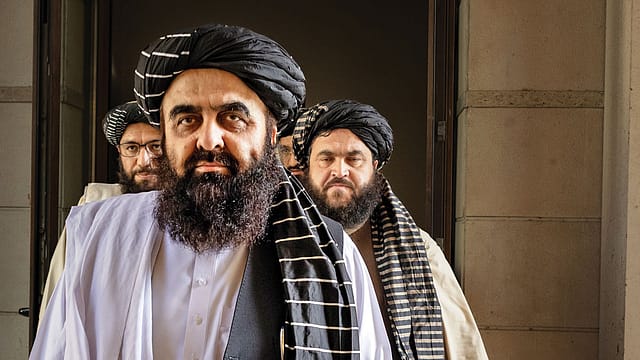
The India visit of Amir Khan Muttaqi, the regime’s foreign minister, during which he met External Affairs Minister S Jaishankar, representatives of Hindu and Sikh organisations, and paid homage to the outfit’s ideological front of Darul Uloom at Deoband marks a dramatic shift in perceptions in India and Afghanistan. “I am overwhelmed by the reception I have received [in Deoband] and the hospitality offered to me. I am grateful to the ulema and the people here. I see the future of India and Afghanistan relations to be very bright,” Muttaqi told news agency ANI at Deoband.
The full extent of how the Pakistan-Afghanistan script has defied Islamabad’s expectations was evident with Pakistan striking targets in Kabul coinciding with Muttaqi’s visit. The fighting between Taliban forces and Pakistan escalated over the weekend with Afghanistan launching retaliatory attacks on Saturday (October 11) night in the border regions of Kunar and Nangarhar. Pakistan said it carried out raids on Taliban camps and training facilities in Afghanistan and accused it of providing shelter to the hardline Tehrik-e Taliban Pakistan (TTP) or ‘Pakistan Taliban’ it holds responsible for several attacks. TTP has attacked Pakistani military targets and is committed to the establishment of an Islamic caliphate in Pakistan. Its immediate goals are to end Pakistani control over the Federally Administered Tribal Areas (FATA) and Khyber Pakhtunkhwa. Asked about Pakistan attacking sites in Kabul, Muttaqi warned the Taliban would defend itself. Unverified videos of Pakistani soldiers in the captivity of Taliban fighters only added to Islamabad’s discomfiture. Taliban spokesman Zabihullah Mujahid’s statement that ISI planned attacks in the Iranian city of Kerman and Moscow in 2024 using the Islamic State (Khorasan) based along the Pakistan-Afghanistan border areas only confirms how much the Taliban’s relations with Pakistan’s military have deteriorated.
India’s decision to host Muttaqi does not amount to a normalisation of relations with Afghanistan or an endorsement of Taliban policies towards women and minorities. But it does mean India is moving to re-establish its presence in Afghanistan, a development that potentially provides an opening to displaced Hindus and Sikhs to return or at least visit their homes. There is a large Afghan refugee population in India and while some of them might be on the wrong side of the Taliban, the ability of many others to visit their country has been restricted by the freeze in India-Afghan ties. In the past, development work carried out by Indian government and private agencies was vulnerable to attacks by Pakistan-sponsored groups. In 2008, three Indian staffers at the embassy in Kabul were killed by a suicide bomber. Another suicide bombing at the Indian consulate in Kandahar was foiled when the bomber was shot dead before he could carry out the attack. The erstwhile Afghan government led by Hamid Karzai was hard put to counter Pakistan-backed attacks and it is possible the Taliban may be able to provide a better level of protection. “Considering Afghanistan’s pressing requirement for economic recovery and development, both sides agreed that India would further deepen its engagement in development cooperation projects, particularly in the sectors of health care, public infrastructure and capacity building,” says the joint statement on Jaishankar’s meeting with Muttaqi.
INDIA’S ASSISTANCE WILL include projects such as a thalassemia centre, a diagnostic facility, a heating system at a children’s hospital in Kabul, construction of a 30-bed hospital, an oncology facility, maternity health clinics, ambulances, scholarships for Indian students, supply of foodgrain and reconstruction in areas affected by natural calamities. But the convergence between the Taliban and India and the basis for the upturn in relations are set out in paragraphs three and four that note Jaishankar expressing his “deep appreciation” of Afghanistan for its strong condemnation of the terrorist attack at Pahalgam on April 22 and the joint condemnation of terrorism. “The Afghan foreign minister reiterated the commitment that the Afghan government will not allow any group or individual to use the territory of Afghanistan against India,” the statement says. This is a crucial commitment as so far the Taliban has not allowed Pakistan to use territories it controls for planning and launching attacks against India. Rather than the strategic depth the Pakistan military anticipated, it is now locked in a deadly battle with the Taliban as the Pashtun fault line has flared to life. As Muttaqi put in colourfully, neither Genghis Khan nor the British could control the 2,400km Durand Line and it is not cast in stone.
The Taliban continues to struggle with international recognition despite following more pragmatic polices since it regained power. Engagement with India, the biggest military and economic power in the region, is a definite gain. Its policies towards women in particular are a sore point with the West where the influence of humanitarian lobbies is significant. The matter was in focus in New Delhi too during a media interaction where only male journalists were invited. A volley of protests saw the Afghanistan embassy organising another interaction, with women journalists prominently seated in the front rows. India’s engagement seems to be driven by a hard-nosed assessment that ruling out Afghanistan from its equations would be a case of self-harm.
The decision to host the Taliban leader has its share of critics. Bollywood veteran Javed Akhtar bemoaned in a post of X that “I hang my head in shame when I see the kind of respect and reception has been given to the representative of the world’s worst terrorists group Taliban by those who beat the pulpit against all kind of terrorists.” The most telling response came from X users who pointed out that the Taliban regime is not instigating terror attacks against India unlike Pakistan where Akhtar has attended literary festivals.
The Indian establishment realises that the Taliban regime faces no serious challenge internally and while Delhi has backed its rivals such as the Northern Alliance in the past, the policy had its limitations. The influence of Deoband is, ironically enough, not limited to the Taliban. The seminary is seen as their alma mater by madrasas in Pakistan seen in turn as fonts of extremism. Muttaqi’s visit to Deoband was not without its oddities but the fact that he was in India as a diplomatic guest shows a preparedness to work with what is possible rather than the ideal. This is a key gain and, interestingly enough, Muttaqi’s tryst with Deoband, where he was given the hadith sanad or certificate of scholarship, plays out well for India. Muttaqi clearly enjoyed his Deoband interaction and his affirmation of India-Afghan ties while surrounded by clerics and students might have caused more than a few hiccups at the Pakistan army’s GHQ in Rawalpindi.
The visit of the Taliban foreign minister has taken some time to come about. It was preceded by MEA joint secretary JP Singh meeting Mullah Yaqoob in Kabul in November 2024, with the Taliban statement noting a shared desire to expand bilateral relations and strengthen further interactions. Foreign Secretary Vikram Misri met Muttaqi in Dubai in January and the Taliban leader’s October visit to India saw Delhi announcing its decision to reopen its embassy in Kabul. Muttaqi will have returned to Afghanistan satisfied with the outcome of the visit and Pakistan’s hostile acts are only likely to convince the Taliban of the utility of improving relations with India. It would be an outcome that serves Indian interests well.