India Allowed Iranian Warship To Dock In Kochi On Humanitarian Grounds: EAM Jaishankar
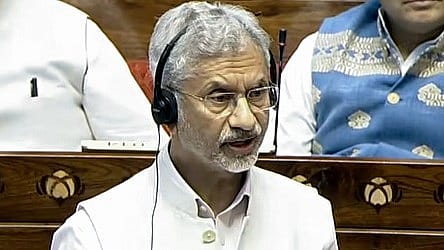
External Affairs Minister S. Jaishankar on Monday told Parliament that India granted docking permission to the Iranian naval vessel IRIS Lavan at Kochi on humanitarian grounds amid the ongoing conflict in West Asia, calling it "the right thing to do".
Addressing both the Rajya Sabha and the Lok Sabha, Jaishankar said the decision came after Iran requested assistance for multiple ships operating in the region during the escalating hostilities involving Iran, the United States and Israel.
Jaishankar said the Iranian side requested permission on February 28 for three ships to dock at Indian ports, and New Delhi approved the request on March 1.
The IRIS Lavan had reported a technical malfunction while operating in regional waters and sought urgent docking for technical checks and logistical support.
Where Is Iran's IRIS Lavan Now And What Is The Status Of Its 183 Crew Members In Kochi?
The ship had earlier participated in the International Fleet Review and the MILAN 2026 multinational naval exercises hosted by the Indian Navy in Visakhapatnam in February.

Open Minds 2026
26 Jun 2026 - Vol 05 | Issue 26
The power of ideas and arguments in 50 portraits
The vessel remains anchored at Kochi while assessments of the technical issue continue. The crew of at least 183 sailors is currently accommodated in Indian naval facilities.
Jaishankar also informed the Lok Sabha that the Iranian leadership had conveyed its appreciation to India for allowing the ship to dock.
The docking occurred on the same day another Iranian warship, IRIS Dena, was torpedoed and sunk by a United States submarine in the Indian Ocean.
The frigate was struck in international waters about 40 nautical miles off the southern Sri Lankan port city of Galle while returning from naval exercises. The vessel had also taken part in the Visakhapatnam drills.
What Happened After Iran Warship IRIS Dena Was Sunk Near Sri Lanka?
At least 87 bodies were recovered by Sri Lankan authorities, while 32 sailors were rescued alive and taken to Galle for medical treatment. Dozens of others remain missing.
A third Iranian vessel, the IRIS Bushehr, also reported engine trouble outside Sri Lankan waters and was allowed to dock there, with Sri Lanka taking custody.
Jaishankar said the government has been closely monitoring the security situation and has issued a series of advisories for Indian nationals and seafarers in view of the deteriorating conditions in the region.
The Ministry of External Affairs first advised avoiding non-essential travel to Iran on January 5, followed by a stronger advisory on January 14.
The Directorate General of Shipping issued a parallel advisory the same day instructing Indian seafarers to follow embassy guidance and avoid unnecessary ship movements. Recruitment and shipping companies were also asked not to deploy Indian seafarers to Iran.
Why Did India Issue Advisories Asking Nationals To Leave Iran Amid The West Asia Conflict?
Further advisories were issued by the Indian Embassy in Tehran on February 14 and February 23, urging Indian nationals including students, pilgrims, business persons and tourists to leave Iran using all available means including commercial flights and to contact the embassy through 24-hour helplines.
The External Affairs Minister also addressed concerns over India's energy security amid disruptions to global shipping routes through the Strait of Hormuz.
"In view of the implications of this conflict for our energy security, the government remains committed to ensuring that it takes into account the availability, cost and risks of the energy markets. For us, the interest of the Indian consumer is and will always be the overriding priority," he said.
Jaishankar said Narendra Modi has maintained close contact with leaders across West Asia during the crisis.
"PM has maintained close contact with relevant countries. He has personally spoken to the UAE President, Emir of Qatar, Crown Prince of Saudi Arabia, Crown Prince of Kuwait, the King of Bahrain, the Sultan of Oman, the King of Jordan, and the Prime Minister of Israel," EAM said.
"I have been in touch with counterparts in these countries. As far as the US is concerned, we have maintained contact through diplomatic channels," he added.
How Is India Assisting Nationals In Iran And West Asia During The Ongoing Conflict?
He added that Indian missions across the region remain operational and continue to issue advisories.
"Indian Embassy in Iran remains fully functional. Every Indian Embassy in the region have issued advisories, including Israel, Bahrain, Qatar, Kuwait, Saudi Arabia, and Iraq," said Jaishankar.
"Many of them did it on February 20, Israel did it on March 1, many countries in the Gulf did it again on March 3 and 5, so this is a continuous process. The MEA has set up a dedicated control room to monitor the situation and respond to queries of those affected," he added.
Jaishankar said the government has been facilitating the return of Indian nationals from the conflict-affected region.
"Till yesterday, almost 67,000 of our nationals have crossed international borders to return. Every effort is being made to bring back our people from West Asia. Once the conflict commenced, the Indian Embassy facilitated the relocation of Indian students in Tehran to places outside Tehran," he said.
During the proceedings, Opposition MPs raised slogans demanding a discussion on the issue and entered the well of the House holding placards.
Presiding over the session, BJP MP Jagadambika Pal urged the members to allow the minister to continue his statement.
"The minister is answering your concerns, please listen. You have been asked not to bring placards. Please let the house function," Pal said.
(With inputs from ANI)