How English Is Faragism? Does Nigel Farage embody Conservatism’s surge as well as crisis?
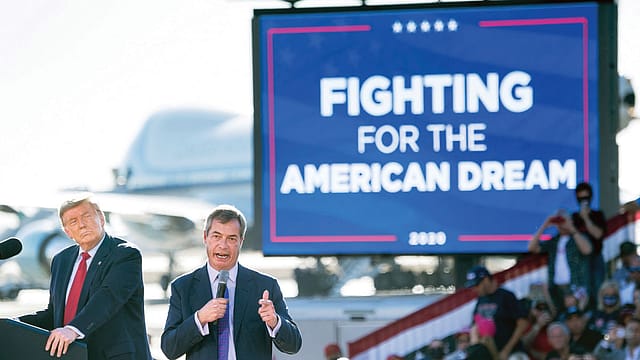
THE COMING YEAR MAY be Nigel Farage’s most difficult yet, even though his Reform UK party has topped the national opinion polls for months now, and he is the bookies’ favourite to be the next prime minister.
This is quite a feat for the leader of an outfit that only garnered five MPs at the last election. We Brits are not supposed to like anti-establishment figures like Farage. We are legendary for clinging to nurse for fear of something worse.
But Reform’s consistent poll lead is as much to do with a collapse in support for our traditional parties as with any great love for Farage, who has always been a divisive figure. The current Labour government is seen as incompetent and ineffective, while the Conservatives are widely reviled after fourteen years of infighting, policy chaos, and an enormous rise in immigration. A perfect time for a disruptor to arrive and break things, perhaps.
Yet 2026 promises to be unkind to Farage. His front-runner status is subjecting him to increasing personal scrutiny, his party’s success is bringing awkward choices with it, and global geopolitics is throwing up some acute dilemmas for him as a long-time anti- European and admirer of Vladimir Putin and supporter of Donald Trump.
Most immediately, a slew of accusations has appeared in the press about Farage’s behaviour while at school, and the racist, anti-Semitic picture that has emerged is not pretty. Many of us might be able to laugh off things we said as a teenager, but Farage has made a real mess of it, trying to use the Trump playbook while apparently not aware that it was designed by Trump to cow the media in the US, not for him to promote himself in the UK.
First, he denied saying anything offensive. It was all just ‘banter’. Then he indirectly conceded that he might have said some things that might have been offensive to some people, and that he might apologise in some unspecified future circumstance. But then he came up with a Trumpian selection of counterattacks and denials, and some unfortunately contradictory stances.
He imperiously declared that no one can reliably remember incidents from fifty years ago, while insisting that he definitely could, very distinctly, remember not saying anything nasty. Then he claimed that back then, in the 1970s, everybody said bad stuff because the BBC showed racist programmes, including The Black and White Minstrel Show, which featured white singers in blackface. But while defending himself by claiming that it was commonplace to say racist things at the time, he denied doing so himself.
Finally, he tried to turn defence into attack, by saying that if anyone should apologise it should be the BBC, for all their historic output. The BBC is just one of the venerable British institutions that Farage has sworn to dismantle, along with the judiciary, the civil service, and the House of Lords. But in demanding an apology, he failed to notice that the Black and White Minstrels never make jokes about Hitler and gas chambers, and neither did anybody else with a shred of decency.
Undeterred, he threatened that if the BBC did not apologise, he would boycott it until further notice. Commentators found this difficult to figure out, because Farage owes his national profile almost entirely to the lavish coverage that the BBC granted him from around 2011, when his then party, the United Kingdom Independence Party—UKIP—first began to make serious inroads in the national opinion polls.

Farage has his own show on GB News, a dedicated rightwing channel, but the BBC’s current affairs programming attracts vastly larger viewing figures, and he would be a fool to deny himself access to millions of eyeballs across the country. He has threatened to boycott Auntie before and never did. He probably knows which side his bread is broadcast.
Most people think he should simply admit that he said some silly things when he was younger and shrug them off. But there are problems with doing something so eminently sensible, because he still says things that are racist adjacent, so nobody believes he has changed his position much over the intervening decades. And by admitting that his former opinions were wrong, he would accept the validity of the ‘woke’ agenda and would essentially be compromising his own brand, which is something Donald Trump would never do. So, no one expects that he will do it either.
Whatever damage may or may not be done to his prime ministerial credentials because of Bantergate, the apparent political strength of his new party brings complicated risks of its own.
One of Reform’s great boasts is that it has brought new people into politics, but if the party is to make the leap from an opposition splinter group to forming the next government, it will have to find over 300 more MPs, and if these are all political novices, the prospect of a Farage-led government would have zero credible authority. This is a serious issue because since last April’s local elections, in which Reform did well, the new recruits who have formed Reform administrations in eleven County Councils have been fighting among themselves, saying ridiculous things, and even forming new mini-parties inside their own party.
The recruitment problem could be solved by attracting high-profile, experienced defectors from the Conservatives, but this is tricky, because Farage has sworn to destroy and replace the Conservative Party, and the more Tories that defect to Reform, the more Reform looks like the Tory party, which is loathed and despised, not only by the public but especially by members of Reform.
So, as the good ship Tory slowly sinks, Farage will have to devise a specific rat selection process, by cherry-picking the most useful applicants, and not simply giving places to Tories who lost their seats at the last election and are looking for a way back in. This means that potential Tory defectors must also pass an ideological test, because if he recruits too many centrists, he risks diluting his party’s brand, and might make his party less manageable than he would like it. So, he needs to attract people who would have been in Reform if it had existed at the time—that is, they have to be a bit mad, but not too mad. The number of swivel-eyed lunatics who are really useful to him is very small, and thus far he has recruited one sitting MP, and one member of the House of Lords, who wants to stand as a member of the Scottish Assembly at the next election.
On this basis, the dream candidate would be Robert Jenrick, a senior Tory hardliner who narrowly lost out to Kemi Badenoch in the last Conservative leadership contest. But someone of Jenrick’s status would also be a natural rival to Farage within the party, and the one thing we all know about Nigel Farage is that he has not tolerated rivals within any of the organisations he has ever led.
So would he take Jenrick? Did the Trojans take the horse? Well, yes, they did. But it didn’t end well for them, and Farage knows this very well.
But perhaps the knottiest of Farage’s dilemmas arrived last week, with the announcement of the new US National Security Policy (NSS), which has caused consternation in foreign ministries all across Europe, and presents some serious problems for Farage too.
The NSS has announced President Trump’s undisguised hostility to the European Union, and on this topic he and Farage are aligned. But there is no ‘carve-out’ for the UK in the new policy. For Trump, Europe is one thing, and he expects that by encouraging ‘patriotic’ parties in France, Germany, the Netherlands, and elsewhere, he can weaken Europe as an entity in terms of its rivalry to the US, particularly in the matter of business regulation. This stance might be promising for Farage, who would lay claim to ‘patriotic’ status, and it matches the favour that Elon Musk has shown his party in the past, even while Musk has complained that it’s not extreme enough.
But the efforts to encourage insurgent parties in order to weaken European unity are also the policy of Vladimir Putin. So even though Farage’s party now seems to be in alignment with the two major adjacent power blocs to the UK, the problem is that neither of those blocs has any intention of accommodating the independent interests of the UK, and will give us no consideration in their geopolitical visions.
This is an embarrassing position, which goes to show that leading a nationalist populist party may be a successful route to power within your own nation state, as Giorgia Meloni in Italy and Viktor Orbán in Hungary have already shown, but if your nation is small, it risks leaving you alone in a playground of much bigger bullies. For Donald Trump, the concept of friends and allies no longer exists. The world is merely a collection of subservient clients, customers and rivals. Putin has always taken an even harsher view, where no independent interests need be served, and all financial roads lead back to his own bank account.
The admiration Farage has previously expressed for both Trump and Putin now looks like he has put the fate of post-Brexit Britain in the hands of outside, unfriendly forces. He can only reiterate his previous claims that the British are better standing alone, without the European Union (EU) beside us, and hope that we might get favourable treatment from Trump, Putin and Xi, the new Three Emperors League.
It’s not clear whether Farage saw this coming. There was a long-term split on the right of British politics between Atlanticists, who admired the US and believed it should be a template for our economy and politics, and Europhiles, who preferred European liberal democratic models. Europhiles predominated in Margaret Thatcher’s cabinet, and it was they who brought about her downfall. At the time, most of the Atlanticists were on the back benches, but they subsequently took over the party, and led the country out of the EU after a long campaign that started in the 1990s.
It is clear that Trump and many other Americans are prepared to use whatever advantages they have to grind the rest of the world into the dust if they refuse to comply with their demands, in terms of culture, business, or direct personal enrichment. Bluntly put, come the next general election, Nigel Farage is going to ask the British people to vote themselves into vassalage in one of two unfriendly blocs whose interests will override anything anyone in Britain can suggest. Trump says we are in danger of ‘civilisational erasure’ and Vladimir ‘traditional values’ Putin claims we are weak, decadent and confused. Farage will have to tell us that we are none of these, that we are still the best, that we alone can determine our fate simply by telling the rest of the world what we want. That was the logic of Brexit, but as yet there is no prospect of us leaving the planet, or Plexit.
The Faragist brand of Atlanticism now looks outdated and unrealistic. We in Europe have been told in capital letters that America is not our friend. Farage may want to rebuild Britain in America’s image, but this is not a popular idea. Two-thirds of Brits dislike Donald Trump, and well over half would now consider rejoining the EU.
Farage still lacks a clear policy platform. He mumbles about mass deportations and immigration bans, and he even invented a cost-cutting body called DOLGE, the Department of Local Government Expenditure. But when it turned out that after fourteen years of painful austerity there was almost no expenditure to slash, the whole project was quietly put aside.
Would a Farage government continue to support Ukraine? He will be asked. Would he simply allow Putin a free hand anywhere in Europe? And would that include the UK?
For a man in opposition, Farage has an unusually large number of questions to answer.