Ganga Treaty: Waters of Discord
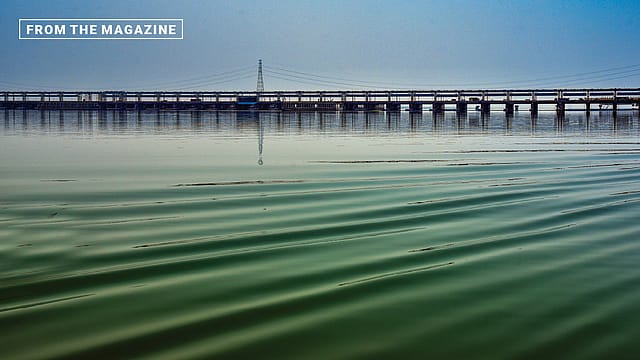
THE TREATY BETWEEN India and Bangladesh on the sharing of Ganga waters is set to expire on December 12 this year, 30 years after it was signed. A storm of sorts is already brewing on the subject. In a recent oped, Sanjay Kumar Jha, an MP from Bihar and national working president of Janata Dal (United), questioned the logic of the treaty and said that it should be allowed to expire.
Jha’s argument is simple: when the treaty was signed, Bihar’s interests were ignored. It is also a fact that water flows in the Ganga have declined significantly since the time the treaty was signed. These assertions have thrown a stone in the water. The ripples will continue until India takes a decision on the matter later this year.
“Tell me one thing: when was this treaty signed? In 1996. When the treaty was being signed between Bangladesh and India who was the chief minister of Bihar? When Bihar’s interests were compromised and sold off. Who was the chief minister of Bihar then? Who ran the government at the Centre at that time? When everything was done and dusted, then 15 year later when everything went into water then you are giving statements,” Jha told reporters in Patna on August 23. He added, “Congress was supporting the (United Front) government then. Congress should explain that when all this was being done how you compromised on Bihar’s interests.”
Jha was making a political point and the observations in his oped and his statement argue that this was the second time in independent India that Bihar’s interests were sacrificed, the first time by the Freight Equalisation Policy that robbed Bihar of its advantage of mineral wealth and later even the Ganga’s water was given away.
Experts concur that the economic and water-sharing aspects of the Ganga Water Treaty should be assessed scientifically. “Bihar’s concerns should be taken into account. There should be a scientific assessment. This is not just about Bihar but also Jharkhand and other states,” Uttam Kumar Sinha, an expert on water-sharing issues in South Asia at the Manohar Parrikar Institute for Defence Studies and Analyses (MP-IDSA), told Open.
There is merit to this line of thinking. The 1996 treaty provides a schedule for sharing of water as well as the actual flows from January to May every year. These are outlined in Annexures I and II of the treaty. In any case, India is bound to give Bangladesh at least 35,000 cubic feet per second (cusec) of water. There are only three 10-day periods in March, April and May when these flows fall below 35,000 cusecs. The calculations are based on average flows from historical data between 1949 and 1988. Since then, these flows have gone down substantially as Jha said and as experts have agreed at different times. These flows are based on availability at Farakka in Murshidabad district of West Bengal. Article XII of the treaty provides an expiry date—December 12, 2026—as well as the option to renew it based on “mutual consent”.

Bangladesh is now seeking “guarantees” to be built into the treaty when it comes up for renegotiation. Given the present climate of hostility against India in Bangladesh, there are doubts about the benefits of renewing the treaty. In recent years, India has prioritised its national interests in handling water issues with its neighbours. The Indus Waters Treaty of 1960 between India and Pakistan on sharing of river waters is now in abeyance after Pakistan refused to stop the flow of terrorists from its territory into India. Bangladesh, too, has posed its own set of security and other challenges to India.
“It (renegotiation) is not going to be easy,” says Sinha. He noted that water politics in South Asia is increasingly nationalist and politicised. “There was a period of cooperation in the 1950s, 1960s and sometime later. That was a period of peace and stability in South Asia when countries thought they could move forward and cooperate,” he adds.
The problem for India now is that treaties like the Ganga Water Treaty and the earlier Indus Waters Treaty were quite generous and did not examine India’s interests with the necessary foresight. This is particularly true for the Ganga Water Treaty that was signed during a time of political flux in India and when a particular ideology of generosity was in vogue.
IF THE KEY aspects of the treaty are now being questioned, the politics behind it was even more questionable when it was signed. The signature on the treaty was that of then Prime Minister HD Deve Gowda but the stamp behind it was of IK Gujral, who was external affairs minister at the time and the moving force behind the treaty.
In the years and decades that followed, retrospective justification for the treaty mushroomed. One potent myth is that India needed a modus vivendi with Bangladesh to ensure that its northeastern states remained peaceful. The hint was at the shelter being given to all manner of terrorist outfits, including the United Liberation Front of Asom (ULFA). To an extent, Sheikh Hasina delivered. There was a crackdown on anti- India groups. But the problem returned five years later when Khaleda Zia become prime minister for the third time.
More than such calculations going awry, India’s choice at that time—sacrificing long-term interests for short-term gains—was dictated by a mix of expediency and an ideological fixation, the so-called Gujral Doctrine. Operationally, this “doctrine” led to India giving up its longstanding positions on several issues in the neighbourhood and favoured its neighbours. It did not seek any reciprocal actions from these countries.
The season of generosity began with Chinese President Jiang Zemin’s visit to India in late November 1996. The embattled United Front coalition government described the visit as historic. It is another matter that Jiang went to Pakistan and Nepal as well immediately after his visit to India. It is another matter again that China did not heed India’s concerns about Chinese assistance to Pakistan’s nuclear weapons programme. On Jammu & Kashmir, too, China issued a vague statement on resolving the problem through “peaceful means”. That was one of the worst phases of insurgency in J&K. At that time, Pakistan and Western countries had mounted a concerted campaign against India on J&K. China’s position did not go against what Pakistan claimed.
Similarly, in late November, India ratified the Mahakali Treaty with Nepal, in essence a water and power sharing agreement. Nepal agreed only reluctantly and even that led to political controversy in that country over a “compromise” with India. In turn, India agreed to allow greater imports from Nepal.
In September of that year, Gujral undertook a three-day visit to Bangladesh, the first by an Indian external affairs minister since 1971. At the same time, he was instrumental in persuading Jyoti Basu, then chief minister of West Bengal, to convince Hasina
to agree on the Ganga agreement. Basu had no formal mandate from the Centre to negotiate on India’s behalf. The crucial enabling condition of this “informal diplomacy” was twofold: one, the Centre was weak and regional parties constituting the government could do pretty much what they wanted. In the 165-member contingent of the coalition in Lok Sabha, the “anchor” party, the Janata Dal had a princely number of 46 MPs. The Left—CPM and CPI—had 44 MPs. In such a situation, could anyone question Basu, let alone ask him not to go ahead with his visit? Two, the water-sharing dispute was, allegedly, complicated as the fate and bickering over previous attempts to solve the problem—the 1972 Joint Rivers Commission and the 1977 agreement on the sharing of Ganga waters—show. The 1977 agreement lapsed in 1982 and was followed by two MoUs (1983 and 1988). This was indeed a complex issue and not just for Bangladesh. India, too, needed to consider its interests. But in the so-called spirit of magnanimity, they were sacrificed.
Even before Jha had raised these points, critics had pointed to the substantially lower flow of water in the river partly due to higher usage in Uttar Pradesh and Bihar. Apart from the waters issue, India’s interests—transit facilities for Indian goods in Bangladesh, export of natural gas from Bangladesh, and the return of Chakma refugees—were not heeded. Bangladesh has substantial reserves of natural gas, around 30 trillion cubic feet, spread over more than two-dozen fields. That country has not exported one cubic foot of gas to India even after India made an economically sound pitch to Dhaka. In fact, not exporting natural gas to India is considered the mark of patriotism in Bangladesh, irrespective of the party in power. The question of a gas pipeline with India is moot.
It took the return of Hasina for agreements on transhipment, transit and port facilities between the two countries. But these have been progressively degraded due to Bangladesh’s political stance against India after Hasina’s ouster in 2024. Bilateral ties deteriorated under the “caretaker” government of Muhammad Yunus. Yunus’ repeated statements on the “seven sisters” and how they are “naturally linked” to Bangladesh—an open statement on India’s northeastern states—led to India progressively tightening the screws on these facilities provided to Bangladesh, especially to its export markets outside neighbouring countries like Nepal and Bhutan.
THE SITUATION HAS changed dramatically since 1996 when the Ganga Water Treaty was signed. There are now voices within India about preserving its interests in utilising these river waters. Again, one of the original motivations for constructing a barrage at Farakka, that of preventing the silting of Kolkata port and ensuring the navigability of the Hooghly river, is no longer relevant. “In any case, Haldia has emerged as a key port in the area,” says Sinha.
India is now insisting that Bangladesh meet it halfway. In recent remarks, External Affairs Minister S Jaishankar has responded to questions about India’s relations with Bangladesh, saying, “For any relationship to work, it has to meet the extent of mutual interest… There has to be a fair degree of, a reasonable degree of, my recognising and respecting what is their interest, just as I expect them also to do so. It is when you get that landing point, that common ground, that relationships work smoothly…”
This is a far cry from the days of the Gujral Doctrine. In recent months, after Tarique Rahman became prime minister, it was expected that the bitterness of the Yunus days would be dispelled over time. Instead of furthering bilateral relations and economic cooperation, Bangladesh now poses security challenges to India.
In a recent interview, Humayun Kabir, foreign affairs adviser to the Bangladesh government, said, “Bangladesh maintains a positive approach towards the possibility of joining an economic or defence framework involving Saudi Arabia, Pakistan and Türkiye, taking into account its own interests and the changing dynamics of the global economy and trade.”Kabir, an anti-India voice in his country, was referring to the Mecca Agreement signed by Saudi Arabia, Pakistan, and Turkey on defence cooperation.
Kabir’s statement is not an isolated one. Bangladesh and Pakistan now have an active defence partnership. Military exchanges between the two, including those between the Inter-Services Intelligence (ISI) and its Bangladeshi counterpart are now frequent.
In such a situation, where Bangladesh now seeks to create security problems for India as a bargaining device, it is debatable whether India should go ahead with renewing the Ganga Water Treaty at all.