G7 Summit: Spotlight On The Seafarers Issue That Dominated PM Modi-Trump Talks in France
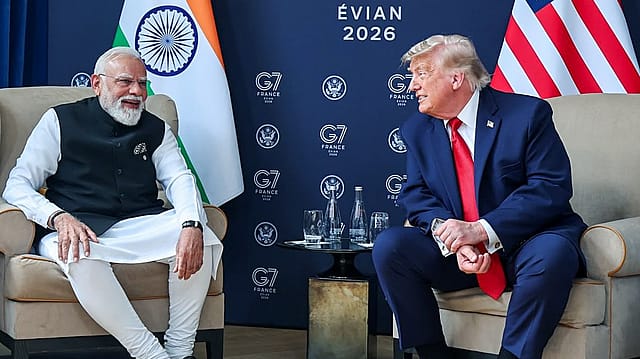
The safety of Indian seafarers emerged as a key issue during Prime Minister Narendra Modi's meeting with US President Donald Trump on the sidelines of the G7 Summit in Evian-les-Bains, France on Wednesday.
The discussion came in the aftermath of a tragic incident in which three Indian sailors were killed during US military strikes in the Gulf of Oman last week. The deaths sparked public concern in India and added urgency to New Delhi's efforts to secure stronger safeguards for Indian maritime workers operating in one of the world's most strategically important and volatile regions.
While the meeting covered a broad range of subjects including trade, defence cooperation, technology, energy, artificial intelligence and regional security, the protection of Indian seafarers emerged as one of the most significant humanitarian issues discussed by the two leaders.
Why Indian Seafarers Matter to the Global Economy
India is one of the world's largest suppliers of maritime labour, with hundreds of thousands of Indian citizens working aboard commercial vessels across international shipping routes. These workers play a critical role in sustaining global trade, including the transport of energy supplies through the Middle East.

Zeroing In on ECI
09 Oct 2026 - Vol 05 | Issue 41
Constitutional legitimacy versus political opportunism
During his conversation with Trump, Modi highlighted the importance of ensuring safe passage through key maritime corridors, particularly the Strait of Hormuz, one of the world's most important shipping chokepoints.
"You and I agree that keeping the Strait of Hormuz open is vital for the global economy," Modi said.
Emphasising India's stake in maritime security, he added: "Hundreds of thousands of Indian seafarers are working and performing their duties across global maritime trade routes... and their safety is of utmost importance to us."
The remarks reflected India's broader concern that any escalation of tensions in West Asia could directly affect not only global commerce but also the livelihoods and safety of Indian maritime personnel.
What Trump Said About the Deaths of Indian Sailors
Trump acknowledged the recent deaths of the Indian sailors and indicated that Washington was prepared to work with New Delhi on the issue, though he stopped short of announcing any immediate measures.
"I heard about that (the deaths), it's a rough profession, no question about it... We will work together," Trump said.
The US President also sought to reassure India about broader security cooperation. Speaking about Washington's willingness to support India in the event of a crisis, Trump said: "Without having a contract, we don't have a contract – but if they were attacked, we would be there to help them."
The comments underscored the strategic importance that both countries attach to maritime security and regional stability.
A Meeting Shaped by Trade, Security and Earlier Diplomatic Frictions
The Modi-Trump meeting took place against the backdrop of a challenging period in India-US relations.
Over the past year, bilateral ties have faced strain over several issues, including US tariffs and Trump's repeated claims that he helped mediate the military tensions between India and Pakistan in May 2025. New Delhi firmly rejected those assertions, maintaining that the cessation of hostilities resulted solely from direct engagement between the two countries.
Immigration policy has also been a source of friction. Concerns over changes to US visa rules and higher H1B visa fees have generated anxiety among Indian professionals. Responding to questions on the matter, Trump told PTI that the United States has maintained a strong employment relationship with India.
Despite these disagreements, both governments used the G7 meeting to emphasise areas of cooperation. Following the talks, Modi said he and Trump had "reviewed the sustained progress" in bilateral cooperation spanning trade, energy, defence, technology and people-to-people ties. He also "Reiterated the importance of ensuring the safety and security of civilians, including seafarers," according to news agency PTI.
US Ambassador to India Sergio Gor described the meeting as "highly productive," saying discussions covered trade, regional security and economic partnership.
Trump also indicated that negotiations on a bilateral trade agreement were progressing well, saying the United States and India were "very close" to finalising a deal, though he did not provide a timeline. He further confirmed that he plans to visit India at a future date.
The personal rapport between the two leaders was also on display. Praising Modi's negotiating abilities, Trump remarked:
"He's a very tough negotiator... He looks so nice, he's like an angel. But actually, he's tough."
Beyond Seafarers: Modi's AI Vision at the G7 Summit
Alongside bilateral meetings, PM Modi also addressed the G7 Outreach Session on artificial intelligence, titled "Ensuring a Safe, Rapid and Efficient Rollout of Artificial Intelligence."
The Prime Minister described AI as a transformative technology capable of reshaping human civilisation but stressed that its development must remain centred on human welfare. He reiterated India's "MANAV" or human-centric vision for AI, arguing that the technology should be guided by inclusivity, security and public benefit.
Calling cyberspace a global public good, Modi said democratic countries must have access to AI systems capable of protecting critical information infrastructure and countering cyber threats. He advocated an integrated approach balancing innovation, safety and efficiency.
He proposed four broad principles for the future of AI: systems should be safe by design; deployment should be governed by common standards and testing frameworks; countries should cooperate against deepfakes, misinformation and cyber fraud; and AI's benefits should extend to the Global South to ensure equitable development.
Modi concluded that AI must "expand human potential, empower human choice and protect human dignity," while reaffirming India's commitment to working with international partners on these objectives.
What the Meeting Means Going Forward
The discussions in France highlighted the breadth of the India-US relationship, from maritime security and regional stability to trade negotiations, defence cooperation and emerging technologies.
A statement issued after the meeting noted that both leaders reviewed progress under the India-US COMPACT initiative and welcomed advances in defence, strategic technologies, energy and bilateral trade. The two sides also expressed satisfaction with negotiations toward an interim Bilateral Trade Agreement and directed officials to work towards a balanced and commercially meaningful deal at the earliest opportunity. US Trade Representative Jamieson Greer is expected to visit India next week as part of that process.
The leaders ultimately reaffirmed their commitment to strengthening the India-US Comprehensive Global Strategic Partnership and expanding cooperation across multiple sectors.
For India, however, one message stood out clearly from the meeting: as geopolitical tensions continue to affect global shipping routes, the safety of Indian seafarers remains a national priority and a key issue in discussions with major world powers.
(With inputs from ANI)