From Knesset Honour to X Trends: PM Modi’s Israel Visit Takes Centre Stage
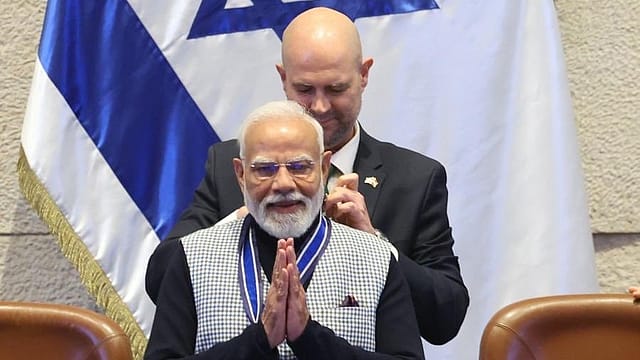
Prime Minister Narendra Modi began his latest visit to Israel with a powerful mix of symbolism and strategy, earning a standing ovation inside the Knesset and receiving one of its highest parliamentary honours.
Addressing a Special Plenary session in Jerusalem, PM Modi was applauded by Israeli lawmakers who rose in acknowledgement at the conclusion of his speech. He was then conferred the prestigious “Speaker of the Knesset Medal,” the highest honour awarded by the Israeli Parliament. The recognition was granted for his "exceptional contribution through his personal leadership" in strengthening India-Israel ties, making him the first foreign leader to receive the distinction.
The atmosphere extended beyond formal ceremony. After the address, Members of Parliament lined up to greet him, exchanging handshakes, brief conversations and selfies that reflected a relaxed camaraderie between the two democracies.
Why Did the Knesset Address Carry Historic Significance?
PM Modi’s speech was steeped in history as much as in present-day geopolitics. He traced the relationship between India and Israel back more than two millennia, underscoring deep civilisational linkages.
“Long before we related to each other as modern States, we were linked by ties that go back more than two thousand years. The Book of Esther refers to India as Hodu. The Talmud records trade with India in ancient times," he said.
The MissOil Strike
03 Apr 2026 - Vol 04 | Issue 65
The War on Energy Security
He emphasised that Jewish communities have lived in India " without fear of persecution or discrimination," preserving their faith while fully participating in Indian society, a legacy he described as a source of pride.
Recalling post-independence parliamentary debates in India, he noted admiration for Israel’s transformation of desert landscapes through agricultural innovation. He also referenced how the Kibbutz movement inspired Indian leaders such as Acharya Vinoba Bhave and Loknayak Jayaprakash Narayan.
On contemporary security cooperation, PM Modi stated that "a strong defence partnership between trusted partners like India and Israel is of vital importance" in an increasingly uncertain global environment.
Describing India as the fastest-growing major economy and Israel as a "powerhouse of innovation and technological leadership," he outlined a forward-looking roadmap.
"We are committed to expanding trade, strengthening investment flows, and promoting joint infrastructure development. The Bilateral Investment Treaty signed last year will provide confidence and predictability to our businesses," he said.
He also highlighted cultural and societal ties, noting the expansion of yoga centres in Israel and rising interest in Ayurveda, inviting young Israelis to explore India’s "holistic wellness" traditions.
"At the heart of the India-Israel partnership are the ties between our peoples," he said, inviting Israeli lawmakers to visit India and deepen parliamentary exchanges.
How Did Public and Digital Israel Respond?
The warmth inside the Knesset found an echo outside its walls — and online. Discussions related to Modi’s two-day state visit trended prominently on social media platform X, securing the No. 2 and No. 3 spots on Israel’s trending list.
The surge of his name in Israel’s digital discourse reflected widespread public interest and affection. Despite earlier boycott threats from some opposition members, his address witnessed strong attendance and sustained applause across party lines.
The bonhomie with Israeli Prime Minister Benjamin Netanyahu remained visible throughout the day. Netanyahu personally received Modi at the airport, later shared a car ride with him en route to a technology exhibition, and surprised him by wearing traditional Indian attire ahead of their joint dinner.
Members of the Jewish Indian community also expressed enthusiasm. Ori Kadvil from the Kochi community spoke of India’s technological scale, recalling his amazement at Indian hackathons hosting hundreds of teams.
"We wish to bring the powers of both of our countries together so we can create marvellous things for both of our people and the entire world," he said, describing his interaction with PM Modi as "an interesting and joyous event."
Another Israeli resident, Yarin Didi, emphasised the complementary strengths of the two nations.
"I am really proud to be here today... Israel is known to have great talent in terms of AI. But I think India has... The Indian market is thousands of times compared to anything I have personally seen before. Both have the talent and the huge economic potential to get innovation to a larger scale," Didi said.
Since diplomatic relations were established in 1992 and elevated to a Strategic Partnership in 2017, India-Israel ties have expanded across defence, agriculture, water management, innovation and technology.
The standing ovation, the historic medal, and the digital buzz together signalled more than ceremonial goodwill. They reflected a partnership rooted in democratic values, civilisational memory, and an ambition to shape the future together.
(With inputs from ANI)