False Calm in Kabul: Five years in power and Taliban still seek legitimacy
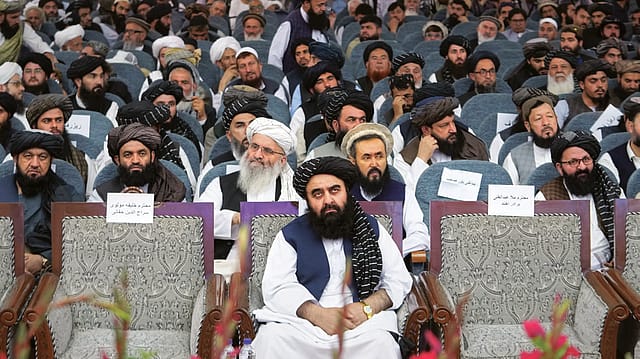
FIVE YEARS AFTER the Taliban returned to Kabul on August 15, 2021, Afghanistan presents a paradox that is increasingly difficult for the international community to ignore. The Islamic Emirate has succeeded where the previous Afghan republic failed: it has established nationwide territorial control and largely ended the large-scale conflict that had consumed the country for two decades. Yet, this achievement has come at an enormous political and human cost. Afghanistan today is more internally secure in the narrow military sense, but less free, less inclusive and economically more fragile. The Taliban have consolidated power at home even as they seek greater acceptance abroad, creating a foreign policy dilemma in which pragmatic engagement has expanded without corresponding political normalisation.
The most striking change since 2021 has been the decline of conventional violence. The fighting that once characterised large parts of Afghanistan has substantially receded, and roadside bombs, factional warfare and clashes between rival armed groups are far less common. For ordinary Afghans, this relative security is not insignificant. Yet, it would be misleading to equate the absence of war with the presence of effective governance. The Taliban’s political order is highly centralised around Supreme Leader Hibatullah Akhundzada and remains overwhelmingly male and dominated by a narrow social and ideological constituency. Institutions associated with the former republic have been dismantled or subordinated, while public punishments, floggings and executions have returned with increasing visibility.
The most consequential dimension of Taliban rule, however, is the systematic exclusion of women and girls. Afghanistan has become an extreme outlier in the international system, with girls effectively denied secondary and higher education because of their gender. Millions of girls have now spent their formative adolescent years outside the formal education system. Restrictions on women’s employment, movement, dress and participation in public life have simultaneously dismantled much of the social and economic space created for women after 2001. This is not simply a human rights concern; it is a structural impediment to Afghanistan’s economic recovery.
A country that excludes half its population from meaningful participation cannot easily build a productive and resilient economy.
The humanitarian picture reinforces this contradiction. Around 45 per cent of Afghans are estimated to require humanitarian assistance in 2026, while food insecurity and child malnutrition remain acute. International assistance has declined substantially from its post-2021 levels at precisely the moment when Afghanistan remains heavily dependent upon external support. The economy has stabilised after the dramatic contraction that followed the Taliban takeover, but stabilisation should not be confused with prosperity. Per capita incomes remain depressed, unemployment and poverty are widespread, and government revenues remain far below the levels of the former republic.
The Taliban’s foreign policy reflects a different kind of pragmatism. The Emirate has sought to escape the isolation that characterised its previous period in power by cultivating relations with virtually every major regional actor. Its approach rests on sovereignty, non-interference and a refusal to accept external political conditionality, particularly on women’s rights and the composition of the government. At the same time, the Taliban have recognised that geography gives Afghanistan few alternatives to regional engagement. China, Iran, the Central Asian states, the Gulf countries, Turkey, India and Russia all have interests in Afghan security, trade, migration or natural resources.
This has produced a peculiar form of international normalisation. Formal recognition remains limited, but de facto engagement has expanded. Russia’s recognition of the Islamic Emirate represents the clearest departure from the international posture adopted after 2021 and is especially significant because it demonstrates that the Taliban can exploit a more multipolar international environment than the one that existed during the 1990s. China has pursued a similarly pragmatic policy, combining economic interests with concerns over militant groups and regional security. European and Western actors, meanwhile, continue technical engagement on issues ranging from migration to humanitarian assistance while withholding full political recognition.
No relationship better illustrates the changing regional equation than the Taliban’s ties with Pakistan and India. Pakistan entered the post-2021 period expecting that a Taliban government in Kabul would strengthen its strategic position. Instead, the relationship has deteriorated dramatically. The central problem is the Tehreek-e-Taliban Pakistan, whose resurgence has become a direct security challenge for Islamabad.
The resulting crisis has moved beyond diplomatic disagreement. Cross-border clashes, Pakistani airstrikes inside Afghanistan, border closures, trade disruptions and the mass deportation of Afghans have transformed what was once described as a close strategic relationship into one characterised by mistrust and intermittent armed confrontation. Pakistan’s experience represents a profound strategic irony: the movement it once regarded as an important instrument of regional influence has developed sufficient autonomy to resist Islamabad’s preferences and, increasingly, to challenge them.
India, by contrast, has moved in the opposite direction. New Delhi initially approached the Taliban cautiously, reflecting its historical concerns about Pakistan’s influence and the Taliban’s ideological orientation. Yet, India’s policy has gradually shifted from limited technical engagement to structured pragmatism. High-level contacts, ministerial visits, the upgrading of India’s diplomatic presence in Kabul and the expansion of discussions on trade, pharmaceuticals, agriculture, connectivity and humanitarian assistance all indicate that New Delhi sees value in engaging the new political reality.
This does not amount to Indian endorsement of Taliban governance. Rather, it reflects a recognition that influence in Afghanistan cannot be secured through political abstention. As Pakistan-Taliban relations deteriorate, India has acquired greater diplomatic space. For New Delhi, engagement offers an opportunity to preserve its developmental and political equities in Afghanistan, prevent Pakistan from monopolising influence and maintain channels on terrorism, connectivity and regional trade. For the Taliban, closer relations with India provide economic opportunities as well as diplomatic leverage vis-à-vis Pakistan.
The broader lesson is that Afghanistan’s post- 2021 order cannot be understood solely through the prism of Taliban ideology. The Emirate remains deeply authoritarian and its treatment of women constitutes the principal obstacle to wider international legitimacy. Yet, the external environment is changing. Regional powers increasingly prefer engagement to isolation because Afghanistan’s instability has consequences for migration, terrorism, trade and connectivity. The Taliban have therefore managed to convert territorial consolidation at home into a degree of diplomatic relevance abroad.
Five years after the Taliban’s return, Afghanistan is therefore neither the isolated Emirate of the 1990s nor the internationally supported republic that preceded it. It is a more secure but more repressive state, economically constrained, yet increasingly connected to its region. The Taliban have won the internal struggle for power, but they have not resolved Afghanistan’s fundamental political and economic problems.
Their greatest achievement has been consolidation; their greatest vulnerability remains legitimacy. For India and the wider region, the challenge will be to engage the Taliban without normalising the exclusionary system they have constructed.