Energy Supply: National Interest First
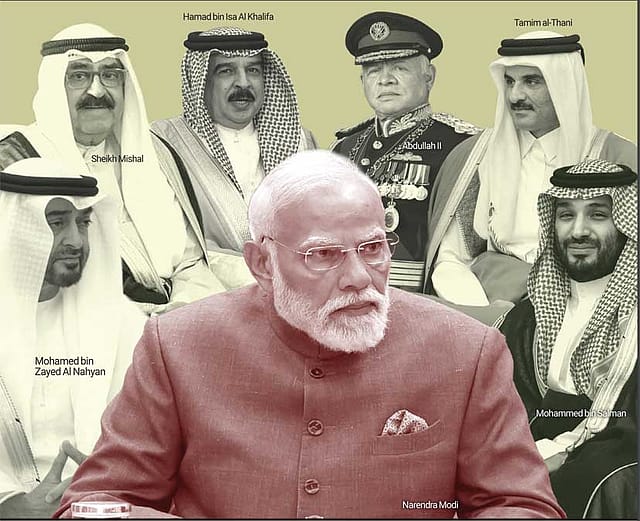
SOON AFTER ISRAEL AND THE US LAUNCHED a massive aerial blitz against Iran on February 28, Prime Minister Narendra Modi spoke to key leaders in the Middle East, not only voicing concern about the evolving situation but also condemning attacks by the regime in Tehran on targets in Saudi Arabia, Jordan, Iraq, Bahrain, Oman, Kuwait, and Qatar, as well as Gulf cities like Dubai. Between March 1 and 3, Modi spoke to King Abdullah II of Jordan, Crown Prince Mohammed bin Salman of Saudi Arabia, King of Bahrain Hamad bin Isa Al Khalifa, UAE President Mohamed bin Zayed Al Nahyan, Sheikh Mishal of Kuwait, and Emir Tamim al-Thani of Qatar. The prime minister denounced the violation of sovereignty and territorial integrity and said India stood in solidarity with the nations at the receiving end of Iran’s retaliation.
It did seem India had chosen a side in the latest war to roil the Middle East and it was not Iran. There has been no official contact with Iran after the initial phone call by External Affairs Minister S Jaishankar to Iranian Foreign Minister Abbas Araghchi to share India’s “deep concern” over the events. On the same day, Jaishankar
told Israel’s Foreign Minister Gideon Sa’ar about the desirability of “dialogue and diplomacy” to de-escalate tensions. The formal statement was guarded, iterating the need for restraint even as it said sovereignty and territorial integrity of “all states” be respected. A day later, Iran confirmed the death of Supreme Leader Ayatollah Ali Khamenei. The decapitation of a regime India recognises and has dealt with was no minor event but events were unfolding rapidly in a region that has seen conflict and war for decades.
War on Iran: The War That No One Won
10 Apr 2026 - Vol 04 | Issue 66
And the price of surviving it
The trajectory of the war had soon become worrisome. Although Khamenei and several top leaders were eliminated, Iran took the war to its neighbours, targeting energy infrastructure besides US bases. The US embassy in Riyadh was attacked and so was a British base in Cyprus. It is evident that US defence systems cannot adequately protect all such targets, including those operated by allies. Drone attacks on the Saudi Ras Tanura refinery that processes 550,000 barrels of crude a day led to a shutdown and Qatar stopped production of LNG as well. Araghchi said military units were acting more or less autonomously in keeping with instructions provided in advance. This might indicate Iran did recalibrate its strategy after the June 2025 US strikes on three of its nuclear facilities. It also indicates the Iranian leadership might have factored in the likelihood of Khamenei being killed in the early stages of war. And Iran may no longer be a ‘one-man show’ with the clergy leadership coming up the ranks and a military-security setup that remains loyal to the Ayatollahs. US President Donald Trump’s statement that the US is prepared for weeks of war and even boots on the ground could spell prolonged fighting and that is not reassuring news for India.
THE ASSESSMENT GUIDING India’s choices might factor in the diminishing of Iran as a military power. But the lack of clarity in US statements over a plan to end the war and Iran’s apparent capacity to hit back saw India issue a much stronger statement on March 3 seeking an end to the hostilities. “In recent days, we have not only witnessed an intensification of conflict but also its spread to other nations. The destruction and deaths have mounted, even as normal life and economic activities come to a halt. As a proximate neighbour with critical stakes in the security and stability of the region, these developments evoke great anxiety. There are almost one crore Indian citizens who live and work in the Gulf region…We cannot be impervious to any development that negatively affects them. Our trade and energy supply chains also traverse this geography. Any major disruption has serious consequences for the Indian economy. As a country whose nationals are prominent in the global workforce, India is also firmly opposed to attacks on merchant shipping… In this background, India strongly reiterates its call for dialogue and diplomacy. We raise our voice clearly in favour of an early end to the conflict,” the Ministry of External Affairs said.

The tone of the Indian statement was much less ambiguous or accommodative of the Israel-US action and this was because the scenarios being considered were worrying. The possibility of US troops in Iran could mean a presence in areas such as the northwest where Azeris, a large minority, are in strength or where Kurds and the Baloch are well represented. In such a situation, the possibility of prolonged instability cannot be ruled out even though US Secretary of War Pete Hegseth asserted on March 2 that the military operation was not a “nation building quagmire” and would concentrate on ensuring Iran does not have an effective naval and missile force and no nuclear weapon. In any event, Iran may well be faced with challenges to its internal order and have to try and negotiate a peace that will permit it to be—under international scrutiny—a member of the international community. It might therefore make sense for India to cement ties with the Gulf nations and a major regional power like Saudi Arabia. India’s trade and investment with these nations have expanded and is a key part of its growth story. Thousands of Indian firms do business in the Gulf where a majority of the 9.5 million Indian nationals in the Middle East are located. The suggestion that Modi’s phone call to Mohammed bin Salman was in part a measure to reaffirm ties after the kingdom was seen to have tilted towards Pakistan may only be partly true. The Saudi-Pakistan defence agreement might be a much more transactional arrangement.
US Secretary of State Marco Rubio’s comment on March 2 that Washington was aware Israel was going to attack Iran and that American forces struck pre-emptively as it was certain that Tehran would retaliate against American interests comes across as convoluted reasoning. There is a case that Iran might have started rebuilding its nuclear capacity after last year’s strikes but the threat has existed for a long time. Further, while Iran was perhaps keen on avoiding a fresh American assault, agreeing to rollback its ballistic missile programme was not easy to accept. It is clear the US began a “war of choice”, one that certainly suits Israel that finds Iran’s missile threat a pressing reality. Under Prime Minister Benjamin Netanyahu, Israel has been prepared to use military options frequently against Hamas and Hezbollah and their patron Iran. The grim results of regime change in Syria and Libya are not too far in the past and yet there is no clarity over who can be expected to be in-charge if Iran is to deliver on US and Israeli demands and ensure that a country one-sixth the size of the US does not become a mosaic of militias. In the immediate context though, Iran is not collapsing just yet. The claim that some of those who could have conducted negotiations have also died in the attacks does not point to great strategy either.
Shipping through the Strait of Hormuz, accounting for half of India’s oil supplies, has ground to a halt. The Qatari decision to stop LNG production is a blow as the Gulf nation supplies 40 per cent of India’s needs. Indian sources said there were 25 days of supplies of crude and refined oil and there was no move to increase pump prices. A significant presence of the Indian Navy in the Arabian Sea-Indian Ocean region can help transport of goods but at present no insurer will underwrite shipping in the Hormuz. Dislocation of commerce in the Gulf can cause intense stress in the Indian economy that has withstood storms caused by other conflicts and Trump imposing tariffs adding up to 50 per cent on Indian exports. With the tariffs currently down to 10 per cent following a ruling of the US Supreme Court, India wouldn’t prefer a fresh upheaval.
Iran’s military and political support to violent proxies like Hamas, the Houthis, Hezbollah, and Shia factions in Iraq and its rivalry with Saudi Arabia are no doubt a threat to peace and stability in the Middle East. In its own view, possibly tailored to justify its actions, Iran’s rulers see proxy militias as a means to keep enemies at bay. But if the war drags on, the possibility of the Arab Street becoming more militant in favour of Iran cannot be ruled out. Iran’s drone and missile attacks on its neighbours have not helped its popularity ratings but it can come across as a victim of the ‘infidel’ forces.
India has a Shia population that is significant presence in parts of Jammu & Kashmir, in Lucknow and Hyderabad, and in Kargil in Ladakh, besides some other cities. The unease of a community less prone to radicalisation—Shias have borne the brunt of extremism in Pakistan—is a matter of concern for India even as it makes pragmatic choices in the war. The opposition accused the government of abandoning values and interests, with Congress, communist and Samajwadi Party leaders questioning India’s silence on the death of Khamenei and its refusal to criticise the US. Yet India has kept away from Trump’s Board of Peace for Gaza and has not endorsed attacks on Iran. The criticism that Modi’s visit to Israel was “ill timed” and created the perception of political endorsement is rejected by officials who point out that India and Israel share a well-defined bilateral agenda bound by strong complementarities on security, tech and trade. India has expressed solidarity with Israel’s fight against terrorism and abstained from a vote in the United Nations calling for a ceasefire in Gaza last year. But it voted in favour of a resolution for a two-state solution for Palestine in September 2025. There are several considerations in the relationship as Israel is a leading—and in India’s case willing—supplier of advanced military technology. A review of the May 7-10 Operation Sindoor identified areas where more work is needed and advanced avionics, radar jamming and evasion, and cyber defence are domains where Israeli assistance is invaluable.
The war in Iran has short and long-term implications. Iran has noted Pakistan allowing the US to use its airspace and while this will be a sour point, India’s actions will not go unnoticed either. A longer US involvement will no doubt please China which would hope this took attention away from the Indo-Pacific. Russia will welcome a distraction from the Ukraine war. In a complex and fast-changing setting, India is not a fence-sitter. It has too many irons in the fire.